Definition
Endurance is the ability to perform movement activity for an appropriate length of time or to repeat it while fatigue increases. In sport, it is not only about the duration of the effort. It also matters how long the athlete can maintain the required technique, coordination, strength, attention, and accuracy of decision-making.
According to how energy is obtained, we simply distinguish aerobic endurance, in which the production of energy with the help of oxygen plays the decisive role, and anaerobic endurance, which is important in short and very intense efforts. For a skier, strength endurance is also important – the ability of the muscles to repeatedly produce or withstand force without an inappropriate drop in performance.
Importance in alpine skiing
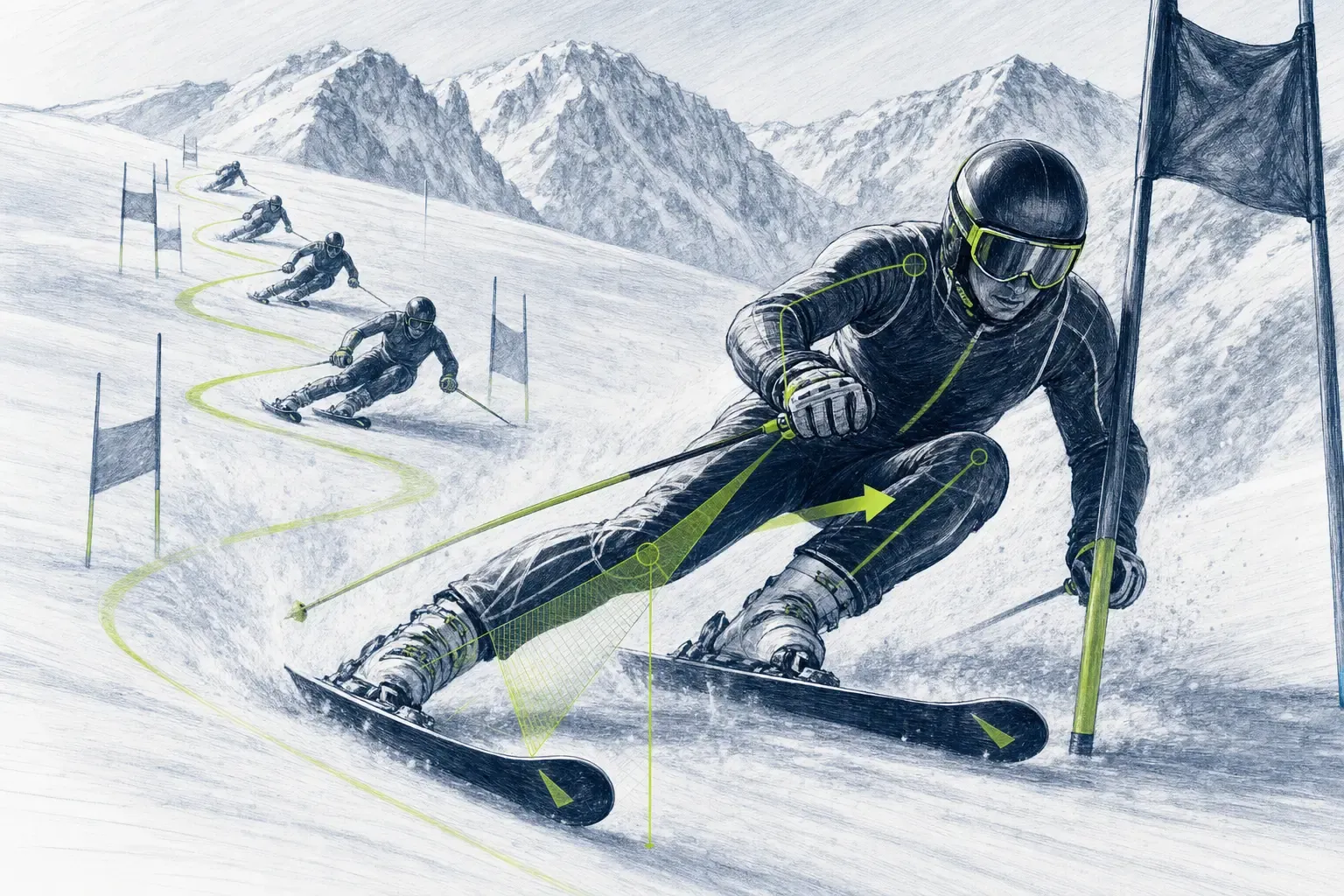
Alpine skiing is among the technically and physically demanding sports. One race run is relatively short, but the muscles of the legs and core repeatedly face high load during it. The result is therefore not created by aerobic fitness alone, but by the interplay of technique, strength, explosiveness, coordination, balance, and several energy systems.
Good general endurance helps a skier:
- recover between runs and training blocks,
- handle more quality repetitions,
- maintain attention and technique during a longer day on snow,
- better tolerate the total training load during the preparation period and the season.
However, it is not reliable to assess a skier only by running, a cycling test, or a value of maximal oxygen uptake. Aerobic performance supports training capacity and recovery, but by itself it does not explain the result in alpine skiing.
Endurance in children
The World Health Organization recommends that children and adolescents aged 5 to 17 years should, on average, get at least 60 minutes of moderate- to vigorous-intensity physical activity per day across the week, mainly of an aerobic nature. This is a recommendation for a healthy movement routine, not a prescription for 60 minutes of endurance training or a standard of sports performance.
In younger children, endurance develops mainly naturally: through movement games, obstacle courses, hiking, cycling, skating, cross-country skiing, swimming, or ball games. These activities also support movement variety and make it possible to alternate intensity without unnecessarily monotonous load.
With increasing age, training experience, and the ability to sense pace, it is also possible to include continuous endurance sections or structured interval training. However, their duration, intensity, and frequency must be based on biological development, health status, previous preparation, and the child’s overall program. Training designed for adults or Olympic competitors cannot simply be shortened and transferred to children. Protecting health and the long-term development of a young athlete take priority over short-term results.
Race context
A racer needs to handle warming up, course inspection, warm-up exercises, the race run, and possibly another round without a significant drop in readiness. In training, this is added to repeated trips to the start, waiting, cold, altitude, travel, and several days of load in a row. Endurance therefore creates the foundation on which quality technical and strength training can be repeated.
In the preparation of top alpine skiers, running, cycling, swimming, paddling, rollerblading, team games, and movement in uneven terrain are used. The choice depends on the season, discipline, the athlete’s needs, and health status. These findings describe the practice of adult elite racers, not the recommended volume for children.
Typical mistakes and misunderstandings
- Endurance is confused with long, slow running. It can be developed through various movements, and for children a varied form is often more suitable.
- Every ski session is considered sufficient endurance training. Runs interrupted by lifts, waiting, and instructions may create a different stimulus than continuous physical activity.
- Fatigue is considered the goal of training. The goal is not to exhaust the child completely, but to create an appropriate stimulus after which they can recover.
- Fitness is given priority over technique. If fatigue significantly worsens posture, balance, or reactions, further technical repetitions may lose quality.
- The result of one test is used to identify talent. A fitness test captures only part of the prerequisites and must be interpreted together with the technical, motor, and developmental context.
The coach’s view
When developing endurance, the coach does not track only distance or time. They also watch movement quality, pace, the child’s reactions, a drop in technique, recovery between repetitions, and readiness for the next training session. In a group, the coach must count on the fact that children of the same age can be at very different levels of biological and motor development.
Good endurance preparation for a young skier is regular, varied, and progressive. It should support skiing, not replace it or create a competition over who can endure more fatigue. The specific volume and intensity are determined by a qualified coach according to the individual, the season period, and the other load.
Sources and further reading
- FIS consensus statement on training and testing in competitive alpine and freestyle skiers and snowboarders
- WHO Guidelines on physical activity and sedentary behaviour: at a glance
- British Journal of Sports Medicine – Safeguarding the child athlete in sport
- Gilgien et al.: The Training of Olympic Alpine Ski Racers
- Turnbull, Kilding a Keogh: Physiology of alpine skiing
- Ferland a Comtois: Athletic Profile of Alpine Ski Racers – A Systematic Review
- Endurance Training in Olympic Winter Sports: A Narrative Review of the Current Literature and Future Research Priorities