What is free skiing
Free skiing, in Slovak most often free skiing or free riding, is skiing without a set gate course. The skier moves across chosen terrain and can ski naturally or work on a specific technical task. In alpine race training, free skiing is used for warm-up runs, practicing basic movement skills, technical drills, observing the skier, and transferring learned movements into gate training.
The term does not mean skiing without rules or automatically skiing off-piste. It should also not be confused with the term Freeski, which is used in the international sports world for a different group of disciplines, such as slopestyle, halfpipe, and big air. In this entry, it refers to free skiing in the context of alpine ski training.
Importance for technique and racing
Methodical materials from U.S. Ski & Snowboard rank free skiing, together with the development of basic skills, among the pillars of long-term racer development. The SkillsQuest program also points out that a young skier’s abilities should not be judged only by race results. It is also important how they control their skis in different tasks, terrain, and snow conditions.
During free skiing, a coach can especially watch:
- balance and basic stance,
- guiding and loading the outside ski,
- independent leg action,
- torso stability,
- edge engagement and pressure control,
- the shape, rhythm, and radius of turns,
- the ability to change speed and direction,
- adapting to slope, surface, and space.
Free skiing makes it possible to isolate a skill without time pressure and without having to react to fixed gates. Later, the improved movement should be transferred into a training course and eventually into race skiing. But simply logging a lot of free miles does not guarantee technical improvement. What matters is the quality of execution, an appropriate task, and feedback.
Free skiing for children
For younger children, free skiing should support a broad movement foundation and confidence on skis. Suitable activities include short, easy-to-understand tasks, changes of rhythm and turn radius, skiing in different tracks, safe terrain waves, or balance exercises. The difficulty must match the age, technical level, fatigue, visibility, slope conditions, and group organization.
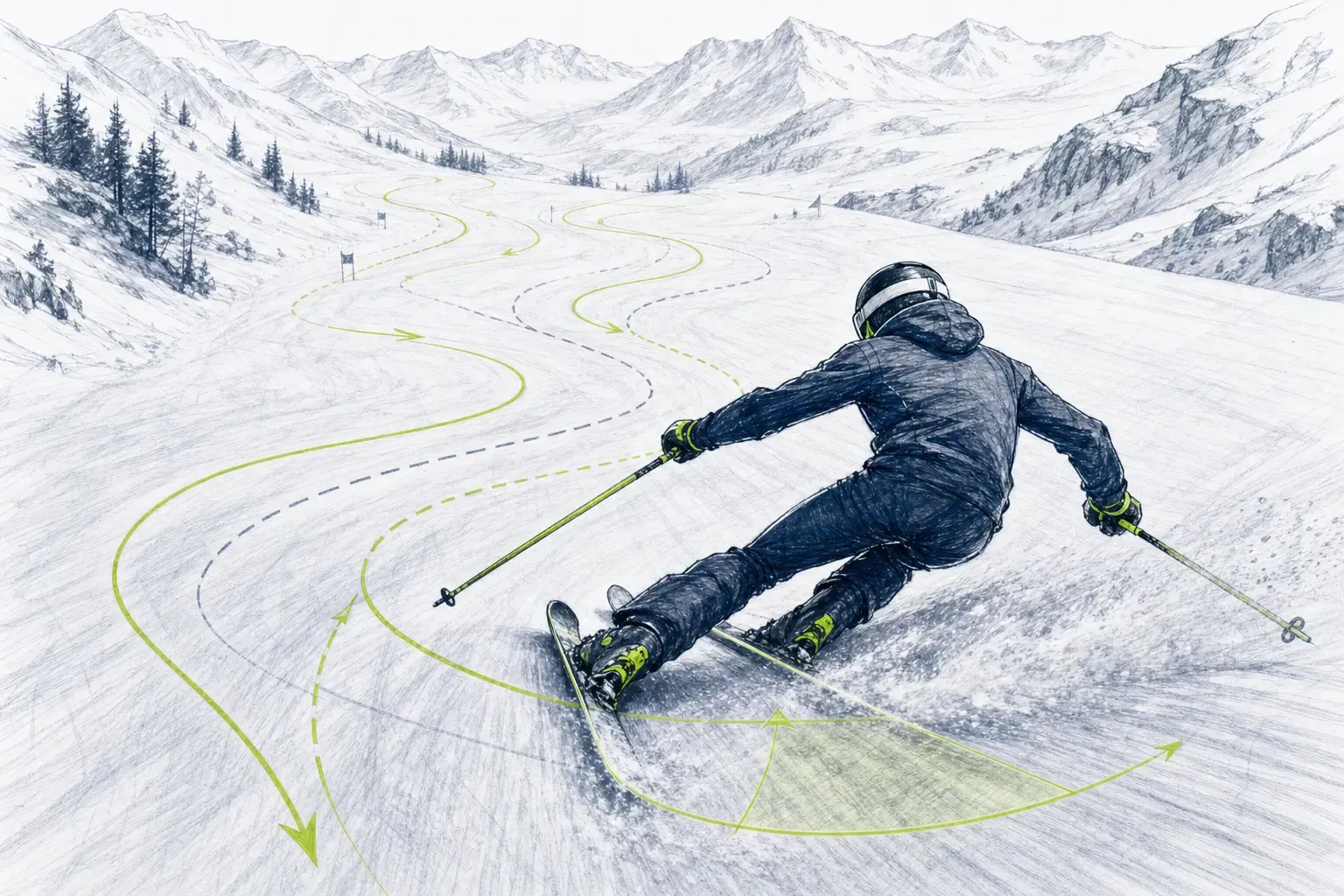
Training practice does not follow a universal ratio between free skiing and gate skiing. The required amount depends on the athlete's developmental level, the goal of the training period, and the needs of the individual child. A beginner primarily needs safe control of direction and speed. A more experienced racer can use free skiing to work on subtle technical details or movements needed for slalom, giant slalom, and speed disciplines.
Typical misunderstandings
A common mistake is to see free skiing only as aimless warm-up laps or a break from “real” training. The opposite extreme is to turn every run into a series of complicated exercises and overload the child with instructions. It is also inappropriate to ski at high speed without a clear task, to have the whole group ski closely behind one another, or to choose terrain that exceeds the abilities of the weakest member.
Free skiing must not replace the safety organization of training. The coach sets the space, stopping place, order, and spacing, and continuously takes slope traffic into account. At competitions, free skiing must be distinguished from the official course inspection and from official training; their regime is determined by the rules of the specific event and the current FIS regulations.
Coach's perspective
Well-prepared free skiing has a specific but simple goal. The coach can vary terrain, speed, turn radius, or movement task and observe whether the skier can use the skill even without constant guidance. Important are not only movement accuracy, but also independence, spatial awareness, and the ability to adapt skiing to current conditions.
For a child racer, free skiing is therefore not the opposite of race training. It is one of the means used to build a skier who can handle a gate course technically, safely, and with a greater movement reserve.
Sources and further reading
- FIS – Alpine Documents: current rules and official documents of alpine skiing
- U.S. Ski & Snowboard – SkillsQuest
- U.S. Ski & Snowboard – Alpine Training System
- U.S. Ski & Snowboard – Alpine Program Information, 2018 Alpine Competition Guide
- U.S. Ski & Snowboard – Alpine Ski Fundamentals, Level 100 Instructor Manual
- U.S. Ski & Snowboard – Men's Tech Reboots at Mt. Hood
- U.S. Ski & Snowboard – 2024 Alpine Guide
- U.S. Ski & Snowboard – Freeski and Snowboard Level 300 Coach Course