Sporting versatility is the broad and appropriately balanced development of movement abilities, basic motor skills, and experience from different sports situations. In children’s skiing, it creates the foundation on which specific technique, conditioning, and race performance can later be built.
It is not a precisely standardized indicator or an obligation to take part in a certain number of sports. It is a principle of long-term development: a child should not be restricted too early to a narrow set of movements, the same terrain, or year-round training in a single sport. Expert consensus defines sports specialization as a deliberate focus on one sport for most of the year, which limits opportunities to take part in other sports and activities.
What makes up a skier’s versatility
Versatility includes more than general fitness. It mainly includes:
- balance, coordination, and body awareness in space,
- adequate strength, speed, endurance, and mobility,
- the ability to accelerate, slow down, change direction, push off, and land safely,
- rhythm perception, response to changing conditions, and adapting movement,
- learning new skills and using them in unfamiliar situations.
The U.S. Ski & Snowboard methodology monitors several physical areas in the development of young skiers, including coordination, speed, strength, endurance, and flexibility. It emphasizes that general readiness and basic skills should come before advanced specialized training.
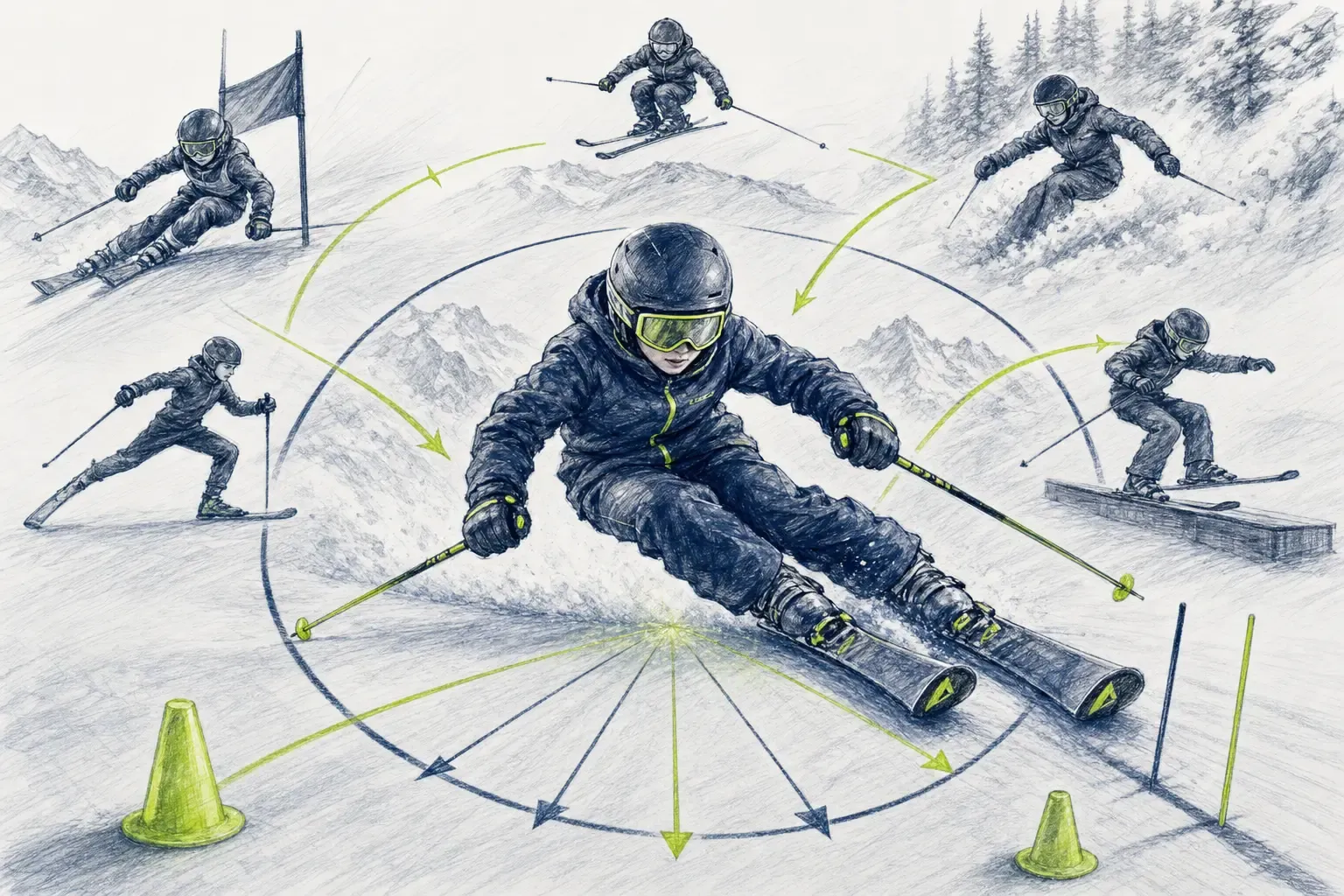
Versatility also has a skiing component. A child needs to ski in varied terrain, slopes, snow conditions, and turn radii, change speed, and handle different movement tasks. They should not know only one learned line or one type of race course. The SkillsQuest program therefore works with basic areas of skiing skills such as balance, edging, turning the skis, and pressure control. The tasks are graded according to the athlete’s developmental stage and experience.
Versatility off the snow
In training practice, the movement foundation can be broadened through running, jumping, throwing and catching, climbing, gymnastic exercises, ball games, swimming, cycling, or other age-appropriate activities. This list is not a prescription. The choice depends on the child’s possibilities, the season, the training goal, and the quality of coaching.
More important than the number of sports tried is the variety of movement tasks addressed. A child may attend several clubs and still repeat similar one-sided loads. Conversely, well-led training can develop balance, agility, reaction, cooperation, strength, and endurance even within a single session.
When planning, growth, biological maturation, training history, fatigue, and individual level must be taken into account. Children of the same age do not have to be equally physically or motorically prepared. The International Olympic Committee therefore describes the development of a young athlete as a long-term and individual process in which health, movement abilities, mental well-being, and sports skills should be combined.
Importance for racing skiing
Sporting versatility is not the opposite of race preparation. It helps create the conditions for a skier to handle new courses, changing snow, higher speed, and technical demands without relying on a single movement pattern. In children’s categories, short-term results should therefore not be the only measure of development. The official SkillsQuest program explicitly emphasizes developing a good athlete and a good skier before one-sided pursuit of race results.
Research does not provide a universal rule for how many other sports a child should do, or exactly what share of training should be devoted to all-round development. A comparison of recommendations from sports organizations showed agreement on the need for quality guidance and skill development, but different recommendations regarding training volume. The coach must therefore adapt the program to the specific group and coordinate it with the child’s overall load.
All-round development and early specialization
Expert opinions do not provide evidence that early narrow specialization is a necessary condition for top-level success in most sports. At the same time, they point to possible physical and mental risks of intense one-sided load, such as overuse, burnout, or dropping out of sport. According to these opinions, a varied sports experience in childhood does not prevent later achievement of a high performance level.
This does not mean that every specialized child will get injured, or that participation in multiple sports automatically protects against problems. More recent expert reviews emphasize that overall training load, recovery, mental well-being, growth periods, and the athlete’s social environment must also be monitored.
Typical misconceptions
- All-round development is not random fun without a purpose. Even play or a supplementary sport should have proper organization and a safe environment.
- It is not just fitness training. It includes learning movements, coordination, decision-making, and adapting to situations.
- It does not mean constant competition. Some activities may take the form of free play and movement exploration.
- It is not a replacement for ski technique. General abilities create the foundation, but technical skiing must be learned on skis.
- It does not look the same at every age. As the level rises, the share of sport-specific preparation increases, but the general movement base does not lose its importance.
The coach’s view
The coach watches not only the result in the gates, but also how the child runs, jumps, lands, keeps balance, responds to change, and learns a new movement. The all-round program is used as a space to uncover weaker points, not as a collection of extra activities.
Good training practice alternates focus, environment, and difficulty, while keeping a clear progression. Tasks should be technically manageable, safe, and sufficiently stimulating. With children, it is important to leave room for success, play, and independent problem-solving. The exact content and load must be set by a qualified coach according to the development and current condition of the young skier.
Sources and further reading
- International Olympic Committee consensus statement on youth athletic development
- AOSSM Early Sport Specialization Consensus Statement
- Consensus Definition of Sport Specialization in Youth Athletes Using a Delphi Approach
- Youth Sport Specialization: Current Concepts and Clinical Guides
- Current Sport Organization Guidelines From the AMSSM 2019 Youth Early Sport Specialization Research Summit
- Sports specialization in young athletes: evidence-based recommendations
- U.S. Ski & Snowboard: SkillsQuest
- U.S. Ski & Snowboard: SkillsQuest-Fitness Manual 2024
- U.S. Ski & Snowboard: Descriptions of SkillsQuest Skiing Drills