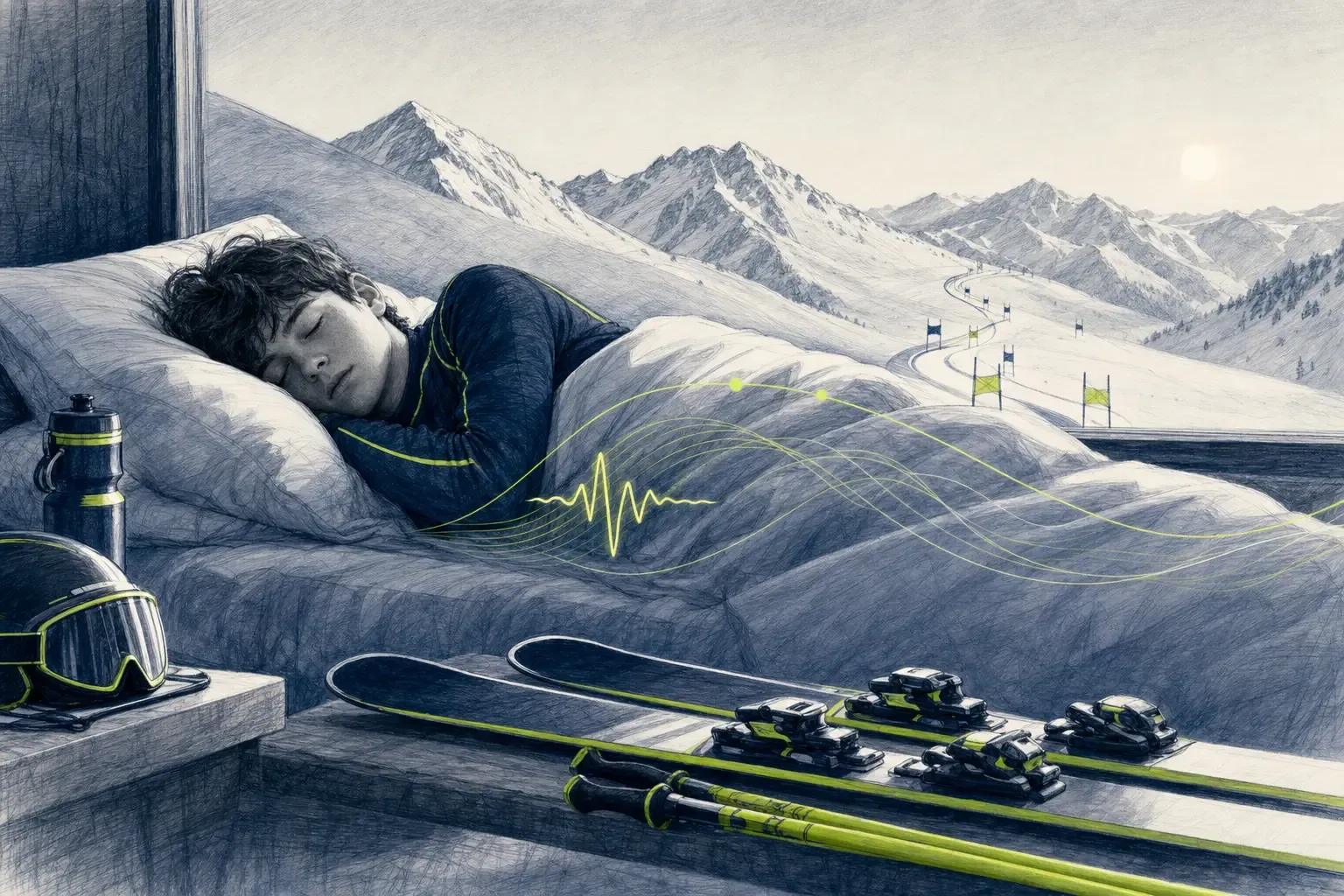
Athlete sleep means not only the number of hours spent asleep, but also regularity, proper timing, continuity of sleep, and the feeling of adequate rest after waking. It is part of the body’s recovery and a condition for a child’s healthy development. It does not replace training, and training cannot replace sleep either.
How much sleep does a young skier need
Consensus recommendations from the American Academy of Sleep Medicine state a total sleep duration of 24 hours:
- children aged 3 to 5 years: 10 to 13 hours including daytime sleep,
- children aged 6 to 12 years: 9 to 12 hours,
- adolescents aged 13 to 18 years: 8 to 10 hours.
These are population ranges for healthy children, not a sports rule or an exact prescription for every individual. Needs may vary depending on age, stage of development, health status, and current workload. Time spent in bed is also not the same as actual sleep time.
Sport is not a reason to automatically choose the lower end of the recommended range. If a child has to get up at five in the morning to leave for the slopes, the required sleep should already be taken into account when setting bedtime. Regularly cutting short the night cannot be considered a fair trade-off for more training volume.
Practical importance in skiing
In children, enough sleep is linked with better attention, behavior, learning, memory, emotional regulation, and overall physical and mental health. For skiing, that matters in practical terms: a young skier learns new movement solutions, processes instructions, judges speed and space, and must respond appropriately to changing situations. From this, it can be assumed that fatigue from sleep loss may reduce training quality, although not every technical mistake or weaker performance is caused by sleep.
In competitive skiing, risky parts of the routine often include early departures, evening equipment preparation, school duties, pre-start stress, and travel between resorts. One bad night by itself does not determine the result. More attention should be paid to a repeated pattern: late falling asleep, short weekdays, and then significant catch-up sleep over the weekend.
What a parent and coach can do
The right bedtime is set backward from the necessary morning wake-up. The plan should include evening hygiene, calming down, and the time needed to fall asleep. Research in adolescents has shown that an earlier bedtime can genuinely extend sleep; it is therefore not true that a teenager with an earlier bedtime is always just awake for longer.
Useful training practice may include:
- similar sleep and wake times for most of the week,
- a calm and repeatable evening routine,
- preparing skis, clothes, and luggage before rather than right before bedtime,
- adjusting the morning schedule to the child's age and the length of the trip,
- monitoring how the child functions during the day, not just the bedtime itself,
- appropriately reducing training intensity if the child is very sleepy or unfocused after a bad night.
These are organizational guidelines, not a universal individual training rule. The coach should not punish a child for fatigue with extra load. At the same time, they should distinguish between a one-time poor night's sleep, an unsuitable routine, and a possible health problem.
Screens, naps, and sleep tracking
Evening use of digital devices can delay falling asleep or shorten the time available for sleep. Light is an important timing cue for the circadian rhythm, but the problem can also be the simple extension of chatting, gaming, or watching content. The practical goal is not an argument about the phone, but ending the activities that keep the child awake early enough.
A daytime nap can help some athletes after an exceptionally early night or trip, but it should not be mandatory and should not regularly interfere with falling asleep in the evening. It cannot serve as a long-term replacement for insufficient nighttime sleep.
When assessing the routine, a simple sleep diary is useful: bedtime, approximate time of falling asleep, nighttime waking, wake-up time, and daytime sleepiness. A person's own estimate of sleep can be inaccurate and, in adolescents, may overestimate its length. Data from a watch or app are only approximate; they do not replace a medical examination.
Typical mistakes and warning signs
A common mistake is to judge sleep only by the number of hours in bed. Long time to fall asleep, repeated waking, difficulty waking in the morning, and how the child functions during the day also matter. It is equally inappropriate to automatically treat marked sleepiness, irritability, or poor concentration as laziness.
A child should see a pediatrician or sleep specialist especially if there are persistent difficulties falling asleep, significant daytime sleepiness, loud regular snoring, gasping for breath, or observed pauses in breathing. Such signs should not be addressed only by changing the training plan.
The coach's view is simple: quality training does not begin with the first run, but with a routine that allows the child to arrive on the slope alert, ready to learn, and able to respond appropriately.
Sources and further reading
- Walsh NP et al. Sleep and the athlete: narrative review and 2021 expert consensus recommendations. British Journal of Sports Medicine.
- American Academy of Sleep Medicine – Pediatric sleep recommendations
- American Academy of Sleep Medicine – Recommended Amount of Sleep for Healthy Children: Methodology and Discussion
- American Academy of Pediatrics – Recommended Amount of Sleep for Pediatric Populations
- American Academy of Pediatrics – The Role of the Pediatrician in the Promotion of Healthy, Active Living
- American Academy of Pediatrics – Earlier Bedtime and Its Effect on Adolescent Sleep Duration
- American Academy of Pediatrics – Insufficient Sleep in Adolescents and Young Adults: An Update on Causes and Consequences
- American Academy of Pediatrics – Digital Ecosystems, Children, and Adolescents: Technical Report