In September there still is no snow. But children run around Kamzík, skate, climb, jump over obstacles, or work out in the gym. So a parent quite logically asks: what does any of this have to do with skiing?
The answer is simpler than it looks. Skiing is not an isolated movement that can be learned only by repeating turns. On the slope, a child needs balance, coordination, agility, spatial awareness, the ability to react quickly, appropriate strength, and fitness.
And a big part of that foundation can also be built when the skis are still in the cellar.
Loko in one sentence: On snow, we teach skiing. During the year, we build a child who can move, learn, and react better on snow.
Year-round preparation does not mean twelve months of the same training
This distinction matters.
When we say that a skier trains all year, we do not mean twelve months of slalom, the same exercises, and pressure to perform. For children, year-round preparation makes sense precisely because it is varied.
In its long-term athlete development model for young skiers, Alpine Canada recommends a wide range of complementary sports and movement environments alongside skiing. In the Skier Essentials stage, it lists for example gymnastics, skating, mountain biking, and soccer, and emphasizes the development of agility, balance, and coordination.
The American Academy of Pediatrics also warns about the opposite extreme: one-sided year-round specialization in a single sport without enough variety and recovery. That can increase the risk of overuse and sports burnout.
Year-round movement, yes. Year-round monotony, no.
What a skier actually needs
At first glance, skiing seems mainly about the legs. In reality, the whole body works, and the brain is constantly processing the changing environment.
During a run, a child must:
- maintain balance on a moving surface,
- change direction while controlling speed,
- react to bumps and snow conditions,
- coordinate the legs, torso, arms and eyes,
- stay aware of other skiers,
- repeat short, dynamic efforts,
- quickly regain stability after a mistake.
These abilities do not come from one “ski exercise.” They are built from many movement experiences.
That is why Alpine Canada uses the term fundamental movement skills for young skiers — basic movement skills that later support more specific sport skills.
What movement off the snow gives us
Not every sport transfers to skiing in the same way, and there is no simple rule like “ten hours of skating = a better turn.” The point is broader: the child collects different movement solutions.
Gymnastics, climbing and obstacle courses
They develop body control in space, balance, stability, coordination, and the courage to handle unfamiliar movement.
The child learns what happens when they shift weight, lose support, change body position, or need to react quickly. That is valuable movement experience for skiing too.
Skates and inline skates
They add movement on a sliding or rolling surface, rhythm, direction changes, and balance while moving. Alpine Canada lists skating directly among suitable complementary activities for young skiers.
That does not mean skating will “teach carving.” It means the child gains another type of balance and coordination to work with later on snow.
Running, games and relays
Running is not just fitness. In games, direction, pace, reaction to a teammate, and decision-making are constantly changing.
Tag can be a very high-quality agility workout for a young child without them even knowing they are training.
Bike
A bike brings longer movement outdoors, endurance, balance, and the ability to read terrain. When riding in nature, the child also deals with the surface, turns, changes of pace, and decisions in motion.
Simple strength
Children need to be appropriately strong, but they do not need a scaled-down version of adult strength training.
For younger age groups, Alpine Canada emphasizes correct movement patterns, games, bodyweight exercises, and age-appropriate drills. More important than “big weight” is movement quality, stability, and the ability to control one’s own body.
What cannot be learned off the snow
Here is the second half of the truth: Dry training does not replace skiing.
A child may be an excellent runner, gymnast or skater and still needs to learn how to work with skis on snow. The feeling of gliding, edge reaction, ski pressure, turn shape, different kinds of snow and speed control are specific experiences.
That is why Alpine Canada, alongside all-round movement, places just as much emphasis on time and kilometres on snow. In their model, fundamental movement skills are also developed off snow, but fundamental skiing skills themselves require skiing.
Dry training creates a better foundation. Snow turns that into a skier. We need both.
Why is variety so important for children?
An adult athlete may have a very narrowly focused training plan. But a five-, eight- or ten-year-old child is still in a stage where they are learning a large number of basic movement patterns.
That is why it makes sense for them to:
- run and jump,
- throw and catch,
- climb,
- balance,
- skate,
- bike,
- swim,
- play with a ball,
- move on snow and off snow.
This is not about collecting sports for a CV. It is about a movement vocabulary.
The more quality movement experiences a child has, the more possibilities they know when a new task appears.
Play is not a break from training
In children’s training, adults sometimes underestimate things that do not look “serious”.
But a chase, relay, obstacle course or simple competition can include exactly what we want to develop: acceleration, braking, reaction, balance, change of direction, orientation and cooperation.
Alpine Canada repeatedly emphasizes play, exploration, and developmentally appropriate activities in the youngest stages. The American Academy of Pediatrics similarly recommends keeping sport for younger children mainly as a positive, varied experience.
For parents, it is therefore helpful not to judge training by how many minutes the children “did the drill.” What matters is, how much quality movement they actually did.
All year does not mean without rest
If a child trains throughout the year, recovery is part of the system, not its weakness.
For youth sports, the AAP recommends regular rest and warns against constant pressure in one sport. Alpine Canada likewise reminds us of the balance between sport, school, family, social life, and recovery.
In practice, “year-round preparation” therefore also means changing the load:
- after winter more general movement,
- during summer different sports and environments,
- in autumn a more gradual return to systematic preparation,
- in winter more time on snow,
- in between easier days and recovery periods.
The exact rhythm depends on age, group, school, health, and the specific season.
What it looks like in Loko
Our philosophy is simple: skiing is the main sport, all-around movement is the foundation.
That is why, during the year, depending on the period, you will see for example:
- gym and coordination exercises,
- obstacle courses and games,
- inline skates,
- running and movement in the terrain,
- bike,
- gymnastics and climbing,
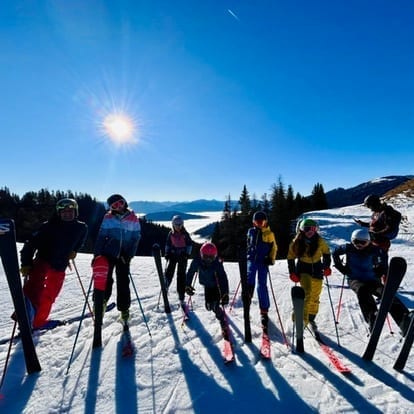
- and then snow, free skiing, technique and gates.
Every activity looks different, but all of them lead to one goal: for the child to be more confident in movement, more adaptable, and able to learn new things.
You can find the current training schedule on the Training page and the club’s broader philosophy on the About the club.
page
What parents can do outside club training
There is no need to create a second training plan at home.
- The best support is often just an ordinary active life:
- go cycling together,
- play ball,
- run into the woods,
- go skating or swimming,
- let the child play freely on the playground,
and give them a day when they do nothing organized. If club training already covers systematic preparation, parents do not need to add extra sets of exercises. They can create space for the child to.
move gladly and in different situations
And when the first snow comes?
That is when the meaning of the previous months becomes clear.
Not in the sense that after summer the child automatically skis better technically without a single run. Rather, they return to the snow with a body that has been moving all year: it can react, balance, coordinate, and handle the load.
Then the coach can spend more time on skiing itself and less time on simply helping the child gain basic confidence in movement.
What to remember","A good children’s ski program should not be a year-round factory for a little racer. It should be year-round development of a young athlete.
Snow is indispensable for skiing technique. Movement off the snow is indispensable for the broader base on which technique stands. And in between, there must be room for play, other sports, friends, and rest.
That is why the skiers at Loko meet even when there is not a single flake outside.
Sources and methodology
- Alpine Canada — Skier Essentials for parents
- Alpine Canada — Skier Essentials: Physical Fitness
- Alpine Canada — Gliding Start
- American Academy of Pediatrics / HealthyChildren — Burnout in Young Athletes
Loko activity examples are based on the club’s current training system. We use external sources to explain the general principles of long-term child development, varied movement, and recovery.