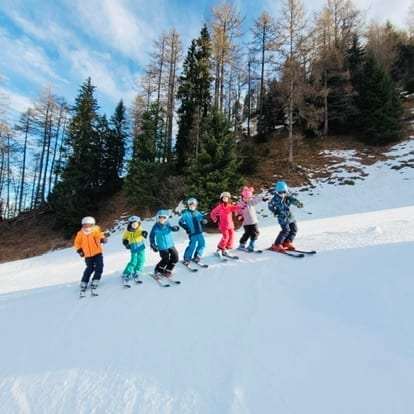
A first day on skis can very easily turn into a project for an adult. The gear is rented, the lift ticket bought, the slope chosen, and in your head the plan is already running: today they will learn to brake, maybe even turn.
But for a child, this is a completely new world. Stiff boots, long skis on their feet, a helmet, gloves, cold, slippery ground, people all around, and movement they have never done before.
That is why a good first day is often much simpler than a parent imagines.
The best result of the first day does not have to be a turn. It can be the sentence: “When are we going again?”
First goal: let the child feel good on the snow
With the youngest skiers in the Gliding Start development stage, Alpine Canada emphasizes fun, discovery, basic balance, and a positive connection with the snow. On the first day, that is a more sensible framework than a list of technical tasks.
Success can already mean that the child:
- accepts the ski boots and equipment without major stress,
- manages to move around in skis for a while,
- falls and discovers that they can stand up again,
- glides briefly,
- stops in a safe place,
- and leaves without feeling that skiing is a struggle.
That is enough for the first day.
Before the slope, start where nothing is happening
The best place for the first few minutes is often not the lift, but flat ground or a nearly flat area.
First, the child needs to find out what the skis do to their feet.
You can try:
- standing with skis parallel,
- taking small steps forward,
- stomp in place,
- turn in small steps,
- lift one ski,
- walk a few meters on flat ground,
- glide briefly on a very gentle slope.
To an adult, these tasks seem trivial. For a child, they are new coordination challenges.
When the child handles them without stress, they have a much better foundation for the first slope.
Gear can decide the whole day
A ski boot that is too big, thick socks stuffed into the boot, wet gloves, or a poorly fitting helmet can turn a pleasant day into misery before the first run.
Before heading to the slope, check especially:
- whether the ski boot does not hurt,
- whether the child has one proper ski sock, not multiple layers in the boot,
- whether the gloves are dry and warm,
- whether the helmet fits snugly and comfortably,
- whether the goggles do not interfere with the helmet,
- whether the clothing allows movement while also protecting against the weather.
The American Academy of Pediatrics recommends layering clothing and regular warm breaks for winter activities; wet clothing should be changed.
You can find more details in the article How to dress a child for skiing and about gear in the article How to choose skis and ski boots for a child.
The first slope should be easier than you think
Wide, clear, and very gentle terrain is a huge advantage for the first experience.
A child should not learn to brake because they got scared by speed. First, they need to understand that they can keep their speed under control.
If the slope already looks steep to the child from the top, it is very likely too demanding for the first attempts.
A simple rule helps when choosing terrain:
If a parent is wondering whether the slope is still gentle enough, for a complete beginner it often is not.
Don’t skip the feeling of gliding
Parents sometimes want to move too quickly to the snowplough and turning. But before that, the child must accept one essential thing: skis move.
Short, controlled gliding on a very gentle slope teaches:
- balance,
- a stable stance,
- calmness in motion,
- looking ahead,
- and the confidence that movement can be managed.
Technical instruction makes sense only when the child can still take in the task.
One short task is better than five tips at once
“Bend your knees, hands forward, look ahead, push your skis apart, and don’t lean back.”
For an adult, that is five simple sentences. For a small child, it is five parallel problems during movement it does not yet know.
On the first day, it is more useful to assign one specific thing at a time.
For example:
- “Look at me.”
- “Come to me.”
- “Stop at this cone.”
- “Try taking small steps.”
When the task works, only then do we add another.
A break is not a failure
Cold, new boots, heavier gear, getting up again and again, and unfamiliar movement can tire a child out faster than parents often expect.
What’s more, tiredness may not show up as the words “I’m tired.”
It may look like:
- more falls,
- irritability,
- refusing another run,
- stiff braking,
- poor focus,
- tears over little things,
- or a sudden “I can’t ski anymore.”
In that case, a warm tea, some food, and a few minutes in the warmth can save the whole day.
Read more about tiredness in the article How long should a child ski?.
The first day does not have to last all day
A ski pass can be for the whole day. A child does not have to be.
At Gliding Start, Alpine Canada explicitly bases the program on age-appropriate length, fun, and success. There is no need to “make use of the ski pass” at the cost of the last hour ruining the good feeling from the first two.
If a child looks happy after a short block and wants to stop, ending there may be the right decision.
With first-time exposure, it is often better to finish a little earlier, than to wait until they are completely exhausted.
What to do after a fall
Falls are part of learning. What matters is how the adult reacts to them.
After a normal safe fall, a calm response and a simple approach help: check whether the child is okay, help them get their skis pointed the right way, and show them how to get up.
Not every fall needs to become an event. At the same time, do not ignore a fall in which the child hit their head or has unusual symptoms.
According to the CDC, if a concussion is suspected, the athlete should be removed from sport immediately and not returned the same day without evaluation by a medical professional. Possible symptoms include headache, dizziness or balance problems, nausea, changes in vision, slowed reactions, or changes in behavior.
If a concussion is suspected, skiing ends.
Helmet yes, but not as permission to take risks
The American Academy of Pediatrics recommends a properly fitting helmet for skiing and snowboarding. A helmet can reduce the risk of some head injuries, but it cannot eliminate the risk of an injury or a concussion.
So this remains more important:
- appropriate terrain,
- controlled speed,
- supervision,
- suitable equipment,
- and an environment that matches the child’s abilities.
What to avoid on the first day
“One more run and then we go” five times in a row
When a child is tired, one more run often does not add skill. It only adds another unpleasant experience.
Comparing
“Look, your sister is already turning.”
The pace of learning is individual. Comparison usually does not tell a child what to do better — only that someone else is ahead.
Pulling a frightened child onto a harder slope
If a child is losing a sense of control, we first reduce the difficulty. More in the article The child is afraid on skis: what to do.
Constant technical commentary
On the first day, the child should above all discover a new movement. Ten tips after every attempt can very quickly turn skiing into a test.
Rewarding every run
A little motivation can help, but if every run needs a sweet or a reward, the joy of movement can easily disappear.
A parent does not have to be an instructor
If a parent can ski well, that does not automatically mean they must lead the entire first day like a lesson.
Sometimes their best role is something else entirely:
- create calm,
- help with equipment,
- choose an easy environment,
- play,
- and leave the technical teaching to someone who works with child-focused methods.
This is especially true when frustration quickly appears between parent and child during learning.
A practical plan for the first day
Not as an exact schedule, but as a simple sequence:
1. Gear and calm
Put on ski boots, helmet, and gloves without stress. If something hurts, deal with it before the slope.
2. Movement without the lift
Flat ground, walking, turning, balance, and short glides.
3. A very gentle slope
A few short attempts with a clear place to stop.
4. One simple task
Do not overwhelm the child with technique. One goal for one attempt.
5. Take a break before the child fights for it through tears
Warmth, drinks, food, rest.
6. Continue only if the child comes back eager to do more
If yes, great. If not, the first day can happily end here.
How to tell that the first day was successful
Not by the number of runs.
Not by whether the child is already making a snowplough.
Not by whether they got on a lift.
Better signs are rather:
- the child felt safe on the snow,
- managed a few new movements,
- does not leave completely exhausted,
- a fall did not put them off,
- and on the way home, skiing is still one of the things they want to try again.
What to remember
The first day does not create a finished skier. It creates the first experience of skiing.
If that experience is safe, appropriate, and enjoyable, technique will have time to come later. If the first day turns into a struggle to meet a parent’s plan, the next step can become unnecessarily harder.
That is why the best rule is often very simple: start easier, talk less, make short successful attempts, and stop while the child still wants to continue.
Sources and methodology
- Alpine Canada — Gliding Start
- Alpine Canada — Gliding Start for parents
- American Academy of Pediatrics / HealthyChildren — Winter Sports Safety
- American Academy of Pediatrics / HealthyChildren — Winter Safety
- CDC HEADS UP — Responding to a Sports-related Concussion
These are general parenting and safety recommendations. If there are health problems or after a serious injury, follow a healthcare professional’s advice.