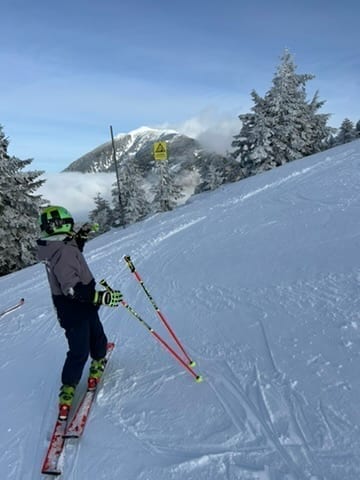
The most common parent mistake with children’s gear is understandable: buy it a little bigger so it lasts longer. With a sweatshirt, that makes sense. With ski boots and skis, much less so. Gear that a child cannot control takes away feel, confidence, and the desire to try new things.
Skis should match the child’s height, weight, and level. The ski boot must hold the foot without painful pressure. Bindings belong in professional setup, and the helmet must truly fit on the head.
1. Skis: length according to the child, not the chart on the wall
There is no single ski length that is right for all children of the same age. What matters is height, weight, technical level, strength, and where and how the child skis.
In its model for young skiers, Alpine Canada gives an approximate guideline for skis between shoulder height and head height, with the less experienced skier closer to the shorter end and the more experienced skier able to go higher. This is a coaching guideline for developing young skiers, not a universal standard for every type of ski.
Choose a shorter, easier-to-control ski. A child mainly needs to turn, stop, and find balance without fighting the equipment.
They can gradually move to a longer, more stable ski if they can handle it technically and it matches their weight and strength.
The same height does not mean the same suitable ski. A lighter child may need a softer, easier-to-control model.
Rental gear, a club bazaar, or quality used equipment is often a better solution than buying a model that is much too big “for three years.”
The worst goal is to choose skis a child will “grow into.” Until then, they still have to ski on them.
2. A shorter ski is nothing to be ashamed of
Parents sometimes see a longer ski as a sign of progress. But when learning technique, it matters more whether the child can pressure the ski, edge it, turn it, and control it on different terrain.
A ski that is too long or too stiff can make a child compensate with force, rotation of the whole body, or sudden braking. On the surface they may “ski on bigger skis,” but technically they may instead be creating a problem for themselves.
Loko note: A ski should not teach a child by being too demanding. A good ski lets them make quality movements, and only then does it make sense to add length, stiffness, and speed.
3. Ski boots: the most important part of the whole set
If we had to tell a parent one thing that is not worth making a big compromise on, it is ski boots.
Alpine Canada emphasizes that a properly fitting ski boot is crucial for developing basic skiing skills. The foot should be stable in the boot, and the child must be able to flex the boot appropriately at the ankle. If the boot is too big, the foot moves around inside it and the child's movement is transferred to the ski late and imprecisely.
The money saved can mean a season in a boot in which the child is swimming, tightening the buckles to the maximum and feeling the ski less well. For growing children, swapping, buying second-hand, or renting often makes more sense.
4. Mondopoint: look at the foot, not the sneaker size
Ski boots are commonly labeled using the Mondopoint system. ISO 9407 defines Mondopoint as a shoe sizing system based on the dimensions of the foot the boot is intended for.
For a parent, the simple takeaway is this: measure the foot in millimeters or centimeters and work with the actual foot length, not with the idea that the child “wears about 35” in regular sneakers. Different brands of everyday shoes can have different sizing and internal volume.
A good boot-fitting measurement does not stop at length. Foot width, instep height, foot volume, and whether the heel stays stable during movement are also important.
5. What a properly fitting ski boot should feel like
A new ski boot should not feel like a slipper. At the same time, it should not cause sharp pain, numbness, or noticeable pressure points for the child.
Practical signs of a reasonable fit:
- the heel does not move up much when the knee is bent,
- the foot does not shift side to side in the shell,
- the buckles do not need to be tightened with extreme force for the boot to hold,
- the child can slightly bend the ankle and bring the shin into the tongue of the boot,
- after a few minutes, there is no sharp pressure on one specific spot,
- one suitable ski sock is enough.
Two or three thick socks usually will not solve the problem of boots that are too big or too cold. They take up space, can create folds, and worsen feel in the boot.
6. Flex: the number is not sacred
Parents often look for a simple chart for ski boots: age = flex. But such a chart cannot take into account weight, strength, technique, or the boot’s specific construction.
What matters more is whether the child can flex the boot appropriately while still getting support from it. A boot that is too stiff can limit ankle movement; one that is too soft may not provide enough support for an experienced, stronger skier.
For club kids, it is a good idea to discuss boot choice with the coach and a qualified bootfitter, not just rely on the flex number in the online shop.
7. Bindings: don’t adjust them based on last year
The release setting of the bindings depends on several skier and boot parameters. It is not right to copy the value from last year’s skis or “guess” it based on what a friend uses.
Current standard ISO 11088:2023 covers the mounting, adjustment, and inspection of the ski-binding-boot system for alpine skiing. For a parent, the most important practical point is this: binding mounting and adjustment belong to a professional service that works with the specific child, boot, and binding.
A change in weight, height, boot type, or sole length is a reason to check the settings. Do not treat the binding as “set forever.”
Have the boot-binder compatibility, the condition of the components, the mounting, and the release settings checked before the first training session.
8. Helmet: it has to fit, not just sit on the head
The American Academy of Pediatrics recommends a sports-appropriate, properly fitting helmet for winter sports. After a fall with impact, if it is damaged, or when a child outgrows it, the helmet should be replaced according to the manufacturer’s recommendations and the type of damage.
A well-fitting helmet:
- sits level, not tipped high back,
- does not shift significantly forward, backward, or to the sides,
- does not require the adjustment dial to be cranked down extremely tight,
- works with goggles without a big gap on the forehead,
- does not press on the child at one point.
Alpine Canada also reminds us that helmets do not last forever and damaged or worn-out ones should be replaced.
9. Choose goggles and helmet together
Even a good helmet and good goggles can make a bad combination. Goggles may press on the nose, the helmet may push them down, or there may be a big gap between them that lets cold air blow onto the child’s forehead.
If possible, try the goggles with the specific helmet, that the child uses. For a small child, comfort is essential — if the goggles keep getting pushed down, lifted up, or taken off, the problem is not just about appearance.
10. Poles: not every young child needs them right away
For complete beginners, poles can add one more thing they have to hold and coordinate. In the initial learning phase, children often ski without them.
When the child starts using them, the length should match their height and technique. For club children, the easiest thing is to ask the coach, who knows what the group is currently training.
11. Race gear does not add technique on its own
A stiffer ski, higher flex, protectors, and a race model can make sense when the child really needs them. But the word “race” on its own will not make the child faster.
For younger racers, it is more important that the gear supports technique and suits their strength. At Skier Essentials, Alpine Canada recommends that parents work with the club coach when choosing equipment, precisely so the gear helps develop skills instead of holding them back.
12. New vs. used vs. rental
Children’s gear changes quickly, so there is no shame in using quality second-hand equipment. In fact, it is often a more sensible solution than buying a new set that is the wrong size.
The advantage is a clear history, the option of a professional fit, and full lifespan. It makes the most sense where the child skis a lot and we know exactly what they need.
It can be excellent if it is the right size and in good condition. However, have the bindings and service checked by a professional.
Excellent for fast-growing children or the first few seasons. It makes it possible to change sizes without buying compromises.
The advantage is that we often know the equipment and know what type of child it worked for. Even here, though, check the condition and the correct fit.
13. Five questions before buying
Before you pay, try to answer:
- Does it fit the child now, or am I buying ahead?
- Can the child technically control the ski and ski boot?
- Is the gear suited to their weight and skill level, not just their height?
- Is the binding professionally set for that specific child and ski boot?
- Does the coach know that we are changing the type or level of gear?
If the answers are yes, the brand and color are already secondary.
A properly sized ski, a well-fitting ski boot, professionally set bindings, and a correctly fitted helmet will do more for learning than a pricier model that is two levels ahead of the child.
Sources and methodology materials:
Alpine Canada — Skier Essentials: Equipment and Gliding Start: Equipment.
ISO — ISO 11088:2023, Alpine ski/binding/boot system — Assembly, adjustment and inspection.
ISO — ISO 9407:2019, Footwear sizing — Mondopoint system.
American Academy of Pediatrics / HealthyChildren — Helmets Save Lives & Reduce Risk of Traumatic Brain Injury.
It is a good idea to consult the coach and a qualified service technician/bootfitter about specific gear for a club child; the recommendations in the article do not replace professional binding adjustment.