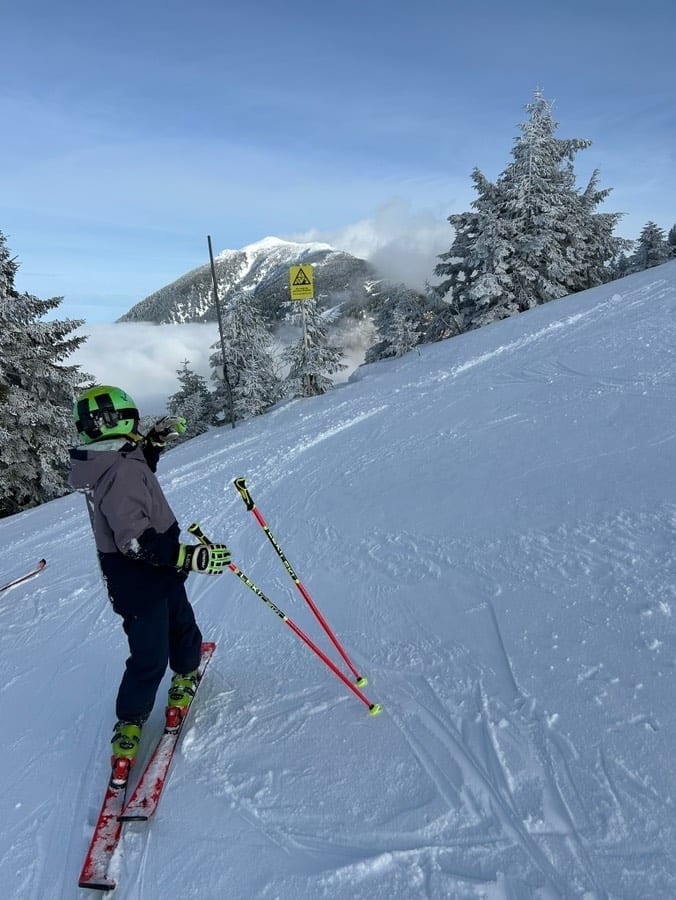
In the morning, everything works. The turns are calm, the child listens, tries new things, and still has energy for races with friends. Two hours later, they are falling on things they handled a moment ago, suddenly they are not “hearing” the coach, and after the third lost glove they burst into tears. That is not necessarily disobedience. Very often, it is simply fatigue.
There is no single right number of minutes for every child. Skiing duration is affected by age, experience, weather, terrain, training intensity, sleep, food, and whether the child is learning a new movement right now. That is why we mainly watch the quality of the run and the child's behavior.
We do not set the duration by one number
With small children, it is tempting to look for a simple rule: one hour, two, three? But without context, such a number does not mean much.
Alpine Canada in the youngest phase Gliding Start states that a formal lesson with an instructor can, depending on level and experience, last approximately 1 to 3 hours. This is not a medical standard or a recommendation that every child should last three hours. It is more of a reminder that even in a development model, time is adjusted to the specific skier.
For us, the more useful question is:
Is the child still skiing well and safely, or are they just collecting more kilometers?
Twenty minutes of focused work can be more valuable than another hour during which technique gradually falls apart.
Suddenly there is more leaning back, sudden braking, loss of balance, or falls without an obvious reason.
The child forgets a simple task, does not react to the situation, or cannot focus again even after a short pause.
Irritability, tears, conflicts, or complete refusal to continue skiing can be a sign of fatigue, cold, or hunger.
A child starts speeding up uncontrollably, reacts too late, or has trouble stopping where they handled it before.
Fatigue often shows up in skiing before the words “I’m tired”
Especially younger children may not be able to say exactly what’s wrong. Sometimes they’ll say their ski boot is hurting, that the slope is boring, or that they want to go home. And sometimes they won’t say anything — they’ll just start skiing worse.
That is why, for a parent or coach, these are important changes compared with how the child was skiing a moment ago.
| What we see | What may be behind it | The first sensible step |
|---|---|---|
| more falls and trips | physical or mental fatigue | easier skiing or a break |
| sudden braking and stiffness | tiredness, fear, terrain that is too demanding | reduce the difficulty |
| the child stops responding to instructions | mental overload, hunger, cold | a break, food, warmth |
| the technique falls apart with every run | fatigue outweighs the ability to learn | end the training or make it much easier |
| irritability and crying | a combination of fatigue, cold, hunger, and emotions | don’t focus on technique, but on basic needs |
If a child can no longer safely perform a simple task, repeating it may not build technique any further. It may only reinforce defensive movements and make the skiing experience worse.
A break is part of training, not a failure
A short rest can do more for the next run than five technical tips. Warmth, a drink, food, and a few minutes out of performance mode often bring a child back to a state where they can learn again.
With younger children, it is often practical to split the day into shorter quality blocks. For example: skiing, a break, another block, and then freer riding. The exact rhythm depends on the child and the conditions.
The skiing settles down, attention returns, and the child feels like continuing. Then the break made sense, and we can add a training task again.
If they are still cold, tired, or the technique remains noticeably worse, it is often wiser to end the day than to try to “ski out” the fatigue.
Five things that change “how much longer they can keep going”
1. Age and experience
A beginner uses a lot of energy just to keep balance, get up after a fall, and process new stimuli. A more experienced child can manage the same run with far less mental and physical effort.
2. Terrain and snow
A gentle groomed slope and a chopped-up steep hill are completely different loads. The difficulty also changes with fresh snow, ice, fog, or heavy traffic.
3. Weather and clothing
Cold, wind, and wet gloves can end a good training session very quickly. The American Academy of Pediatrics recommends more thin layers and regular breaks in the warm for winter activities; wet clothing should be changed as soon as possible.
More practical tips in the article How to dress a child for skiing.
4. Sleep, food, and hydration
A long car ride, an early wake-up, a small breakfast, and then intense movement in the cold all add up. Alpine Canada, in its recommendations for parents of the youngest skiers, specifically reminds them about food and water during a longer day on the hill.
5. Type of training
Free skiing with friends and focused slalom training are not the same load. A new technical task requires more attention, even if it does not look physically dramatic.
When it is no longer about training, but about safety
Winter is not just about comfort. CDC lists warning signs of hypothermia, for example shivering, extreme fatigue, confusion, clumsiness in the hands, and sleepiness. For frostbite, watch for pain or redness of the skin; more serious signs are numbness and unusually pale, grayish-yellow, or waxy skin.
If we suspect hypothermia, it is no longer a “break from training” but a medical situation. The child needs to get warm and, depending on the severity, medical help should be sought. Hypothermia is an urgent condition.
A successful day is not measured by the price of a ski pass or the number of runs. With children, we want quality movement, safety, and the desire to come back to the snow. When technique, attention, and mood go sharply down, training usually no longer adds what we want from it.
Sources and methodology: Alpine Canada – Gliding Start for parents; Alpine Canada – Skier Essentials; American Academy of Pediatrics – winter safety; CDC – hypothermia; CDC – frostbite. Alpine Canada time recommendations are a coaching development framework, not an individual medical prescription.