What a direct line is
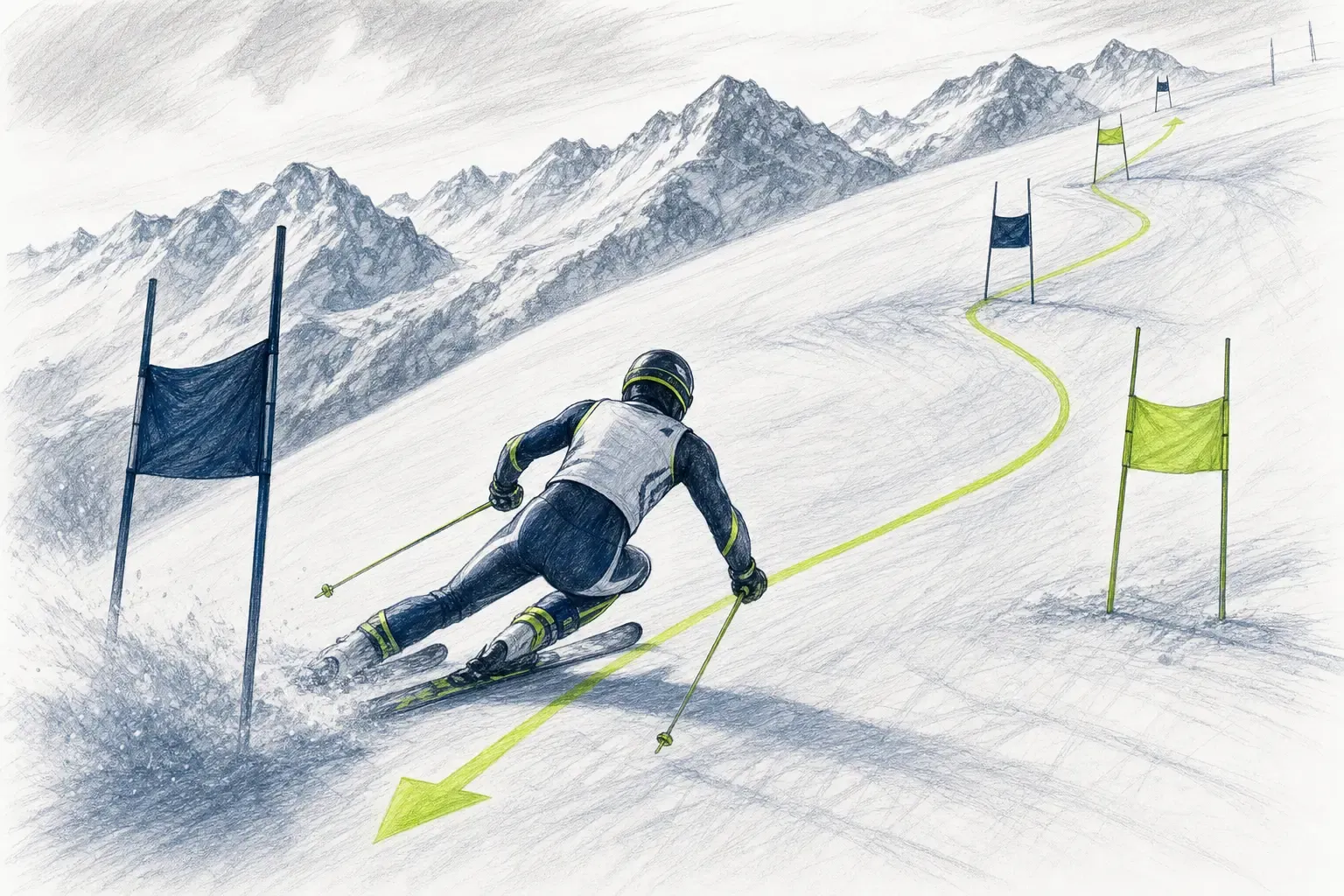
Direct line (English direct line or straight line) is the skier's chosen path with little sideways deviation and the shortest possible route down the slope or between designated points. In racing skiing, it refers to a short, attacking line choice between the gates. However, it does not mean the skier travels in a geometrically straight line without turns.
It is mainly a coaching and tactical term. The FIS rules define the course setting and the conditions for a correct gate passage, but they do not prescribe one ideal race line. The racer chooses it according to the gate set, slope, terrain changes, snow surface, speed, and their own ability.
Direct line, fall line, and gate line
These terms should not be confused:
- Fall line is the direction of steepest descent on the slope at a given point. A skier moving along the fall line loses elevation fastest.
- Direct line is the actual chosen track. It may approach the fall line, but between offset gates it is made up of linked turns.
- Gate line is a term from the rules used to assess whether a gate has been passed correctly. Its exact definition depends on the discipline and the gate configuration. It is not a recommended line for the racer to follow.
According to the FIS rules, a gate is passed correctly when both ski tips and both feet of the racer cross the gate line; the rules also cover special situations, such as slalom with a single pole or a lost ski.
Is the shortest line the fastest?
Not always. A shorter path is an advantage only if the skier can handle it without significant braking, skidding, or loss of balance. An overly direct line can cause the racer to start the turn too late, get below the gate, and have to change direction sharply. The result is usually more ski drag, loss of speed, and poor positioning before the next gate.
The fast line is therefore a compromise between:
- the length of the line travelled,
- keeping speed,
- the shape and timing of the turn,
- being ready for the next gate,
- safely handling the terrain.
An advanced racer may, depending on the situation, combine a carved turn with a short redirection of the skis. But that does not mean that the straight line is synonymous with skidding or, on the contrary, exclusively riding on the edges.
Children’s skiing
For a child, the straight line should not mean the instruction “go straight and as fast as possible.” A smaller sideways guiding of the skis usually brings a faster increase in speed, less time to react, and greater demands on balance and the timing of movements.
In training practice, the ability to: is therefore developed first.
- change direction to both sides,
- link turns in an appropriate rhythm,
- control speed through the shape of the turn,
- stop at a designated place,
- perceive space, terrain, and other skiers.
The line can be marked with brushes, cones, paint, or a wider corridor. For beginner children, the corridor should be wide enough so they can finish the turn without forced movement. As technical confidence grows, the coach can gradually make the task more precise. There is no single suitable straight line for all children of the same age.
Race context and the coach’s view
When inspecting the course, the racer does not assess only the individual gates. They watch the whole section and the place from which they need to start the next turn. A straight line may be suitable on a smooth section with enough space, but unsuitable before a course break, a terrain edge, a combination of gates, or a place that requires speed control. In ski cross, they must also account for opponents and have a backup line ready.
The coach should not evaluate only the distance of the skis from the pole. More important is whether the skier passes through the section in balance, does not lose speed unnecessarily, and can link the next turn. A straight line is useful only when it is part of mastered technique and a conscious tactical decision.
Sources and further reading
- FIS – Alpine Documents: current international rules and documents for alpine skiing
- FIS – Para Alpine Skiing Rules and Regulations: definition of the gate line and correct passage through the gate
- FIS – Moguls 101: a direct line in the context of skiing fall line
- U.S. Ski & Snowboard – Athlete Performance Profile: choosing the shortest line while maintaining speed and developing tactics
- U.S. Ski & Snowboard – Introduction to Ski Cross: choosing multiple lines, tactics and risk management
- U.S. Ski & Snowboard – Using Dye Lines for Tactics: using colored lines in tactical training
- U.S. Ski & Snowboard – Alpine Ski Racing Vocabulary: technical terminology and using brushes to mark the line
- U.S. Ski & Snowboard – Alpine Competition Officials Education Resources