What is the ideal line
Ideal line is the trajectory of the skis and skier through the terrain or a marked course that best matches the goal of the run. In recreational and children’s skiing, the goal may be safe control on the slope, smoothness, or speed control. In racing, the goal is the shortest possible finishing time with a valid run through the course.
It is not one precisely defined line. The right line depends on the discipline, gate setting, slope pitch and terrain features, snow quality, speed, turn radius, equipment, and the technical and physical abilities of the specific skier. Model and biomechanical studies therefore work with trajectory optimization under multiple constraints, not just with finding the shortest distance.
The shortest line is not necessarily the fastest
A direct line between gates shortens the path, but it may require a sharp change of direction, more skidding, or hard braking. A slightly rounder line may be longer, but it allows the skier to carry more speed, load the skis more smoothly, and aim more advantageously into the next gate.
The resulting time is therefore influenced at the same time by:
- the length of the traveled line,
- speed on entry, in the turn, and on exit,
- loss of mechanical energy from skidding and sharp changes of direction,
- the timing of edging and loading the skis,
- the direction of the exit relative to the next gate or change in terrain.
Research in giant slalom compares strategies with a longer straight section and a sharper change of direction with strategies based on smoother, longer turns. The results do not support the idea of one universal line; more powerful skiers were able to limit energy losses with different ways of shaping the line. Expert reviews also point out that keeping speed may be more important for the result than shortening the trajectory itself.
The line in a marked course
The current FIS rules available as of 2. 2026 set the conditions for a valid run through the course and for individual disciplines. They do not, however, define one mandatory “ideal” racing line. Choosing the line is therefore a tactical decision for the skier and coach, with the basic requirement remaining correct completion of the course.
In coaching practice, for example, these terms are used:
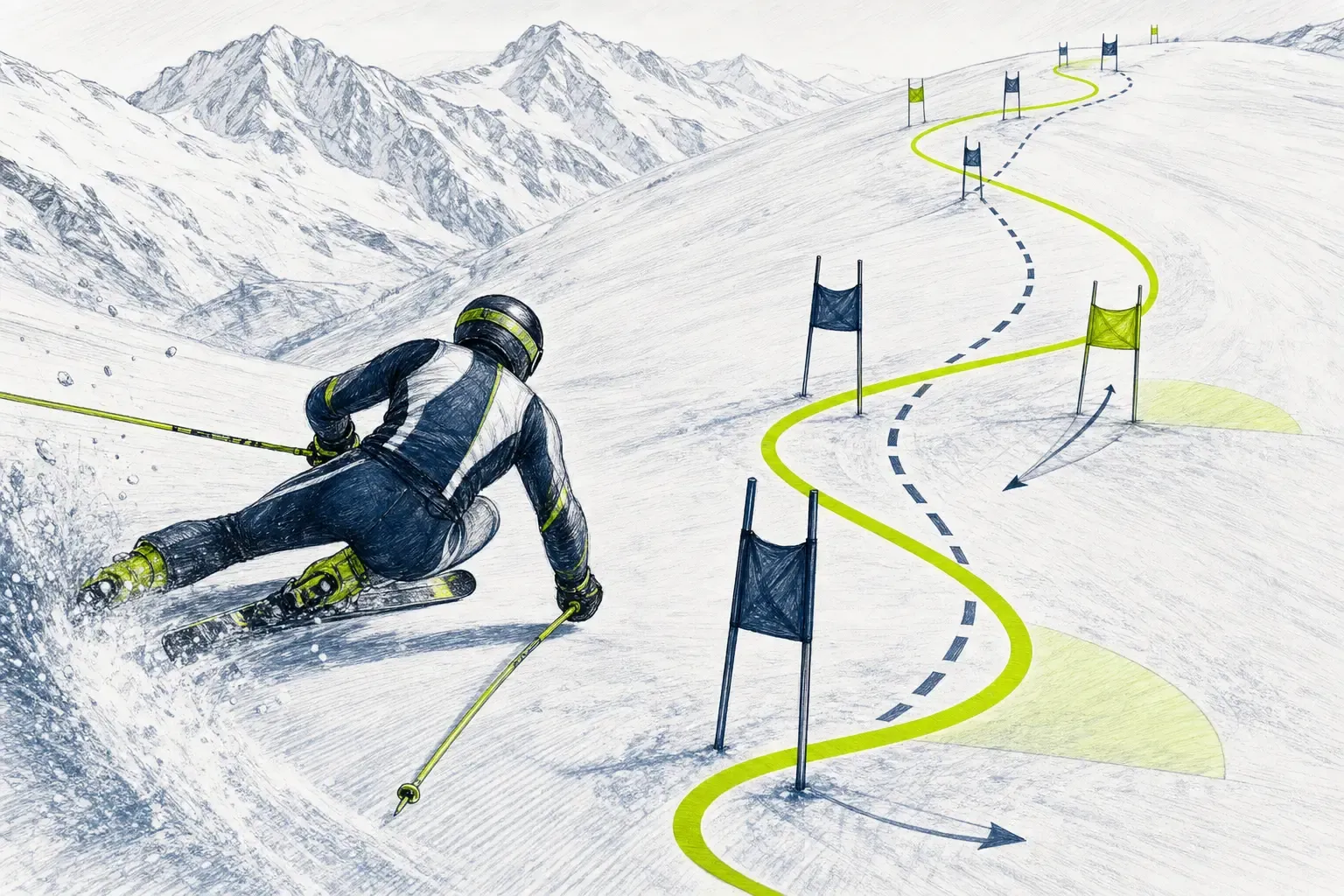
- higher line – the skier starts changing direction earlier and creates space above the gate,
- direct or tight line – runs closer to the gate and shortens the path, but leaves less margin,
- rounded line – uses a longer arc and usually provides more time to change direction,
- late or low line – the skier arrives at the gate without enough direction and must finish a large part of the turn below it.
These terms describe training practice, not separate categories of FIS rules. None of the listed lines is automatically right or wrong. What matters is what enables the skier to do in the next part of the course.
In slalom, the line is assessed mainly in connection with a fast rhythm and early preparation for the next turn. In giant slalom, the balance between the smoothness of the turn, the distance covered, and maintaining speed becomes more important. In speed disciplines, planning also includes terrain breaks, jumps, compressions, aerodynamic position, and safe handling of high speed. Specific tactics always belong in the hands of a qualified coach and are based on inspecting the course.
Ideal line for children
For a beginner child, copying the racing line of an adult skier is not the priority. First, the child needs to be able to follow the set direction, regulate speed, link turns, and react to the terrain. The coach therefore adapts the line to the child's age, motor level, experience, and current conditions.
For children, simple external tasks are often more understandable than abstract instructions about the exact point of edge engagement. Brushes, cones, colored markers, or lines in the snow can help by showing the space for initiating the turn and the required direction of exit. Using visual lines and a gradual transition from free skiing to gate drills are among the established methods of coach education.
A young skier should get to know more solutions. On a gentle slope, the child can try a turn that is higher, lower, rounder, or more direct and compare which solution keeps the skier calm, holds the line, and easily links the next turn. Such learning develops spatial awareness and tactical decision-making without the coach prescribing a single line for every situation. U.S. Ski & Snowboard educational materials emphasize progression, feedback, and adapting tasks to the athlete's level.
Typical mistakes and misunderstandings
- “The shortest is always the fastest.” An overly direct line can end in hard braking or an uncontrolled next turn.
- Starting the turn only at the gate. The skier arrives without the necessary direction and performs a large part of the change of direction late below the gate.
- Unnecessarily high and wide line. It adds meters and can reduce speed without tactical benefit.
- Looking only at the nearest gate. A good line is planned with at least the next turn in mind, not as a series of isolated passes.
- Copying an elite racer. A line manageable with top-level technique and strength may not be suitable for a child or a less experienced skier.
- Judging the line without technique. The same drawn line can lead to a different result depending on how the skier works with the edges, pressure, balance, and body direction.
Coach's view
The coach does not assess only the skier’s distance from the gate. They watch the entry speed, the place and timing of the direction change, the quality of support on the outside ski, the amount of skidding, the exit direction, and readiness for the next situation. Video, split times, or colored markers matter when they help connect the choice of line with its technical execution.
The ideal line is therefore always a line for a specific skier in a specific situation. A good line creates not only a fast pass through one gate; it leaves the skier with balance, control, and options for continuing the course.
Sources and further reading
- FIS – Alpine Documents: International Competition Rules, July edition 2026
- Supej et al. – Influence of Line Strategy Between Two Turns on Performance in Giant Slalom
- Gilgien et al. – Recent Kinematic and Kinetic Advances in Olympic Alpine Skiing
- Cai, Yao – Trajectory optimization with constraints for alpine skiers based on multi-phase nonlinear optimal control
- Dynamic analysis and trajectory optimization for the nonlinear ski-skier system
- U.S. Ski & Snowboard – Level 200 Alpine Technique & Tactics Course Outline
- U.S. Ski & Snowboard – Level 100 Alpine Manual
- U.S. Ski & Snowboard – Using Dye Lines for Tactics