Definition
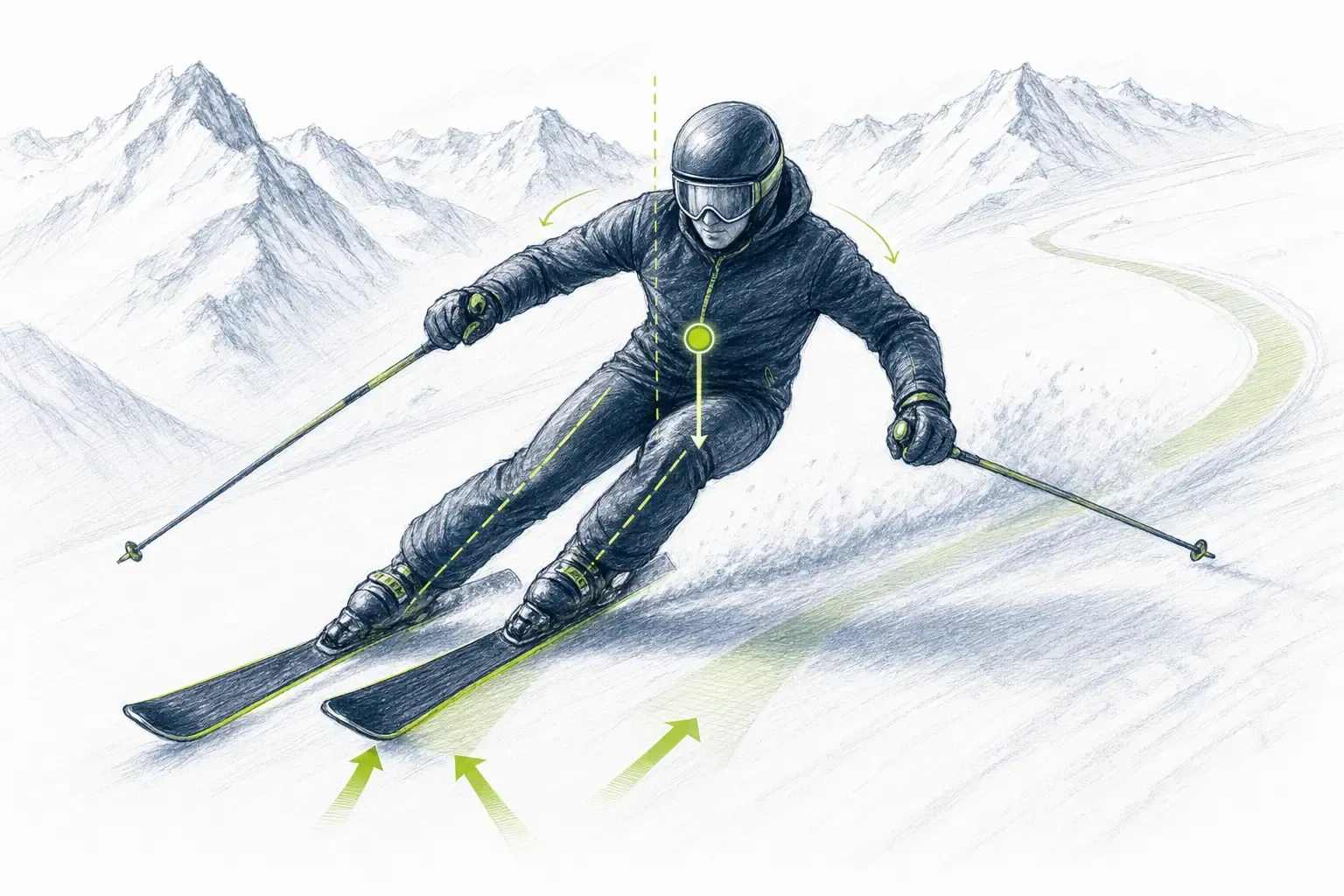
Balance stance is a functional and mobile body arrangement in which the skier can maintain or regain balance while also controlling the skis effectively. It includes control of position forward and back, side to side, and during rotational movements. In alpine skiing methodology, balance is considered the foundation on which edge control, pressure control, and ski direction are built.
The term stance can suggest a motionless pose. In skiing, however, balance is dynamic. The skier accelerates, goes over uneven terrain, inclines the skis onto the edges, and changes direction. A position that is functional at the beginning of a turn therefore does not have to be the same in the middle or at the end.
How the balance stance shows up
Balance stance cannot be defined by one correct joint angle. Its typical signs are:
- the ankles, knees, and hips remain sufficiently mobile,
- the skier feels support under the feet and can smoothly shift pressure,
- the torso is neither unnecessarily stiff nor collapsed,
- the position of the hands and arms supports balance, but does not replace the work of the legs,
- the skier can absorb an uneven surface, change edging, or recover from a small deviation without losing control.
In the lengthwise direction, the term central stanceis often used. This does not mean that pressure must stay exactly in the middle of the foot throughout the whole turn. Rather, it refers to a range from which the skier can effectively move the body forward and back without staying “behind the skis” for long or relying only on the front of the ski boots. Current PSIA methodology therefore also works with conscious movement forward, back, and return to a functional center.
The distribution of load between the skis changes in the same way. Balance stance does not mean a permanent distribution of weight 50: 50. Depending on the task and the phase of the turn, one ski may be loaded more strongly, while the skier keeps the ability to adjust pressure.
Practical meaning
Good balance allows the skier to apply pressure to the edges more precisely, adapt to the surface, and make the next movement without unnecessary tension. In racing skiing, it shows in the ability to stay functionally over the base of support even at higher speed, strong edging, lightening, or sudden contact with uneven terrain.
However, laboratory balance while standing is not the same as balance on skis. Research on young racers showed that sport-specific balance tasks could distinguish performance level better than general tests. Another longitudinal study recorded a stronger relationship between balance and results in the younger U14 category than later in U16. These findings do not treat one test as a prediction of success, but support assessing balance in conditions similar to skiing.
Balance stance in children
When working with a child, age, experience, body proportions, motor development, and current fatigue all need to be taken into account. Children’s balance has several components - static, dynamic, anticipatory, and sensory - and one simple test cannot describe it completely.
For beginners, it is not appropriate to demand an exact “adult” position. A child first needs to safely discover where they have support on skis and how body position affects gliding, braking, and turning. Learning basic technique in children is linked to a broader set of motor skills, such as coordination, agility, strength, and movement speed, not just the ability to stand still on one leg.
Fatigue can worsen postural control. In a study of thirteen-year-old alpine skiers, several indicators of the center-of-pressure movement changed after intense exertion. A coach therefore evaluates stance also in relation to fatigue, snow quality, and task difficulty, not just as a technical mistake.
Typical mistakes and misconceptions
- Stance as a squat: too deep and rigid a bend limits further movement.
- Permanent sitting back: the pelvis stays behind the support, and the skier reacts late or tries to regain balance with abrupt arm movements.
- Excessive forward pressure: strongly pressing the shins into the tongue of the ski boots is not a universal solution and can limit stance adjustment.
- Fixed rule 50: 50: the load on the skis changes during the turn.
- A rigid torso at all costs: stable does not mean stiff. The torso should help direct movement, not block the reactions of the lower limbs.
- Hands as the only fix: the right arm position can help, but the cause of imbalance may lie in ankle work, pelvis, timing, or choosing terrain that is too demanding.
Coach’s view
In training practice, balance stance is not developed only by the verbal cue “move forward.” A coach can set tasks on a gentle and safe slope in which the skier explores movement from front to back, changes pressure between the feet, briefly unweights one ski, or lands after a small hop into a stable, mobile position. The PSIA methodology uses similar progressions. The choice of exercise, however, must match age, speed, level, and slope conditions.
The coach mainly watches the outcome: whether the child can change direction smoothly, respond to terrain, release unwanted tension, and regain balance. A single photo or a brief moment without context may not reveal the cause of the problem.
Stance is also affected by the contact between the body and the equipment. Research in adults showed that boot stiffness changes the mechanical support for maintaining balance. This result cannot be automatically transferred to children, nor can a suitable boot stiffness be derived from it. If a child cannot achieve a functional stance, or if the boot restricts them or causes pain, a qualified specialist should assess the suitability and setup of the equipment.
Sources and further reading
- U.S. Ski & Snowboard – Level 100 Alpine Manual
- U.S. Ski & Snowboard – Level 100 Alpine Ski Fundamentals Instructor Manual
- PSIA-Rocky Mountain – Alpine Assessment Guide 2025–26
- Rizzato et al. – Sport-specific balance tests account for youth alpine skiers' ranking
- Balance, Basic Anthropometrics and Performance in Young Alpine Skiers
- Success in Adopting Technique of Alpine Skiing with Respect to Motor Abilities of Children Aged 7–8 Years
- Gender Differences in Postural Stability among 13-Year-Old Alpine Skiers
- Components of Standing Postural Control Evaluated in Pediatric Balance Measures: A Scoping Review
- The Influence of Wearing Ski Boots with Different Rigidity Characteristics on Postural Control