What ankle work is
Ankle Work It is the active and coordinated setting of the ankle joint, foot, and muscle tension in the ski boot. It allows the skier to gently regulate fore-aft balance, contact with the boot shell, power transfer into the ski, and, together with movements of the knees and hips, also the edging of the skis.
It is not a large, freely visible movement. The rigid shell of the ski boot limits the range of the ankle, but at the same time provides support and transfers forces between the body and the ski. Research on posture shows that experienced skiers can compensate for the ankle’s limitation in the ski boot by changing muscle coordination and use the support of the shell to maintain balance.
Closing and opening the ankle
When the ankle closes the lower leg moves closer to the instep — anatomically, this is mainly dorsal flexion. The skier may feel appropriate contact of the shin with the tongue or the front part of the cuff. When the ankle opens the angle between the lower leg and the foot increases; this corresponds to movement toward plantar flexion.
These movements do not occur in isolation while skiing. A change in ankle angle is connected with movement of the knee, hip, and torso. Biomechanical models therefore assess the lower limb as a whole movement chain and at the same time account for the ski boot’s passive resistance to ankle movement.
An active ankle does not mean constantly and as forcefully as possible pushing into the tongue of the ski boot. Contact with the shell changes during the turn depending on the terrain, speed, radius, phase of the turn, and distribution of load between the skis. Too much or uninterrupted forward pressure can limit the skier’s ability to react; a completely passive ankle, on the other hand, makes it harder to maintain precise balance.
Practical importance
The ankle is the first movable link above the foot through which the skier acts on the ski. Its main tasks are:
- to continuously adjust fore-aft balance,
- to create and release support against the ski boot shell,
- to transfer force between the lower limb and the ski,
- to support gentle edging of the ski,
- to react to bumps without unnecessarily stiffening the whole body.
The methodology of the U.S. national team program describes functional ankle strength as the ability to quickly create and transfer force into the ski. It also points to the role of the lower-leg muscles in dorsal flexion, foot stabilization, and precise ski control.
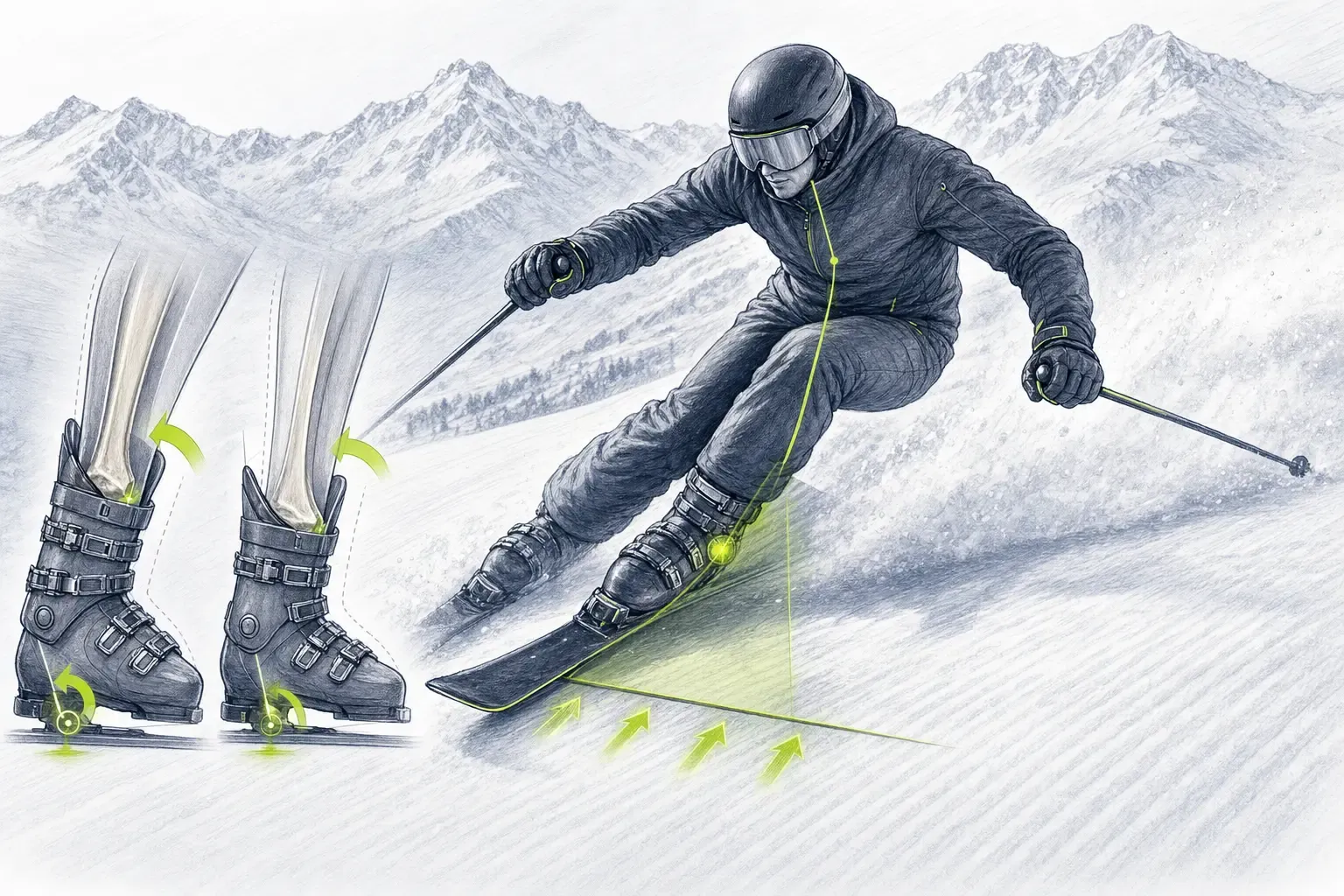
In a carved turn, the outside leg is usually loaded more heavily. Measurements and biomechanical models have recorded high forces in the ankle area of the outside leg and greater pressure against the cuff of the outside ski boot. But that does not mean the inside ankle should stay passive: it helps steer the inside ski, its edge angle, and its position under the body.
Children and young skiers
In children, ankle action develops gradually together with balance, coordination, and awareness of pressure under the feet. A small child will usually understand a simple movement task or a feel-based cue better than an anatomical explanation. The coach can therefore watch the result — for example, a stable stance over the feet and a smooth reaction to the terrain — instead of demanding a fixed ankle angle.
Exercises must match the child’s age, skiing level, speed, and conditions. First, the child should master the movement on gentle, clear terrain. Only then can you add more speed, greater edging, or more demanding race situations. Dryland training can appropriately develop balance, mobility, and lower-leg muscles, but it should not replace learning the movement in ski boots and on snow.
Poorly fitting ski boots can make proper ankle action much harder. If the heel lifts, the foot slides around in the boot, the child feels pain or numbness, or cannot work with the lower leg properly in a buckled boot, the problem cannot be solved with a technical cue alone. A qualified specialist should assess the size, shape, fit, and stiffness of the boot; neither the coach nor this glossary replaces boot fitting or professional service.
Typical mistakes and misunderstandings
- Constantly pushing the shins forward: contact with the tongue is mistaken for the goal. The result can be a stiff ankle and limited ability to regulate pressure.
- Skiing back with no tension in the ankles: the pelvis drops behind the feet and the skier leans on the back of the cuff. US Ski & Snowboard coaching materials recommend paying attention to active ankle flexion in such a case, but not to an isolated movement without adjusting the whole body position.
- Replacing the ankle with the knee alone: the knees move forward or inward, but the foot, hip, and torso do not follow the movement.
- The idea that edging comes from the ankle alone: a greater ski angle is created by the coordination of the ankle, knee, hip, and the position of the whole body.
- The same action in both legs: the outside and inside leg perform different, though interconnected, roles in the turn.
- Confusing lifted toes with the whole technique: activating the muscles on the front of the lower leg can be a useful training stimulus, but by itself it does not guarantee proper balance or force transfer.
Coach’s view
The coach does not assess the ankles separately from the rest of the body. They watch whether the skier stands functionally over the feet, can change pressure without abrupt upper-body movement, uses the support of the ski boot, and at the same time remains mobile in the knees and hips. What matters is the effect on the skis and the track in the snow, not the biggest possible movement or the strongest possible pressure into the cuff.
In racing skiing, the importance of precise timing and the ability to change muscle tension quickly increases. Ankle action is therefore a subtle but essential part of balance and force transfer — not a separate trick or a fixed position the skier should hold throughout the whole turn.
Sources and further reading
- US Ski & Snowboard – Functional Ankle Strength in Alpine Skiing
- US Ski & Snowboard – Level 100 Alpine Manual
- Noé, Amarantini, Paillard – How experienced alpine-skiers cope with restrictions of ankle degrees-of-freedom when wearing ski-boots
- Eberle et al. – Model-based estimation of muscle and ACL forces during turning maneuvers in alpine skiing
- Frontiers – Estimation of Joint Moments During Turning Maneuvers in Alpine Skiing
- Klous, Müller, Schwameder – Lower Extremity Joint Loading in Carved Ski and Snowboard Turns
- Shealy, Miller – Dorsiflexion of the Human Ankle as it Relates to Ski Boot Design in Downhill Skiing
- Frontiers – Asymmetries in Ground Reaction Forces During Turns by Elite Slalom Alpine Skiers