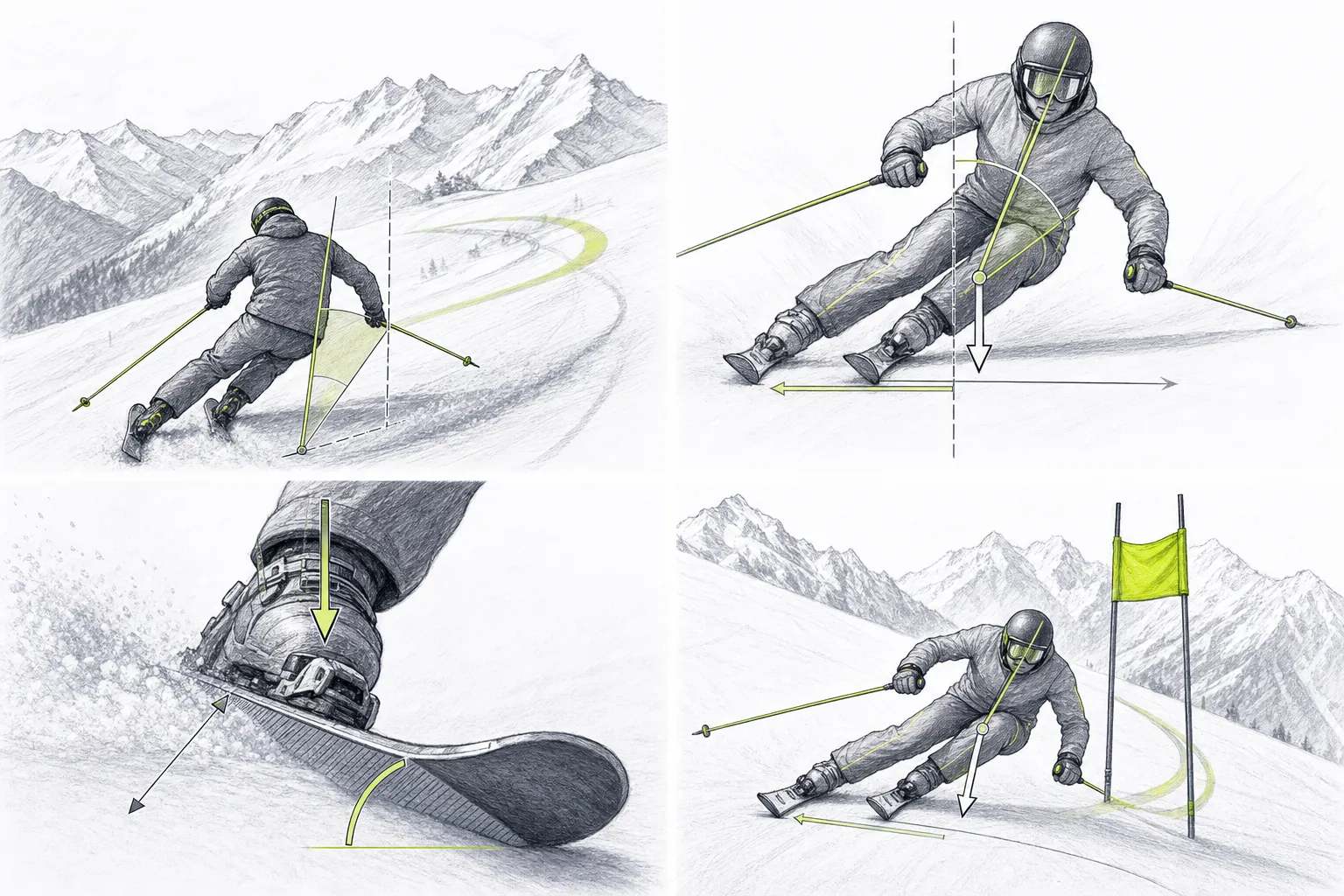
What is inclination
Inclination (eng. inclination) is the sideways displacement of the skier and their center of mass toward the inside of the turn. It helps the skier stay in dynamic balance while moving along a curved path and at the same time increase the angle between the skis and the snow surface. In coaching terminology, inclination usually means moving a larger part of the body into the turn, not just a separate tilt of the knees or pelvis.
In biomechanical measurements, the skier’s position is described by the position of the center of mass, individual body segments, and their relationship to the skis or the slope. That is why inclination is not always expressed by a single universal angle. Research methods may, for example, track the line between the center of mass and the area of the ankle of the outside leg, or the separate inclination of the lower leg and torso.
Importance in the turn
When changing direction, the snow acts on the skis with a force that allows the skier to move along a curved path. The position of the center of mass and the ski support surface must continuously adapt to this. Inclination into the turn helps organize the body relative to these forces and put the skis on edge. By itself, however, it does not guarantee a clean carved turn, proper loading of the outside ski, or a stable position above the skis.
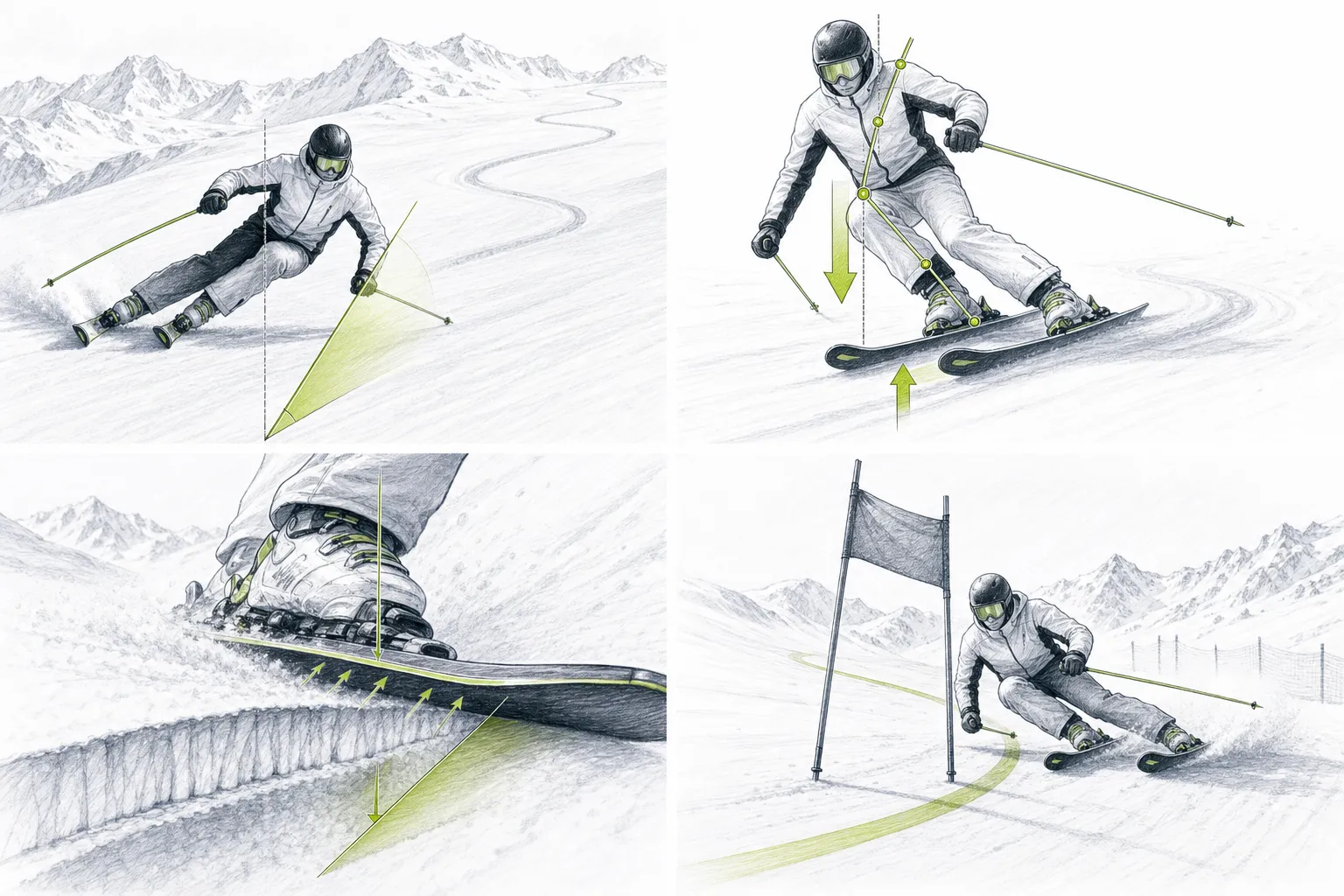
The required inclination changes during the turn. It is influenced mainly by speed, turn radius, slope steepness, the amount of skidding, snow conditions, and the way the skis are edged. At higher speed or with a smaller radius, functional inclination may be more pronounced, but there is no single correct angle for every skier and every turn. Research in racing skiing confirms that changes in slope steepness affect the path of the center of mass, acceleration, reaction forces, and the sideways position of the lower limbs.
Inclination and angulation are not the same
Inclination is often confused with angulation or angulation (angulation). In inclination, the body or a larger part of it tilts into the turn. In angulation, side angles are created mainly in the ankles, knees, and hips, so the skis can be edged more than the torso. Both components are combined in real skiing, and their ratio changes continuously. Official teaching methods describe edging as the result of inclination, angulation, or a combination of both.
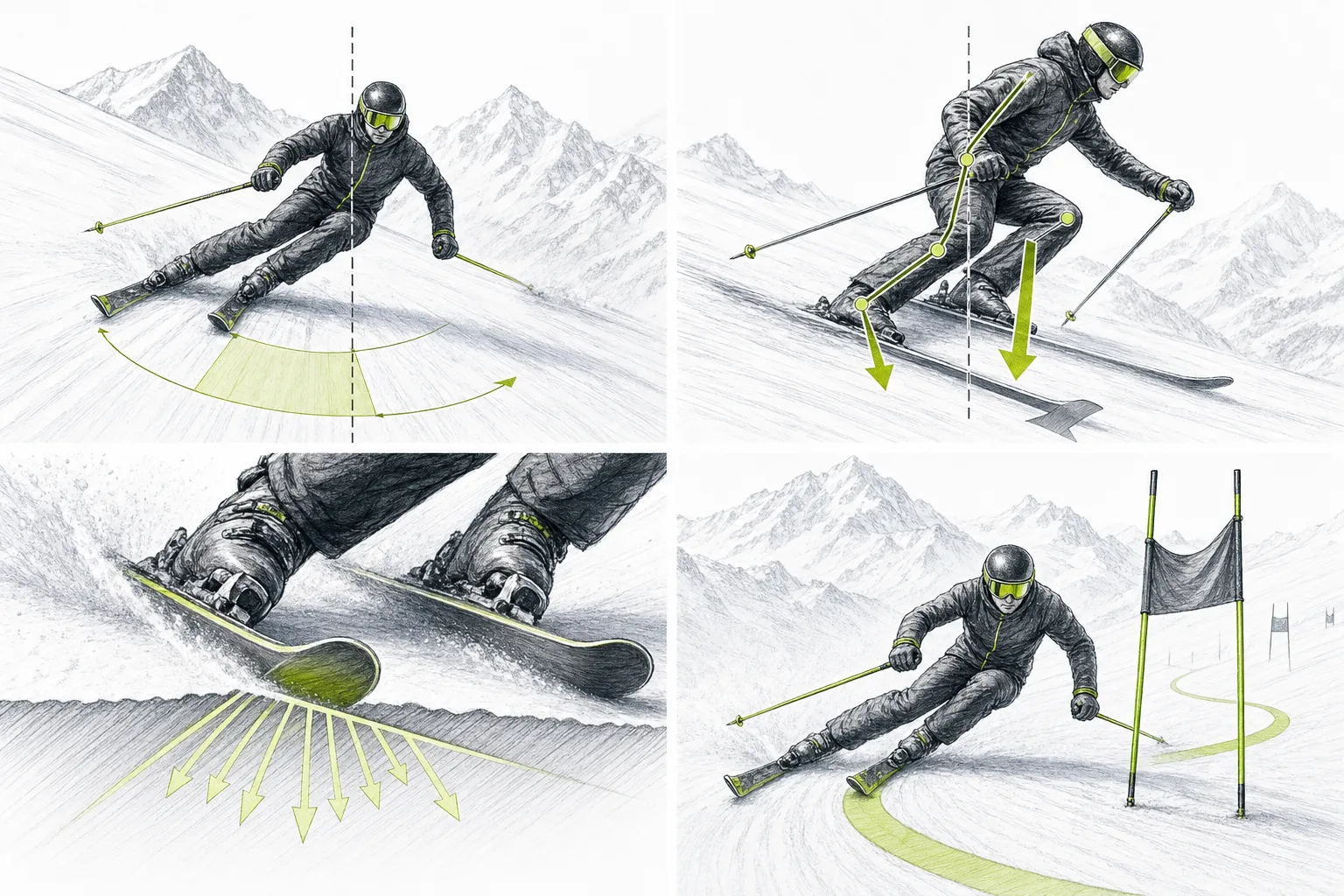
Any significant inclination is sometimes considered a mistake. That is not accurate. Inclination is an essential part of dynamic skiing. The problem is rather an excessive “collapse” of the whole body inward without enough support and control in the joints. In English coaching terminology, the term bankingis used for this unproductive movement. It can lead to early loading of the inside ski, loss of support on the outside ski, or a fall to the inside of the turn.
Children and learning
In children, inclination develops gradually together with balance, coordination, and the ability to regulate pressure on the skis. At low speed, a beginner does not need to imitate the extreme positions of a racer. A simple instruction like “lean inward” can lead to passive falling onto the inside ski or to bending the body in the wrong place.
Training practice: it is better to create a task in which inclination appears as a natural response to guiding the turn — on a safe, appropriately gentle slope, at a controlled speed, and under the coach’s supervision. U.S. Ski & Snowboard recommends using mostly easier terrain when learning the technique, where the child does not have to fight steepness or excessive speed.
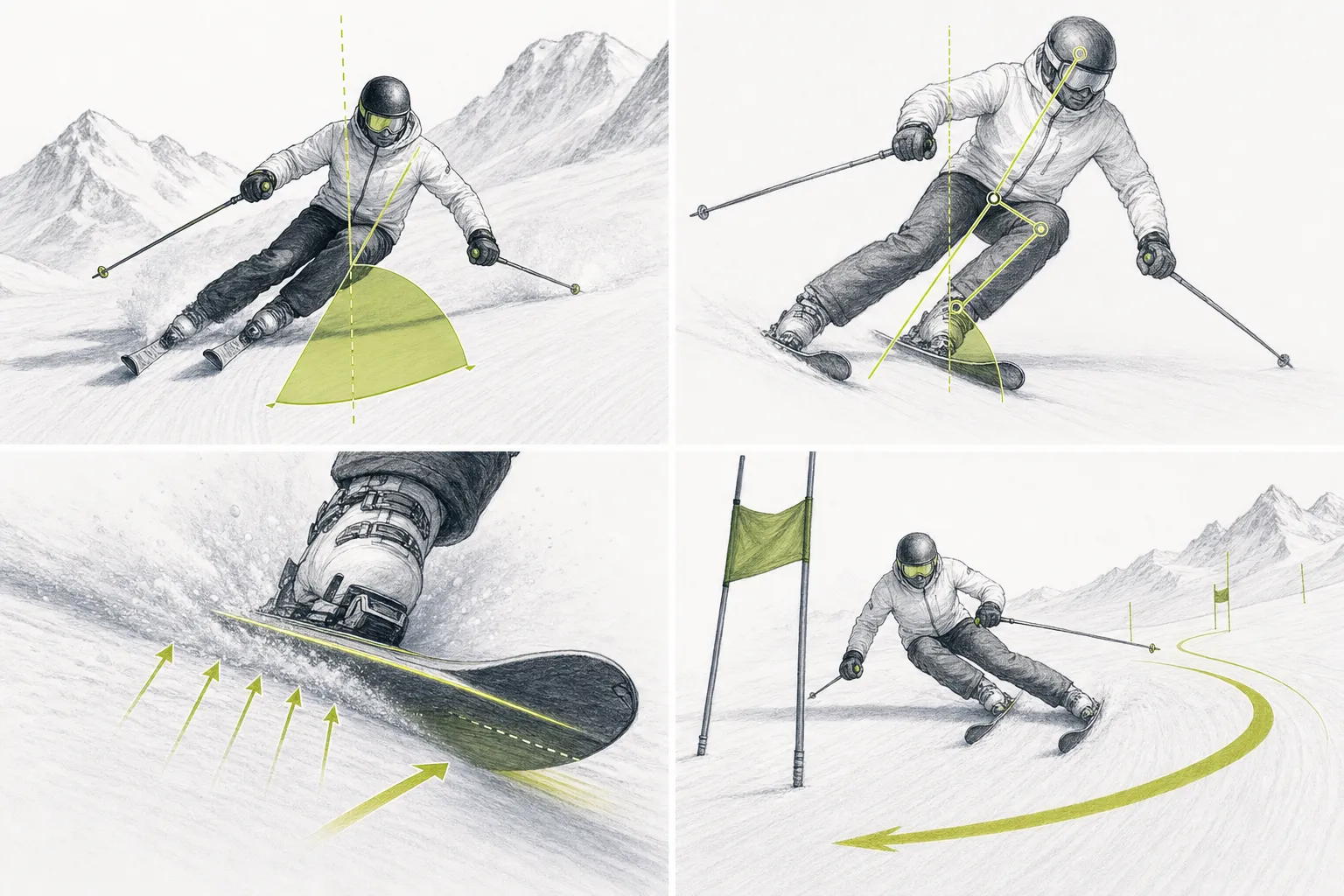
Race context and the coach’s view
In racing skiing, inclination can be very pronounced because the speed, turn radius, and forces between the skis and the snow are greater. A photo from one moment, however, is not enough to assess technique. The coach watches the entire turn: the timing of the movement of the center of mass, the edge change, creating support on the outside ski, regulating angulation, trunk stability, and a smooth transition into the next turn. A position that is functional at high speed may be ineffective or unstable at slow speed.
Inclination is therefore not a goal in itself. It is one of the tools the skier uses to control edging, balance, and the path of the center of mass. Its quality is not determined by how dramatic the skier looks, but by whether the chosen movement matches the specific turn and allows further movement without loss of control.
Sources and further reading
- U.S. Ski & Snowboard – Alpine Training Systems
- U.S. Ski & Snowboard – Level 100 Alpine Manual
- Professional Ski Instructors of America – Fundamental Mechanics of Alpine Skiing
- Frontiers in Physiology – An Inertial Sensor-Based Method for Estimating Joint Center Positions and Center of Mass Kinematics in Alpine Ski Racing
- British Journal of Sports Medicine – Course Setting and Selected Biomechanical Variables Related to Injury Risk in Alpine Ski Racing
- International Journal of Sports Physiology and Performance – Impact of the Steepness of the Slope on the Biomechanics of World Cup Slalom Skiers
- Journal of Science in Sport and Exercise – Monitoring the Performance of Alpine Skiers with Inertial Motion Units
- Frontiers in Physiology – Estimating Alpine Skiers’ Energetics and Turn Radius Using Different Morphological Points