What ski unweighting is
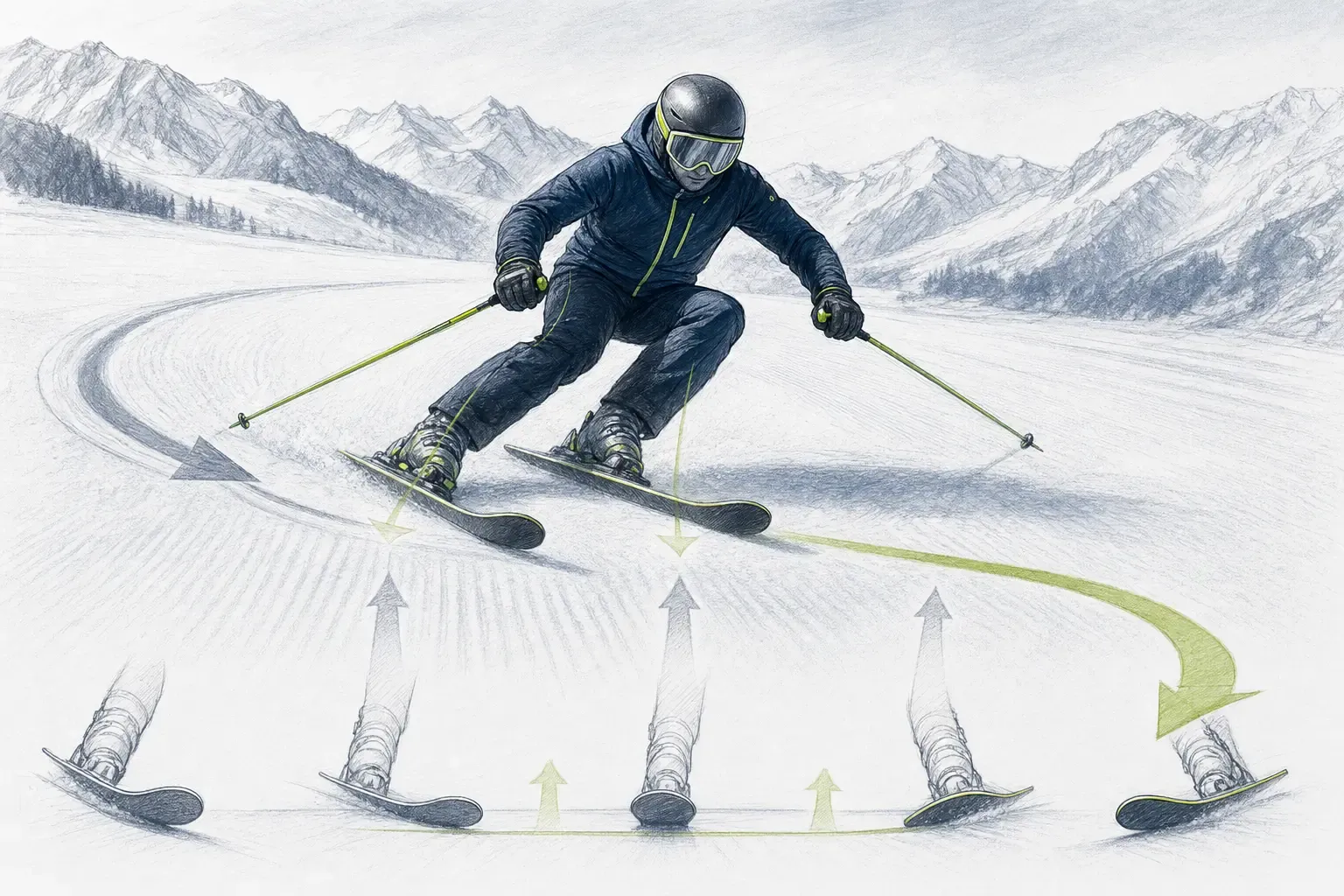
Ski unweighting is a short-term reduction in the load on one ski or both skis, more precisely a reduction in the forces transmitted between the skis and the snow. It most often occurs in the transition between turns. It helps release the old edges, reduce resistance to turning the skis, and prepare them to edge into the new turn.
Unweighting does not necessarily mean that the skis leave the snow. In smooth skiing, it may be only a brief and barely visible reduction in pressure. Modern shaped skis allow a transition from edge to edge without a noticeable upward movement, but you still need to reduce the load appropriately and release the edges of the previous turn.
How can a skier unweight the skis
In technical methodology, several methods are distinguished, and they can overlap with one another:
- Up unweighting: by extending the lower limbs, the skier moves the center of gravity farther away from the skis. During the movement, the amount of load changes and there is a moment suitable for releasing the edges or redirecting the skis. A pronounced form may resemble a jump, but that is usually not the goal in a normal turn.
- Down unweighting: by bending the legs, the skier reduces the distance between the center of gravity and the skis. The load can decrease without a significant lift of the torso.
- Retracting the legs: the feet and skis move closer to the center of gravity as the legs bend, while the path of the torso remains smoother. This method is used in dynamic transitions and when adapting to bumps.
The result does not depend only on the skier’s movement up or down. Load is also affected by speed, turn shape, slope steepness, terrain irregularities, edging, and the relative position of the center of gravity and the base of support. That is why the same movement may not have the same effect in every situation.
Practical significance
Unweighting can allow the skier to:
- smoothly release the edges at the end of a turn,
- move from one pair of edges to the other,
- turn or redirect the skis more easily,
- regulate ski contact with the snow on uneven terrain,
- adapt the turn to soft, broken, or icy snow,
- change the load distribution from the old outside ski to the new outside ski.
Unweighting is therefore a means, not a goal in itself. In some carved turns it is very subtle; in short turns, terrain irregularities, or when a stronger redirection is needed, it can be more noticeable. Even in demanding terrain, what remains important is regulating the overall pressure and maintaining balance, not mechanically repeating one movement.
Unweighting in children’s skiing
For children, the concept must be adapted to their level of motor development. For a beginner, the idea of “heavy and light skis” is usually more helpful than explaining the path of the center of mass. Practice belongs on a gentle, open slope and at a speed at which the child can keep balance and respond to instructions.
Training practice: the coach can use simple changes in stance height, skiing over small terrain waves, alternating more pronounced and subtle transitions, or turns with different rhythms. The goal is not to teach the child to jump in every turn, but to build a sense for changing load and correct timing. The specific task is chosen according to age, skiing level, terrain, and the child’s ability to maintain a stable stance.
With more advanced young skiers, the ability to vary the way and size of unweighting according to the situation is developed. In its development profile, U.S. Ski & Snowboard emphasizes gradual mastery of load transfer in the transition, pressure regulation, and movement from ski to ski, not a single universal technique.
Race context
In racing, the effect of movement is assessed: how quickly and precisely the racer releases the old edges, shifts support, and creates the conditions for loading the new outside ski. Excessive upward movement of the torso can lengthen the path of the center of mass or delay the reapplication of pressure. However, completely suppressing vertical movement can lead to a stiff transition and problems releasing the skis. The optimal solution depends on the discipline, course shape, speed, snow surface, and the required change of direction.
Typical mistakes and misunderstandings
- Unweighting is confused with jumping. Loss of contact with the snow is only an extreme form, not the definition of unweighting.
- The skier rises sharply only with the torso. The skis are briefly unweighted, but the movement can upset balance and smoothness.
- The movement comes too late. If the old edges stay loaded for too long, the transition is blocked and the new turn starts abruptly.
- Unweighting is too large. The skier loses precise contact with the snow and the subsequent loading is hard.
- Unweighting of the whole system is confused with unweighting of the inside ski. Reducing the total load on both skis is not the same as shifting most of the support to the outside ski.
Coach’s view
The coach does not watch only whether the racer “rose” or “crouched.” What matters is whether the movement at the right moment released the edges, allowed a smooth transition, maintained balance, and prepared the new load. Good unweighting is appropriate to the task: sometimes almost invisible, other times pronounced, but always controlled.
Sources and further reading
- PSIA-AASI – Is Moving Up Not Moving Forward?
- PSIA-AASI – 3 Tips to Smooth Out Your Turn Transitions
- PSIA-AASI – Fundamental Mechanics of Alpine Skiing Across Adaptive Disciplines
- U.S. Ski & Snowboard – Athlete Performance Profile
- PSIA-AASI – Improving Touch with the Underrated Fifth Fundamental
- PSIA-AASI – How to Apply Pressure Control in the Bumps