What counter-rotation is
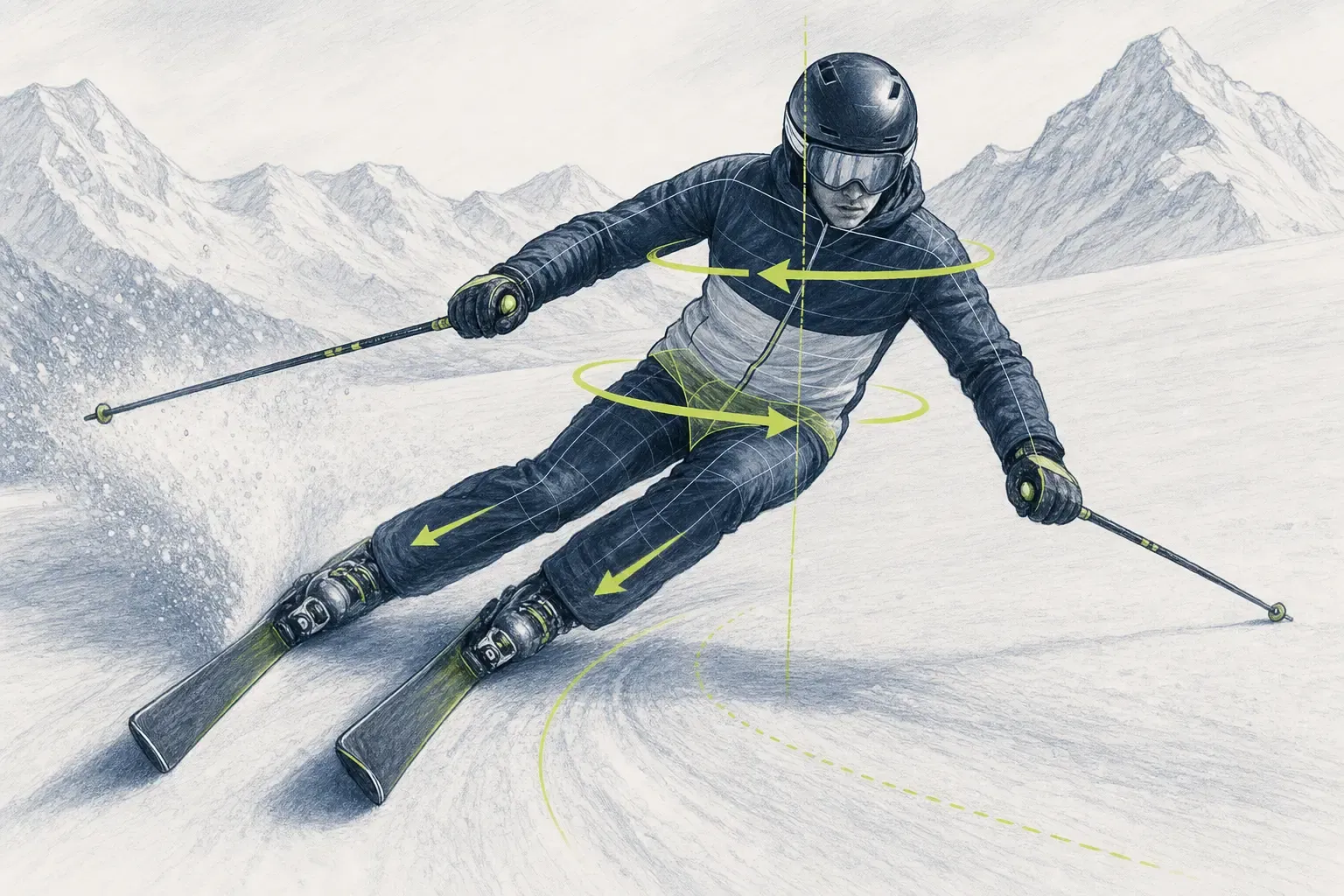
Counter-rotation (eng. counter-rotation) is a relative rotational movement of the upper and lower parts of the body around the longitudinal, approximately vertical axis in opposite directions. In skiing, it typically shows up as the feet, skis, and legs continuing to turn, while the torso stays calmer and is oriented more toward the fall line or outward from the turn. The pelvis at the same time forms a mobile link, not a firmly locked part of the torso.
It is necessary to distinguish counter-rotational movement and counter-rotational stance. Movement describes a change in the mutual orientation of the individual parts of the body. Stance is the resulting position in which the chest does not face the same direction as the skis. So a skier can be in a counter-rotational stance even at the moment when they are no longer actively performing counter-rotational movement.
The importance in the turn
When skis change direction, forces and moments act on the skier that tend to rotate the whole body with them. Appropriate counter-rotation allows the legs to work under a more stable upper body. It therefore supports rotational balance, more precise ski guidance, and readiness for the next turn. A stable torso, however, does not mean an immobile or rigidly braced torso. The upper body also makes small, well-timed movements that match the movement of the legs and the course of the turn.
The degree of counter-rotation is not the same in all turns. In short, quickly linked turns, the legs rotate and switch edges faster, so the separation of leg and torso movement is more visible. In a long carving turn, the rotational changes are slower and counter-rotation may be less noticeable. In neither case is it a goal in itself: it must correspond to the turn radius, speed, slope gradient, and the way the skis are guided.
Counter-rotation is sometimes confused with angulation. Angulation is a sideways angling of the body, through which the skier changes the inclination of body segments relative to each other and creates conditions for edging and balance. In a narrower technical sense, counter-rotation refers to rotation around the vertical axis. Both actions can occur in a turn at the same time, but they are not identical. The terminology used by individual ski schools is not completely uniform, so when explaining, the coach should always name which part of the body is moving and around which axis. Research comparing methodological systems has also recorded different strategies of upper-body rotation.
Counter-rotation in children
For beginner children, it is not appropriate to require counter-rotation as an isolated “turning of the shoulders against the skis.” First they need to master balance, a proper stance, changing direction, and more independent leg work. The separation of movement between the lower and upper body develops gradually together with coordination and the ability to guide parallel skis.
The training practice therefore usually aims to make the child:
- look ahead in time toward the next direction of travel,
- let the legs change direction under a calmer torso,
- held the hands naturally in front of the body without swinging,
- could link turns without rotating the whole body at once.
The specific task must match the child’s age, motor skill level, and the conditions on the slope. Too-complex instructions about pelvis and shoulder position can lead younger children to become stiff rather than better coordinated.
Race context
In ski racing, appropriate counter-rotation helps keep the upper body oriented toward the next section of the course while the skis finish the current turn. It is especially pronounced in slalom and in quick direction changes, where the legs work fast under a relatively stable torso. In giant slalom and speed events, movements tend to be slower and smoother; the required degree of separation depends on the line, radius, and dynamics of the particular turn.
Counter-rotated position alone does not guarantee pressure on the outside ski or clean edge control. It only creates the conditions in which the skier can better coordinate edging, pressure management, and ski direction. Biomechanical studies therefore track torso rotation together with angulation, center-of-mass inclination, and the edge angle, not as an isolated element of technique.
Typical mistakes
Rotating the whole body into the turn: shoulders, pelvis, and skis rotate as one block. By the end of the turn, the skier is often facing too far across the slope, and the transition into the next direction is delayed.
Snapping the shoulders against the skis: excessive active counter-rotation disrupts flow, makes free pelvic movement harder, and can shift attention away from the work of the feet and legs.
Locked torso: the effort to keep the shoulders quiet turns into tense, rigid posture. Functional core stability must allow breathing, arm movement, pole planting, and adaptation to the terrain.
The same position in every turn: the needed amount of counter-rotation changes. A noticeably large counter-rotated position in a long carved turn can be just as unsuitable as complete body rotation in a short turn.
Coach’s view
A coach does not assess counter-rotation from a single photo, but from how it is created, timed, and released. The main focus is the relationship between ski direction, pelvis, and chest throughout the entire turn. What matters is whether the counter-rotation arises naturally from the work of the legs under a stable torso, or whether the skier creates it with a swing of the shoulders.
Good counter-rotation is appropriate and adaptable. It allows the skier to finish one turn without the upper body losing readiness for the next. It is not about twisting the body as much as possible, but about purposeful separation of movements that changes according to the situation.
Sources and further reading
- U.S. Ski & Snowboard – Alpine Training Systems
- U.S. Ski and Snowboard Association – Level 100 Alpine Manual
- Yoon et al. – Effects of Counter-rotation Position on Knee/Hip Angulation, Center of Mass Inclination, and Edging Angle in Simulated Alpine Skiing
- A framework for measuring alpine skiing technique – PubMed
- The one-ski-method—effects of an alternative teaching approach on selected movement patterns in alpine skiing
- Analysis of the biomechanical characteristics of different swinging techniques in alpine skiing – PubMed