What is edge angle
Edge angle (English edge angle) is the angle between the plane of the ski base and the local plane of the snow surface. When the ski lies flat on level snow with its base, the edge angle is approximately zero. As the ski is tipped onto its edge, the angle increases.
The local snow surface matters, not the horizon. On cross-slope, uneven, or broken terrain, the angle cannot be reliably judged just from the skier’s position in a photo. In addition, it can vary slightly along the ski due to its flex, torsion, and snow deformation.
In this sense, it means the ski’s riding angle relative to the snow. It should not be confused with the side-edge tuning angle or with the angle of the edge off the base.
How it affects the turn
On a shaped ski, a greater edge angle usually leads to a stronger bend in the ski and, with sufficiently clean tracking, allows a smaller radius carved turn. However, there is no simple rule that doubling the angle creates a turn that is twice as sharp. The actual path is also affected by:
- sidecut, ski stiffness, and torsional properties,
- the size and distribution of load,
- speed,
- snow hardness and cohesion,
- the phase of the turn,
- the ski’s angle of attack and the amount of skidding.
Angle of attack describes the difference between the ski’s longitudinal direction and the direction it moves down the slope. A ski can therefore be tipped to a large edge angle and yet still skid significantly. High edging alone is not proof of carving or good technique.
The edge creates effective lateral support only together with appropriate loading and a suitable snow surface. On soft or broken snow, the ski may cut into or deform the surface; on hard snow, the condition of the edges, the precision of tracking, and the skier’s stability may become more noticeable.
How a skier changes edge angle
The edge angle is created by coordinated edging of the skis and lower limbs together with the movement of the whole body. In technique, the main distinctions are inclination, meaning tilting the body toward the inside of the turn, and angulation, in which the angles change mainly at the ankles, knees, and hips so that the position of the torso and legs adapts to each other.
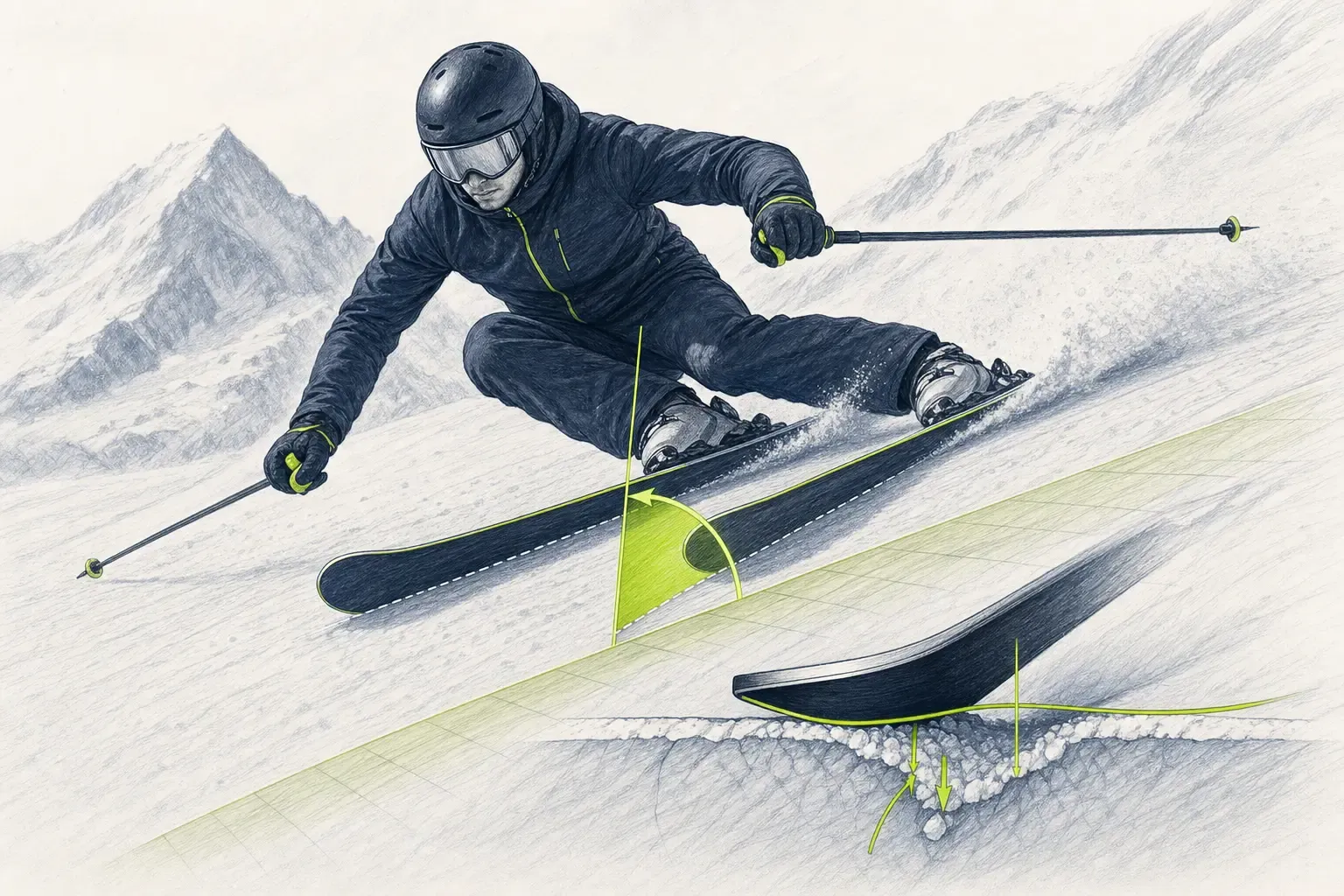
This is not about pushing the knee inward in isolation. Functional edging must remain linked to balance, ski support, and the ability to smoothly increase and decrease the angle. When transitioning between turns, the skier releases the old edges, moves through a more neutral ski position, and sets the new edges.
Children and learning
For children, it is not appropriate to set a target number of degrees or imitate the extreme positions of adult racers. Range of motion, strength, balance, and the ability to sense pressure change with age and motor development.
A beginner first learns to release and re-engage the edges safely, control skidding, and change direction on a suitable slope. Later, they can distinguish flatter and more edged ski guidance, work with support on the outside ski, and create a smoother edging phase. The tasks should match the speed, slope steepness, snow conditions, and the child’s current level.
A common mistake is trying to get the knee or hip as close to the snow as possible. Such a position may be the result of forces and a large angle in a well-executed turn, but it should not be the goal in itself. Premature or forced inclination without a created support often leads to loss of balance, overloading of the inside ski, or a sudden skid.
Race and coaching perspective
In racing, the coach does not assess only the maximum angle, but especially when, where, and how quickly the racer creates and releases it. The required progression depends on the discipline, gate setup, chosen line, speed, and the course profile. A large angle created too late may not help if the skier has already missed the proper line or has to finish the turn sharply.
The edge angle is therefore the result of solving a specific turn, not a universal measure of performance. The coach watches it together with balance over the outside ski, ski direction, the track in the snow, pressure control, and the smoothness of the transition. A narrow, clean track may indicate carved skiing; a wide track and spraying snow point to a greater share of skidding, but the track alone still does not explain all causes.
Sources and further reading
- Reid et al.: Alpine Ski Motion Characteristics in Slalom, Frontiers in Sports and Active Living
- Snyder et al.: Connected skiing – Validation of edge angle and radial force estimation, European Journal of Sport Science
- Kröll et al.: Technique-Dependent Relationship between Local Ski Bending Curvature, Roll Angle and Radial Force in Alpine Skiing
- US Ski & Snowboard: Alpine Training Systems
- US Ski & Snowboard: Level 100 Alpine Manual
- Komissarov: Mechanics of wedge turns in alpine skiing, Sports Engineering
- Komissarov: Mechanics of side-slipping in alpine skiing – theory of machining snow and ice, Sports Engineering
- Spörri and colleagues: Sidecut radius and the mechanics of turning in alpine giant slalom ski racing