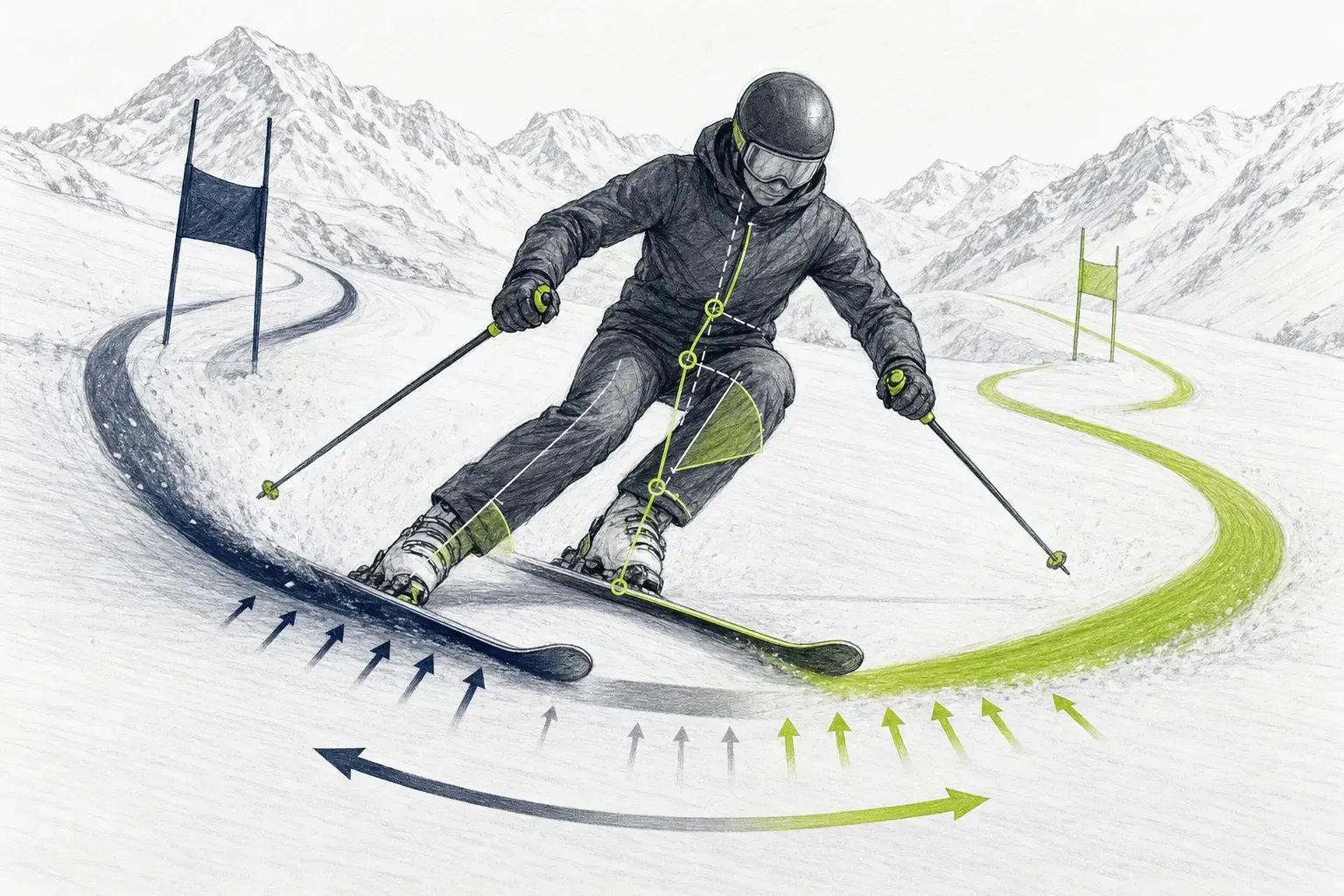
Edge change is the part of the transition between two turns in which the skier releases the edges loaded in the previous turn and tips the skis onto the opposite edges for the new turn. The skis pass through a flat position or very close to it. Edge change is not the same as the whole transition: at the same time, pressure distribution, the support leg, body position, and the direction of ski movement can also change.
What happens between turns
In linked parallel turns, the outside ski of the previous turn becomes the inside ski of the new turn and vice versa. By releasing the old edges, the skis stop creating the original side support. The skier’s movement and the skis then make it possible to set the new edges.
The edge angle is created by a combination of body inclination and angulation in the joints. The movements are coordinated especially in the ankles, knees, and hips; however, this is not about pushing the knees out to the side in isolation. The US Ski & Snowboard methodology describes edging as the result of inclination and angulation and, in technique development, emphasizes coordination of movements from the lower limbs upward.
In a normal parallel turn, the edges of both skis usually change almost at the same time. However, perfect timing symmetry is not the goal in every situation. A beginner, a child in a wedge stance, or a skier dealing with uneven terrain, loss of balance, or a tactical line change may move onto the new edges gradually. What matters is whether the way the edge change is done matches the task and allows a controlled entry into the next turn.
Practical meaning
The timing of edge change affects where and how the new turn starts. A smooth release of the old edges lets the skis move into the new direction without unnecessary braking or jerking. If the skier stays on the old edges too long, they often extend the end of the turn, get below the intended line, and then have to start the new turn abruptly. Premature or forced engagement of the new edges can, on the other hand, cause a sudden edge catch, loss of balance, or an overly early turn of the skis.
The edge angle is related to the shape and radius of a carved turn, but it does not determine the line by itself. The result also depends on ski flex and geometry, force distribution, speed, slope angle, snow conditions, and any steering or skidding of the skis. Measurements of elite slalom racers confirm the relationship between edge angle and the achieved radius, while also pointing to the importance of ski construction and ski-snow contact.
Children’s and racing context
In children, edge change develops first as the ability to release the edge, not as an effort to create the greatest possible inclination. A gentle, clear slope and a speed at which the child can experiment without fear are suitable. Exercises may include side slipping, alternating side slipping and stopping on the edges, garlands, shallow linked turns, or edge change in a marked corridor. US Ski & Snowboard uses the transition from side slipping to edging as an exercise for coordinating lower-limb rotation and edge control.
This is training practice, not a universal approach for every child. The coach chooses the terrain, speed, and task according to age, balance, experience, and the child’s ability to understand instructions. For younger skiers, a simple movement task or game is often more effective than a detailed anatomical description.
In racing skiing, edge change is assessed in connection with the line, rhythm, and linking of turns. Modern racing turns do not always have a clearly separated end and start; the movements that finish one turn overlap with the preparation of the next. The racer therefore thinks not only about how quickly they tip the skis over, but also about where their center of mass is moving, when support on the new outside ski is created, and whether the edge change supports the planned line.
A faster edge change is not automatically better. In slalom, the transition can be very short, while in a longer turn, on a wave, or during a tactical extension of the line, a calmer transition may be appropriate. Even the shortest and most direct line may not be the most efficient in terms of energy or time. In gliding sections, it is also beneficial to limit unnecessary edging, because edges and direction changes increase resistance compared with flat skiing.
Typical mistakes and misconceptions
- Holding on to the old edge: the skier continues too long across the slope and the new turn then starts late or with a sudden rotation.
- Throwing the shoulders into the new turn: The upper body replaces the work of the lower limbs, which can weaken support on the outside ski.
- Pushing the knees inward themselves: a passive position is created without proper work from the ankles and hips. The goal is not to imitate a big edge angle at any cost.
- A mandatory jump with every change: the skis can be lightened and the edges released also by smooth flexion and extension of the lower limbs; the push-off is only one option for a given situation.
- Confusing edge change with pressure transfer: these are related, but different processes. The skis may change edges before significant pressure is created on the new outside ski.
- The idea of a long ride on flat skis: the flat-ski position may be only a very brief moment in a dynamic turn, not a separate phase that needs to be deliberately prolonged.
Coach’s view
The coach does not watch only how quickly the skis roll over. They assess whether the skier released the old turn without blocking, whether the body moves into a suitable position for the new turn, whether the skis remain controllable, and whether the new outside ski can gradually build support. Tracks in the snow, video from the front and from behind, and comparison of right and left turns all help.
When correcting technique, it is usually best to change the terrain, speed, or turn shape first and only then add more verbal cues. The goal is not one mechanically identical edge change, but the ability to adapt its timing and extent to the terrain, speed, and intended line.
Sources and further reading
- US Ski & Snowboard – Alpine Training Systems
- US Ski & Snowboard – Level 100 Alpine Manual
- US Ski & Snowboard – Straight Run to Sideslip to Edge Set with Pole Plant
- Reid et al. – Alpine Ski Motion Characteristics in Slalom, PubMed
- Federolf et al. – Impact of Skier Actions on the Gliding Times in Alpine Skiing, PubMed
- Supej – Differential Specific Mechanical Energy as a Quality Parameter in Racing Alpine Skiing, PubMed
- Komissarov – Balanced Carving Turns in Alpine Skiing, PubMed
- Spörri et al. – Course Setting and Selected Biomechanical Variables Related to Injury Risk, PubMed