What the basic ski stance is
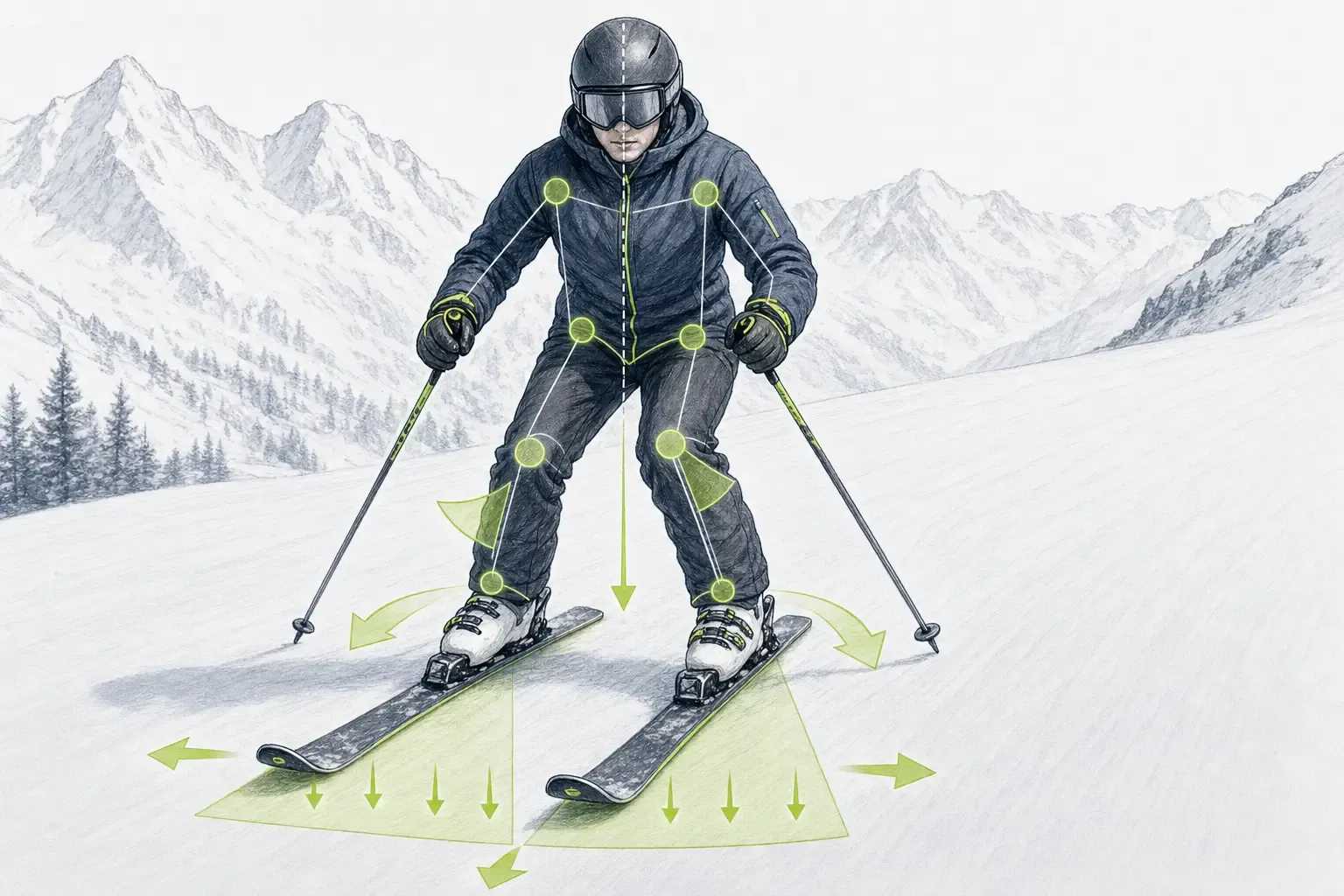
Basic ski stance is a balanced, movement-ready body position above the skis. The ankles, knees, and hips are appropriately flexed, the torso stays naturally upright, the hands are comfortably in front of the body, and the gaze points forward. The skier stands over the support area formed by the feet and skis in a way that allows movement forward and back, side to side, and rotation of the lower limbs.
It is not one exact silhouette that applies to everyone. Professional teaching methods also use the term athletic stance and emphasize its adaptability. The body position changes continuously while skiing according to speed, slope steepness, terrain, the phase of the turn, and the forces arising between the skis and the snow.
How to recognize the stance
In calm gliding on a gentle slope, a functional basic stance usually has these features:
- the skis run steadily and without unnecessary crossing;
- the ankles, knees, and hips are flexible, not locked;
- body weight is not constantly pushed onto the heels or forcibly shifted onto the toes;
- the pelvis and torso remain above the support area and allow further movement;
- the head is lifted and the skier watches the direction of travel;
- the hands are naturally in front of the body, not pressed to the sides or raised in tension;
- the whole body looks ready to react, not stiff.
The term balanced or centered stance does not mean that the pressure must be the same on both skis throughout the whole turn or evenly distributed along their entire length. When turning, the relationship of the center of gravity to the skis changes, and the pressure shifts between the skis and along them according to the task. In many turns, the outside ski is loaded more strongly.
Importance for children’s skiing
A child needs a stance from which they can move, keep balance, and react safely. Simply copying a “correct pose” is not enough. In practice, the stance is developed mainly through skiing in suitable terrain, changes in body position, gliding, shifting balance between the skis, and simple movement tasks.
Instructions must match the child’s age, experience, and motor level. For a younger skier, a short image or movement game usually helps more than a detailed description of angles in individual joints. The terrain should be easy enough that the child does not have to save balance with fear, leaning back, or tense braking.
Equipment can significantly affect the stance. Improper size or stiffness of ski boots can limit ankle movement and make balanced standing more difficult. Assessment of boot suitability, its settings, and bindings belongs to a qualified specialist; the coach should not replace servicing or the manufacturer's instructions.
Typical mistakes and misunderstandings
A common mistake is backward lean: the pelvis moves behind the feet, pressure shifts mainly to the heels, and the skier loses the ability to guide the front of the skis precisely. The opposite extreme is forcing the torso forward without adequate movement in the ankles and legs.
Other problems include too deep a squat, straight and stiff legs, looking at the tips of the skis, hands by the hips, or trying to maintain one fixed position throughout the turn. Bent knees alone do not create the correct stance. What matters is coordination of the whole body and the ability to keep balance while moving.
Coach’s view and race context
The coach does not assess the stance just from a photo. They watch whether the skier can smoothly edge and turn the skis from it, regulate pressure, transfer from one ski to the other, and react to uneven terrain. What matters is the way the skis move on the snow, not a mechanical copy of the body’s outer shape.
Even in racing, the foundation remains an adaptable athletic stance. Slalom, giant slalom, and speed disciplines place different demands on range of motion, upper-body stability, and pressure control. A racer therefore does not abandon the basic stance, but continually adjusts it according to the course, speed, and phase of the turn.
Sources and further reading
- U.S. Ski & Snowboard – Athletic Stance, Basic Skiing Drill Plan
- U.S. Ski & Snowboard – Alpine Level 100 Manual
- U.S. Ski & Snowboard – Athlete Performance Profile
- U.S. Ski & Snowboard – Alpine Level 300 Slalom Technique and Tactics
- PSIA-Rocky Mountain – Alpine Assessment Guide 2025–26
- PSIA-Rocky Mountain – The Skills Concept and Skiing Fundamentals