What Is the Ski Edge
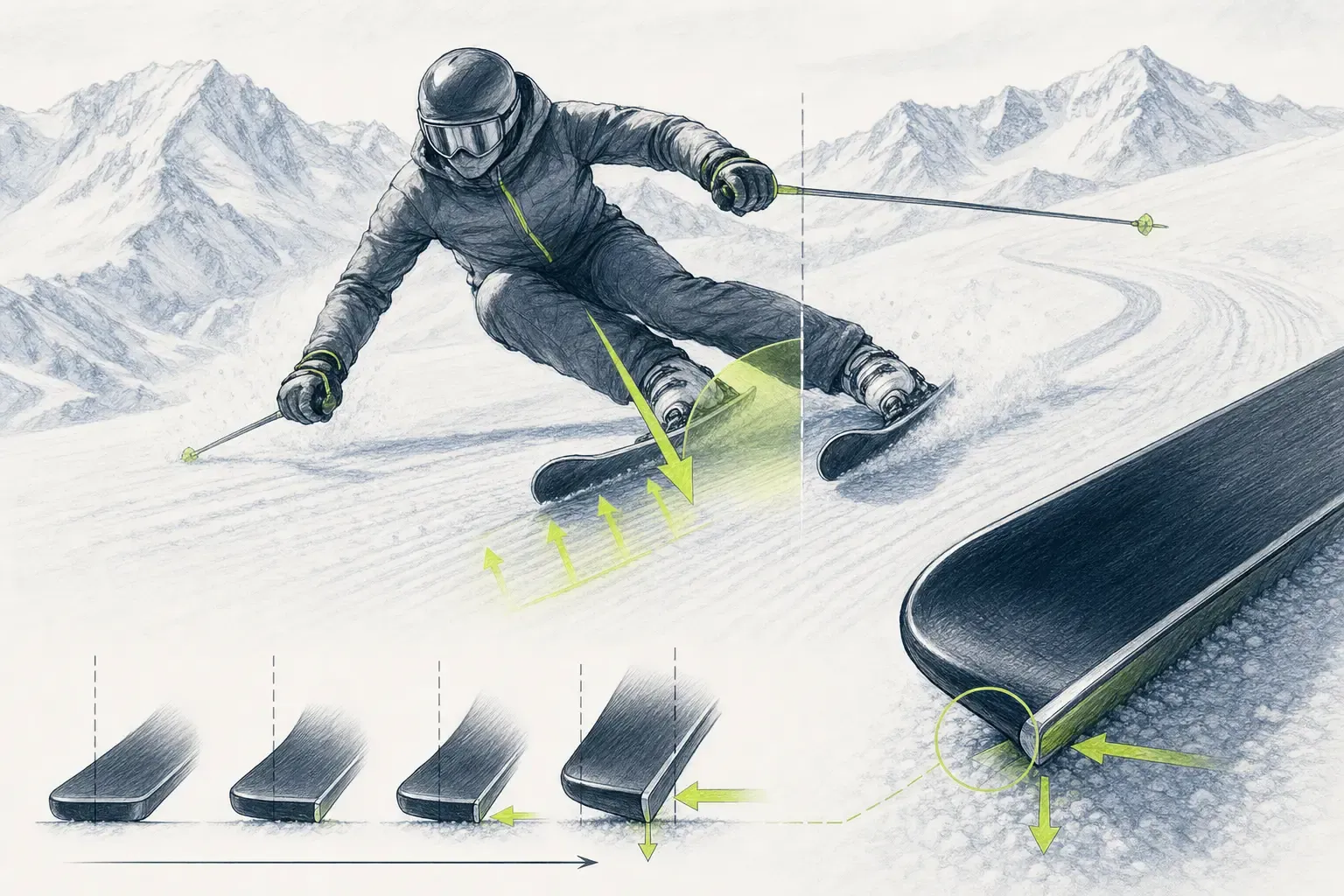
Ski Edge is a narrow, usually steel strip running along both sides of the base. It forms the interface between the ski and the snow, especially when the ski is tilted. It makes side support possible, helps guide the turn, controls skidding, and stops the ski. On hard or icy snow, its condition is much more noticeable than in soft snow.
Every ski has two edges. In a regular parallel turn, the outside ski relies mainly on its inside edge and the inside ski on its outside edge. The degree to which the ski is tilted relative to the snow is called edge angle (edge angle). The movement by which the skier engages, releases, or changes the angle of the edges is called edging.
How the Edge Works
On a flat ski, the base slides more easily sideways too. As the ski is gradually tipped, the edge begins to bite more into the surface and limits side slip. The result depends on several factors:
- edge angle,
- pressure and how it is distributed along the length of the ski,
- speed and the shape of the turn,
- the hardness and structure of the snow,
- sidecut, flex, and torsional stiffness of the ski,
- the sharpness and evenness of the edge.
In a carved turn, an edged and loaded ski follows a track with limited side slip. In a skidded turn or sideslip, the skier intentionally works with a smaller angle and less edge support. Skidding is therefore not automatically a mistake. It is an important way to control direction and speed.
Children and Learning to Edge
A beginner does not need the largest possible edge angle. First, they must learn to keep their balance, release the skis, sideslip safely, and gradually change how the skis stand on the snow. Suitable exercises, depending on age and level, include controlled sideways slipping, stopping on the edges, or alternating between flat and slightly edged skis on a safe slope.
The coach watches whether the child tips the skis with a coordinated movement of the lower limbs while staying balanced. Trying to create an edge only by pushing the knees inward often leads to an unstable position. It is also unsuitable to lean the whole body too much without enough support on the outside ski. The specific drill, slope gradient, and speed must match the child’s motor development, not just their age.
The Edge in Racing Skiing
A racer needs to time the release of the old ski edge, the transition, and the smooth creation of a new edge angle precisely. Setting the edge too early or too abruptly can upset balance and direction of travel; setting it too late often leads to slipping and loss of height in the course. A large angle by itself is not the goal. It should be the result of the right line, balance, movement, and the forces acting in the turn.
The FIS regulates competition equipment and the dimensions of racing skis in separate specifications. However, these rules cannot be used as a general guide for tuning children’s skis. Service settings are chosen according to the ski, discipline, conditions, and the racer’s level in cooperation with a coach or technician.
Edge condition and service
In servicing, edge work is distinguished between the base side and the side edge. Numeric angle labels may not be recorded in the same way across different service systems, so it is necessary to know what a particular figure means. Improper filing can change a ski’s riding characteristics or remove material unnecessarily.
Typical problems are:
- a rounded or unevenly worn edge,
- a sharp burr after contact with a rock,
- rust after storing wet skis,
- different tuning of the left and right ski,
- an edge that is too aggressive for the child’s ability and the conditions.
Sharp edges can cause cut injuries. The FIS specifically cites the risk of edge-related injuries as a reason for using cut-resistant protective clothing in top-level competitions. When carrying and servicing skis, the edges must be handled carefully. Sharpening racing skis or heavily damaged children’s skis belongs to qualified service.
Coach’s view
Good edge work is not a synonym for constant carving. A young skier should know how to create an edge, apply it in a controlled way, and release it. The coach therefore evaluates not only the track in the snow, but also balance, timing, smooth movement, and the ability to adapt edging to the terrain and speed.
Sources and further reading
- FIS – Specifications for Alpine Competition Equipment 2026/27
- FIS – Alpine Skiing Documents: International Competition Rules and current documents
- FIS – Alpine Meeting: Athlete Safety and Season Outlook
- U.S. Ski & Snowboard – Alpine Coaching Dictionary
- U.S. Ski & Snowboard – Side Slip With Edge Set
- U.S. Ski & Snowboard – Straight Run to Sideslip to Edge Set with Pole Plant
- U.S. Ski & Snowboard – Level 100 Alpine training resources