What Is Edge Angle
Edge Angle describes how much the ski is tilted relative to the local snow surface. In practice, it is the angle between the base of the ski and the snow surface, viewed across the ski. When the ski lies flat, it is roughly zero; tilting the ski onto the inside or outside edge increases it. In ski terminology, the terms edging angle or edge engagement angle.
are also used.
Edge angle is not a fixed position. During the turn, it changes smoothly: in the transition between turns, the skis usually move closer to a flat position, then they are set onto new edges, the angle increases, and before the next transition it decreases again. Each ski can have a different angle at the same moment.
This term should not be confused with the edge-grinding angles used in service. Service angles describe the geometry of the steel edge and the base; the edge angle while skiing describes the ski's immediate position relative to the snow.
Meaning in Turn Control
By tipping the ski, the steel edge grips the snow and the shaped ski can bend into an arc under load. In a clean carved turn, a larger edge angle usually allows a smaller turning radius. However, this is not a simple rule of “the bigger the angle, the shorter the turn.” The outcome is also affected by sidecut, the ski's longitudinal and torsional stiffness, its load, speed, snow hardness, and the angle between the ski's direction and its direction of travel.
A ski can therefore skid even at a fairly large edge angle. Conversely, a well-guided and appropriately loaded ski can carve a turn without strikingly extreme tipping. Edge angle is one condition for carving, not its only sign.
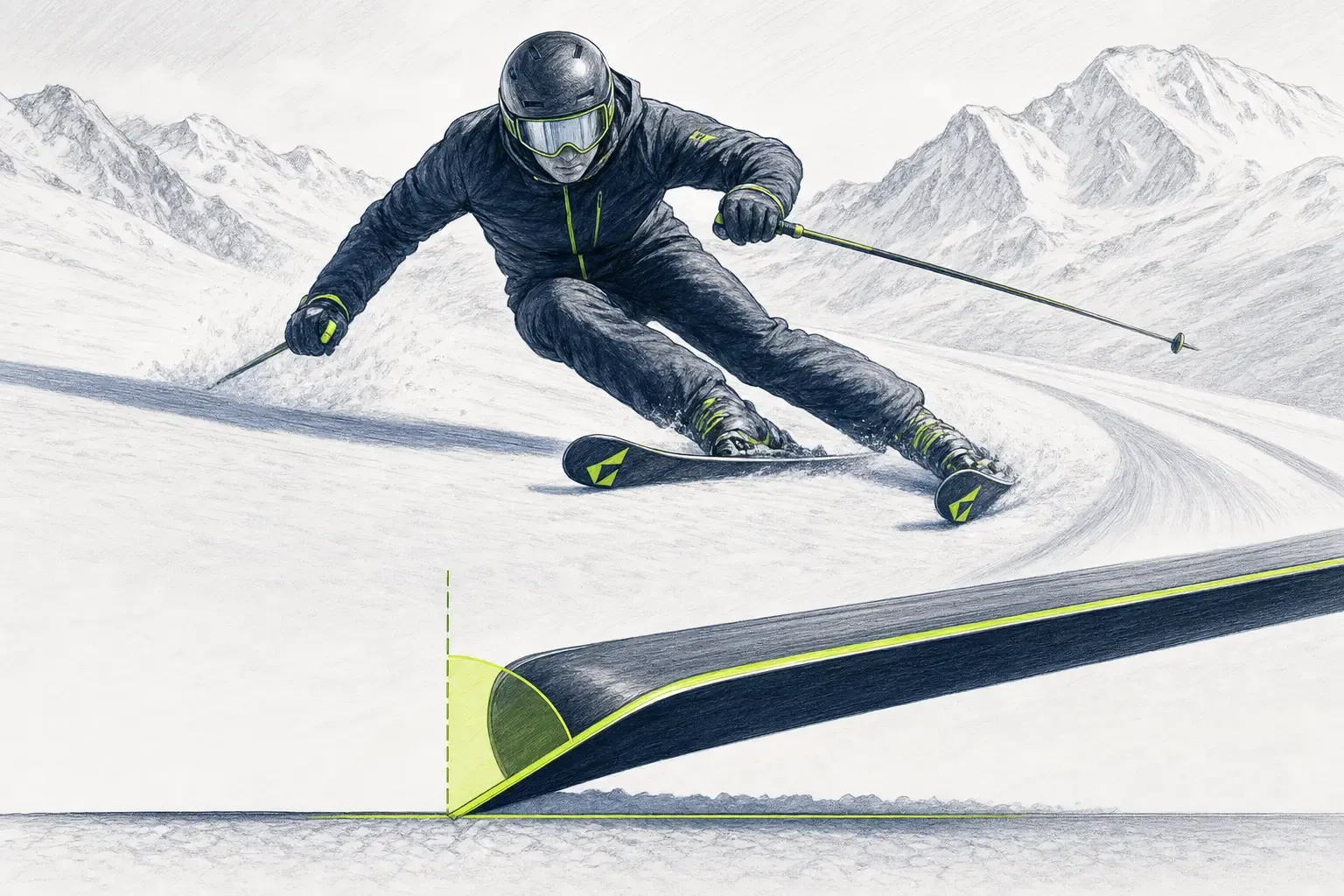
Edge Angle – technical illustration Ski Loko
Children and Training Practice
For beginners, the goal is not to achieve the largest possible angle. A child first learns to recognize the difference between a ski lying flat and a ski set on edge, to change edges at low speed, and to keep balance. In a wedge turn, the edge angle of the outside ski increases, while the inside ski may be guided more flatly. In training practice
the difficulty is increased gradually: from simple edging on a gentle slope, through smooth edge changes, to earlier and more dynamic angle building in a sport turn. The appropriate level depends on age, motor skills, speed, terrain, and equipment. A single value in degrees is not a suitable universal goal for children's training.
A young skier should not create an apparently large angle just by falling the torso inward into the turn. What matters is support on the skis, mobility in the ankles, knees, and hips, and the ability to regulate pressure. Body position and ski angle are related, but they are not the same thing.
Racing Skiing
In racing skiing, attention is paid not only to the maximum angle, but especially to its development and timing in relation to the gate, the fall line, and the action of forces. A study of elite skiers on model slalom courses on a slope with an incline of 19° recorded maximum outside-ski angles of approximately 66° and 71° at two different gate spacings. These are results of a specific measurement, not a technical standard or a target for children. Copying such values without the corresponding speed, balance, and strength has no training value.,
- A larger edge angle is always better. Not necessarily; it must match the situation and the required turn shape.
- A large edge angle automatically means carving. If guided incorrectly or loaded improperly, the ski can slip sideways.
- The angle should be maintained through the turn. Purposeful edging is dynamic and also includes releasing the edge in time.
- Body angle and ski angle are the same. A skier can change the ski angle through joint movements without tilting the whole body by the same amount.
- Edge angle refers to the way the edge is sharpened. In movement analysis, it means the ski’s position relative to the snow, not the service geometry.
From a coach’s point of view, edge angle is useful only in connection with balance, ski track, pressure control, speed, and the intent of the turn. What matters above all is whether the skier creates it smoothly, in the right part of the turn, and without losing support or the ability to safely start the next turn.
Sources and further reading
- U.S. Ski & Snowboard – Alpine Training Systems
- U.S. Ski & Snowboard – Level 100 Alpine Manual
- PSIA-Rocky Mountain – Alpine Assessment Guide 2025–26
- Alpine Ski Motion Characteristics in Slalom – Frontiers in Sports and Active Living
- Technique-Dependent Relationship between Local Ski Bending Curvature, Roll Angle and Radial Force in Alpine Skiing
- Mechanics of Wedge Turns in Alpine Skiing – Sports Engineering
- Connected Skiing: Validation of Edge Angle and Radial Force Estimation as Motion Quality Parameters during Alpine Skiing
- Joint Motion and Reacting Forces in the Carving Ski Turn Compared with the Conventional Ski Turn