What is course rhythm
Course rhythm is the way turns and changes of direction follow one another while skiing. It comes from the spatial layout of the gates, but it appears in time: between individual turns, the skier has a certain amount of time to release the skis, move through the transition, set up the new turn, and build the needed pressure.
Rhythm is not the same as gate spacing. Two sections with a similar distance between turning poles can feel completely different if they differ in lateral offset, pitch, speed, or a terrain break. Nor can one automatically say that a greater distance means a slower rhythm: in a more open and faster section, the skier can move between gates in very short time intervals.
In coaching language, rhythm and tempoare sometimes distinguished. Rhythm describes the arrangement of turns and their mutual relationship, while tempo refers more to their frequency. In practice, the two terms overlap.
What creates rhythm
The biggest influences are:
- the distance between the next turning poles or gates,
- the lateral offset of the gates from the fall line,
- the alternation of more open and more closed turns,
- slalom combinations and offset gates,
- changes in pitch, terrain waves, or side slope,
- the speed gained in the previous section,
- the condition and profile of the course surface.
A regular rhythm contains a longer sequence of similarly sized and similarly timed turns. A change in rhythm happens when the next gate requires an earlier or later turn initiation, a bigger change of direction, a faster edge change, or a different line. The change may be gradual, for example when entering a steeper slope, or sudden - typically before a combination, after a terrain break, or with a noticeably shorter or more open spacing.
Current FIS rules regulate gate dimensions, allowed distances, combinations, and other course-setting parameters according to the discipline. Rhythm itself, however, cannot be reduced to a single number; it emerges from the combined effect of geometry, terrain, and speed. In competition, you must always start from the current edition of the International Competition Rules and the relevant national regulations.
Reading the rhythm during inspection
A racer should not perceive each gate in isolation. During inspection, the course is broken into shorter sections and you look for:
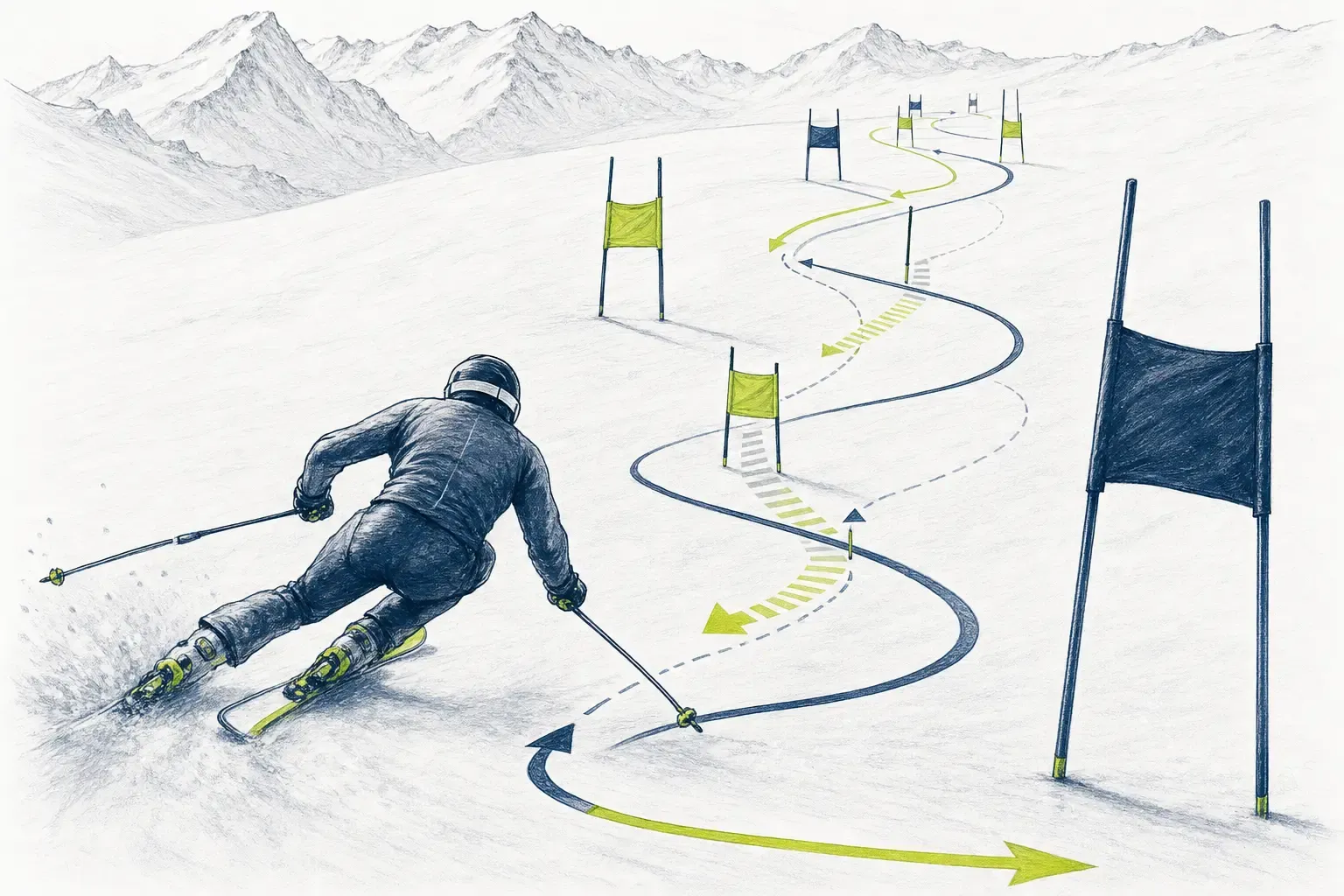
- where the rhythm stays steady,
- where the spacing tightens or opens up,
- where to start the turn earlier,
- where speed will build,
- what comes after a crest or terrain break,
- which gate sets up the approach into a combination or a difficult section.
What matters is not only the problematic gate, but also the one or two gates before it. If a skier starts reacting only at the turning pole, it is often too late: they end up below the ideal line, have to brake hard, or miss the next turn. Good course setting should test the racer’s line choice and technique, not leave them guessing the direction. The U.S. Ski & Snowboard rules and course-setting guidelines therefore emphasize course rhythm and a clear preferred line.
While skiing, rhythm is not maintained by mechanically repeating the same movement. The skier must look ahead on the course and adjust the length of the transition, the point where the turn starts, and the pressure they apply. Smoothness does not mean every turn is the same.
Children’s and training context
For children, the rhythm must match their technical level, experience, speed, and ability to orient themselves in space. Federation methods therefore distinguish course setting according to developmental stage and age category; one course model does not suit everyone.
A beginner in gates first needs sufficiently long sections with a clear, regular rhythm. This lets them focus on linking turns, looking ahead, and maintaining a stable line. Later, one clear change of rhythm can be added and more stimuli gradually combined. U.S. Ski & Snowboard coaching materials work with regular sections as well as intentionally more demanding rhythm changes, always according to the training goal and the athlete’s level.
There is no universal rule for the number or spacing of gates. Course setting belongs in the hands of a qualified coach who knows the slope, the conditions, and the group. At higher speeds, they must also respect the course safety plan and the valid rules.
Typical mistakes and misunderstandings
- Rhythm is only the distance between gates. Offset, terrain, speed, and the linking of turns also matter.
- A smooth course must not change rhythm. A quality course can include changes of rhythm and still have a logical flow.
- Each gate must be handled separately. The line through one gate sets up the next section.
- The same movement works on the entire course. Changing rhythm requires adjusting timing, direction, and movement intensity.
- A child only learns rhythm by repeating one course. It also needs appropriate variation in spacing, terrain, and speed so it learns to perceive the relationships between gates.
Coach’s view
When it comes to rhythm, the coach does not only watch whether the child hit the gates. They also notice whether the child prepares in advance, links turns without unnecessary corrections, recognizes the change, and can rejoin the course after a mistake. More useful than the general instruction “find the rhythm” is specific feedback: for example, that the spacing is getting shorter, the next gate requires an earlier turn initiation, or that the approach into the whole section is decisive.
The goal is not to teach a young skier one fixed cadence. The goal is to develop the ability to recognize the rhythm, anticipate its change, and adapt technique and line to it.
Sources and further reading
- FIS – Alpine Skiing Documents: International Competition Rules, edition published in 6. 2026
- U.S. Ski & Snowboard – Alpine Training System: Course Setting Recommendations
- U.S. Ski & Snowboard – Alpine Course Setting, training material
- U.S. Ski & Snowboard – Alpine Officials’ Manual: The Racecourse
- U.S. Ski & Snowboard – Alpine Course Setting Specifications 2023/24
- U.S. Ski & Snowboard – Alpine Competition Officials Education Resources, 2026 Alpine Officials Manual