Definition
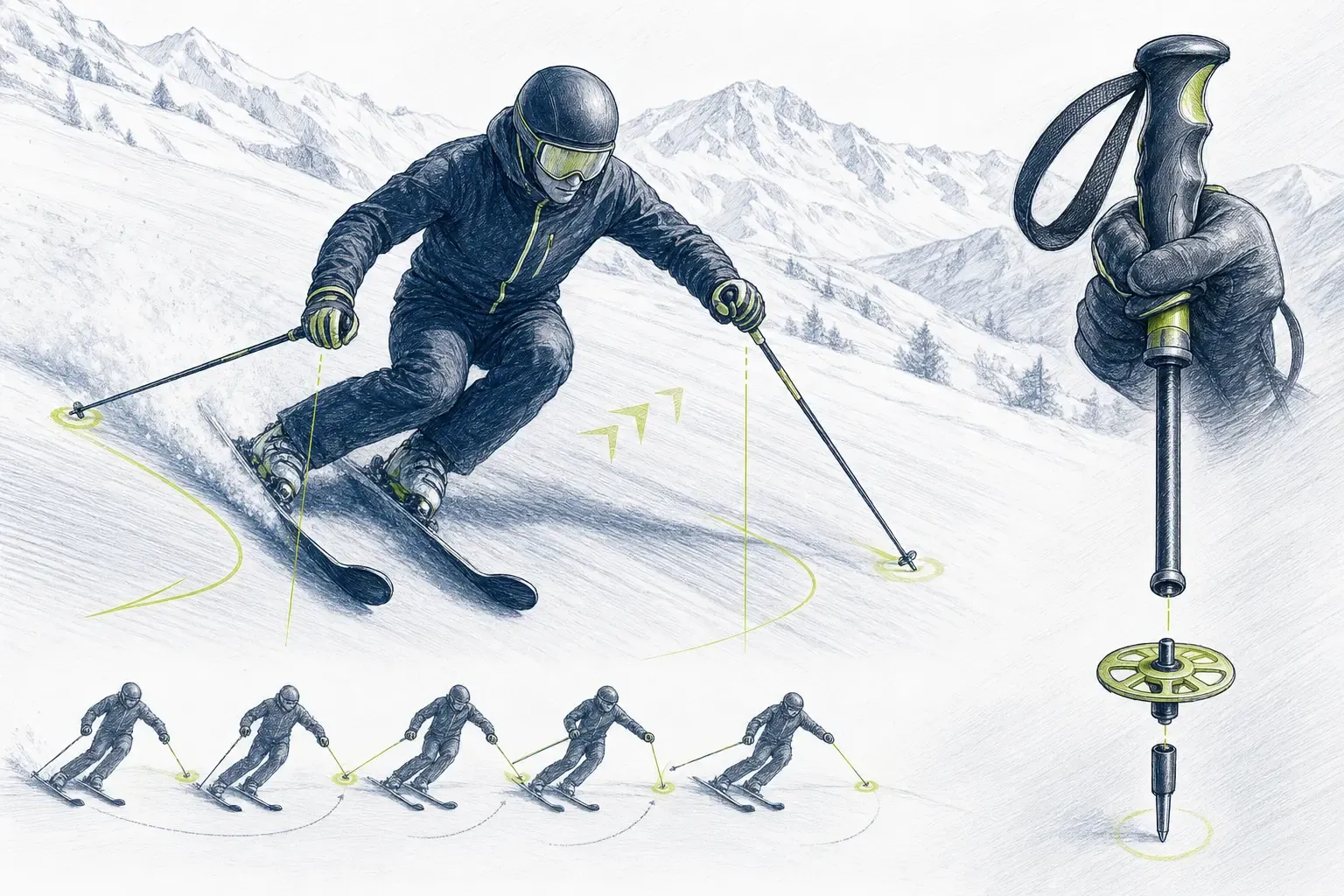
Ski poles are part of the equipment that helps a skier with balance, rhythm of movement, pushing off, and moving on flat ground. In its competition equipment specifications, FIS describes them as an aid that makes skiing and keeping balance easier. A pole consists mainly of a grip, strap or release system, shaft, basket, and tip.
Practical importance
In alpine skiing, poles serve several roles. A push-off makes starting, moving on flat ground, or getting up after a fall easier. Brief contact between the pole and the snow can support the timing and rhythm of linked turns, especially in short turns, on steep slopes, and in uneven terrain. In a long carved turn, the pole plant is usually less pronounced and sometimes shows only as a hand movement or a light touch on the snow.
However, a pole should not replace a balanced stance. If a skier leans on the poles, plants them far in front of the body, or swings them strongly from the shoulder, it can disturb torso position and smooth ski control.
Choosing length and design
A common practical check is to turn the pole handle down to the ground and hold it just below the basket. The forearm should be roughly horizontal and the elbow should form about a right angle. This is a practical aid, not a competition rule. The result is affected by the height of ski boots, body proportions, technique, and intended use. Poles that are too long may force the skier to raise a shoulder or plant the pole far from the body. Poles that are too short make an effective push-off harder and can encourage unnecessary lowering of the torso. For a child, the grip diameter should also be checked: they should be able to hold it naturally with a glove without a cramped grip.The basket prevents the pole from sinking in too deeply. Smaller baskets are commonly used on groomed slopes, larger ones in soft snow. In competition equipment, FIS bans metal baskets because of the risk of injury; this rule belongs to racing regulations and is not a guide for judging every recreational pole.
Poles in teaching children
A beginner does not have to get poles right away in the first stage of instruction. Skiing without them can make it easier for a child to focus on the basic stance, balance, braking, changing direction, and standing up independently. However, there is no single age limit that is right for all children. Motor skills, ski control, terrain, and the purpose of a particular exercise all matter.
Ski poles – technical illustration by Ski Loko
Once poles are introduced, the child first learns to carry them safely, keep the hands in front of the body, and use the push-off on flat ground. Planting the pole in a turn should come gradually. The coach can alternate skiing with and without poles so the pole supports rhythm but does not become a support that the technique depends on.
Racing skiing
In slalom, plastic hand and knuckle guards are commonly mounted on poles because the racer actively brushes against the slalom gates. The guard must be compatible with the grip and properly secured. In giant slalom and speed events, shaped poles are also used, as they follow the body better in a downhill stance. This is discipline-specific practice, not a universal requirement for children’s races.
In competitions, the current FIS rules, national rules, and the regulations of the specific event must be followed. FIS published the current international alpine rules for the 2026/27 season in July 2026.
Typical mistakes and the coach’s view.
Typical mistakes and the coach’s view.
Typical mistakes and the coach’s view.
The most common mistakes are an unsuitable length, arms hanging behind the body, a wide arm spread, a big swing from the shoulder, and planting the pole too late. Before skiing, check for a loose grip, a damaged strap, a missing basket, a bent or cracked shaft, and a dangerously damaged tip.
The coach does not only watch whether the child planted the pole. More important is whether the movement comes from a suitably relaxed arm, supports the rhythm, and does not disturb balance. The right pole is one that a young skier can control safely and that helps them solve a specific movement task.
Sources and further reading
- FIS – Alpine Skiing Documents: current international rules and documents
- FIS – Specifications for Alpine Competition Equipment 2026/27
- FIS – Specifications for Alpine Competition Equipment 2025/26, Ski poles chapter
- FIS – General Regulations and Code of Conduct for Skiers and Snowboarders
- ISO 7331 – Ski poles for alpine and touring skiing: requirements and test methods
- REI Co-op – How to Choose Ski Poles