What skis are
Skis are paired sports equipment that connects a ski boot to the snow through bindings. They allow gliding, edge support, changes of direction, and speed control. In downhill skiing, skis, bindings, and boots form one functional unit; an unsuitable combination can make control difficult as well as proper binding adjustment.
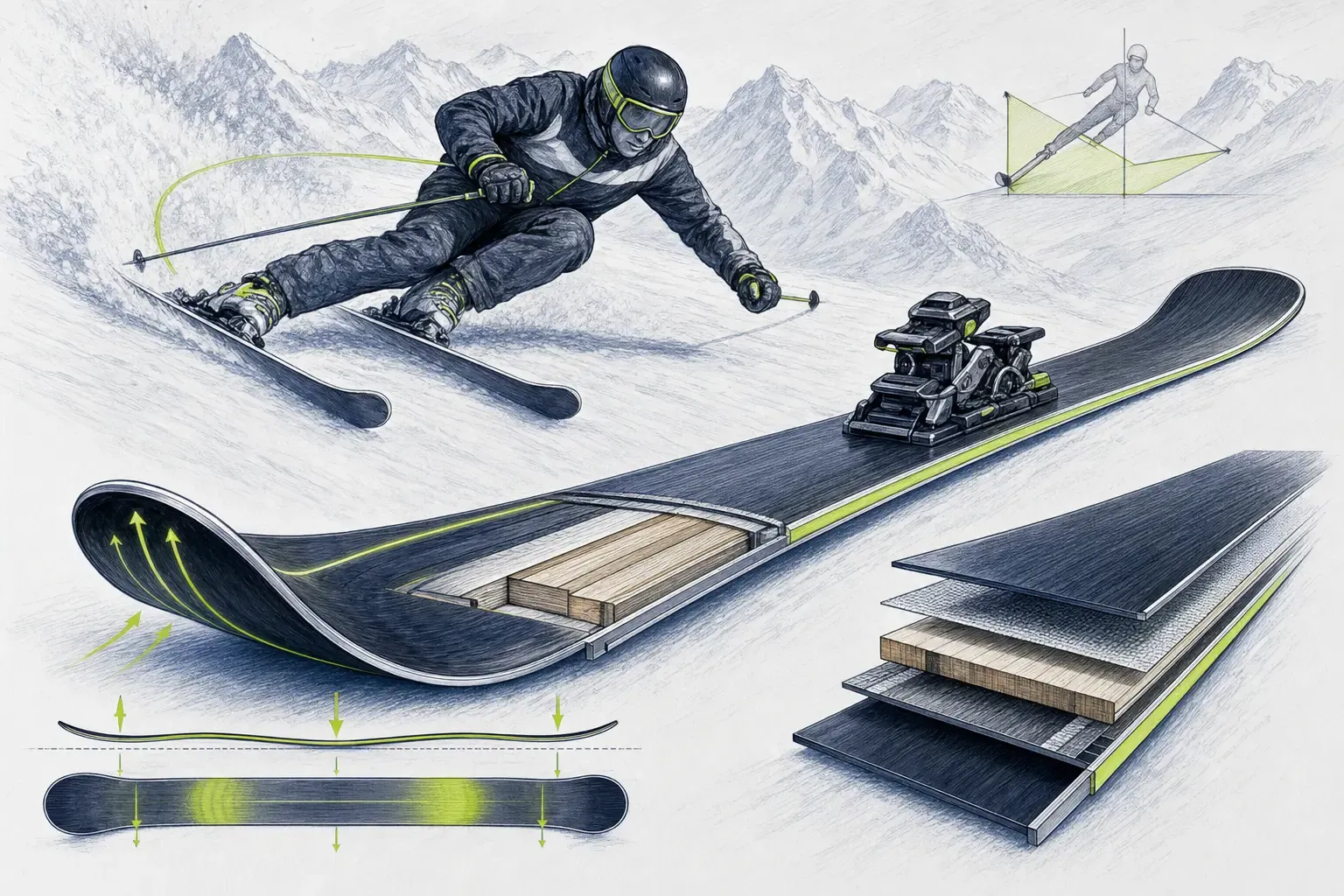
The basic parts of a ski are the tip, the waist or midsection, the tail, the base, steel edges, and the internal supporting construction. The specific materials and layering differ from model to model. The core and other structural elements mainly affect longitudinal flex, torsional stiffness, damping, and the transfer of force to the edges.
Ski geometry and behavior
Length affects handling, the contact area with the snow, leverage, and stability. However, a longer ski is not automatically faster or better, and a shorter one is not automatically safer. The result also depends on stiffness, sidecut, profile, the skier’s weight, speed, and snow quality.
Sidecut is the difference between the width of the tip, waist, and tail. From this geometry comes the ski’s nominal radius, often marked with the letter R. The nominal radius is a design specification, not a promise that every turn will be the same size. The actual turn shape is influenced by edging, ski flex, skier pressure, speed, surface, and the way the turn is carved.
Longitudinal flex determines how easily the ski bends. Torsional stiffness expresses resistance to twisting and relates to the ability to keep the edge engaged along the length of the ski. A stiffer ski may feel more precise under higher load, but a light or less technically advanced child may not be able to flex and guide it properly.
A ski’s profile can include traditional camber under the binding and an earlier rise of the tip or tail, called rocker. The profile affects turn initiation, the length of effective edge, and behavior in different kinds of snow. However, the name of a technology alone does not say whether a ski is suitable for a particular child.
Children’s skis
When choosing children’s skis, there is no single reliable rule such as “to the chin” or “to the nose.” Such a guideline can serve only as a first point of reference. The following should be considered in particular:
- the child’s height and weight,
- strength, coordination, and motor development,
- current technical level,
- the speed and terrain where the child skis,
- the purpose of the skis – lessons, recreational skiing, or race training,
- the stiffness and specific construction of the model.
In training practice, beginners are usually given an easier-to-handle ski of an appropriate length and flex. The goal is not the biggest possible reserve “to grow into,” but equipment that lets the child independently change direction, stop, control speed, and repeat movements without undue fatigue. A ski that is too long or too stiff can encourage leaning back, turning the whole body, and pushing the skis sideways instead of actively guiding them.
Children’s skis should be changed not only according to height. A significant change in weight, strength, technique, or training focus can also be a reason. The right choice depends on the child’s real behavior on snow, not on the number printed on the ski itself.
Race skis
Race skis are designed for a specific discipline. Slalom models are usually shorter and have a smaller nominal radius, while giant slalom and speed skis are longer and have a larger radius. They also differ in construction, stiffness, and the demands placed on edge and base preparation.
FIS sets the parameters of competition equipment through separate specifications. The rules valid for the 2026/27 season, effective from July 2026, distinguish between discipline, gender, competition level, and, for selected provisions, also the U14 and U16 categories. They track, for example, ski length, radius, and profile dimensions. Specific limits therefore cannot be replaced by a general table in the glossary; before a race, they must be checked in the current FIS rules, the national federation regulations, and the competition invitation.
Using a race ski just because older or stronger racers use it is not the right approach. The move to a longer, stiffer, or discipline-specific model should be based on the child’s technical readiness, physical development, and training program.
Ski condition and service
The quality of skiing is also affected by the condition of the equipment. The edges must be free of serious damage, and the base should be reasonably flat, clean, and maintained. Uneven damage to the left and right ski can change how they behave. Loose edges, cracks, layer separation, or damage in the binding area are reasons for professional inspection.
Mounting the bindings, checking compatibility, setting release values, and performing more serious repairs should be done by qualified service staff according to the manufacturer’s documentation. The coach may determine the required character of edge and base preparation, but should not replace the manufacturer’s service procedures or safety rules.
Typical misconceptions
- “The child will grow into the skis.” Excessive length can slow learning precisely during the period when basic movement habits are being formed.
- “A smaller radius means the ski turns by itself.” Guiding an arc still requires balance, edging, proper pressure, and the work of the whole body.
- “A race ski automatically improves technique.” A more demanding ski will more likely expose shortcomings if the child cannot flex it and apply pressure precisely.
- “It is enough to choose by age or height.” Two children of the same height may need different skis because of different weight, strength, and experience.
- “One pair of skis is the same for all disciplines.” In teaching, versatility can be an advantage, but race disciplines place different technical and rule-based demands.
From a coach’s point of view, the right ski is one that allows the child to complete the current training task safely and repeatedly. The equipment should support technical development, not get ahead of it.
Sources and further reading
- FIS – Alpine Skiing Documents: current international alpine skiing rules and documents
- FIS – Specifications for Alpine Competition Equipment 2026/27, document page
- FIS – Specifications for Alpine Competition Equipment 2025/2026, full technical specifications
- U.S. Ski & Snowboard – Rules & Equipment
- U.S. Ski & Snowboard – Alpine Equipment and Course Setting
- U.S. Ski & Snowboard – Alpine Equipment Regulations
- U.S. Ski & Snowboard – Alpine Membership Rules and current competition resources