What Is the Ski Waist
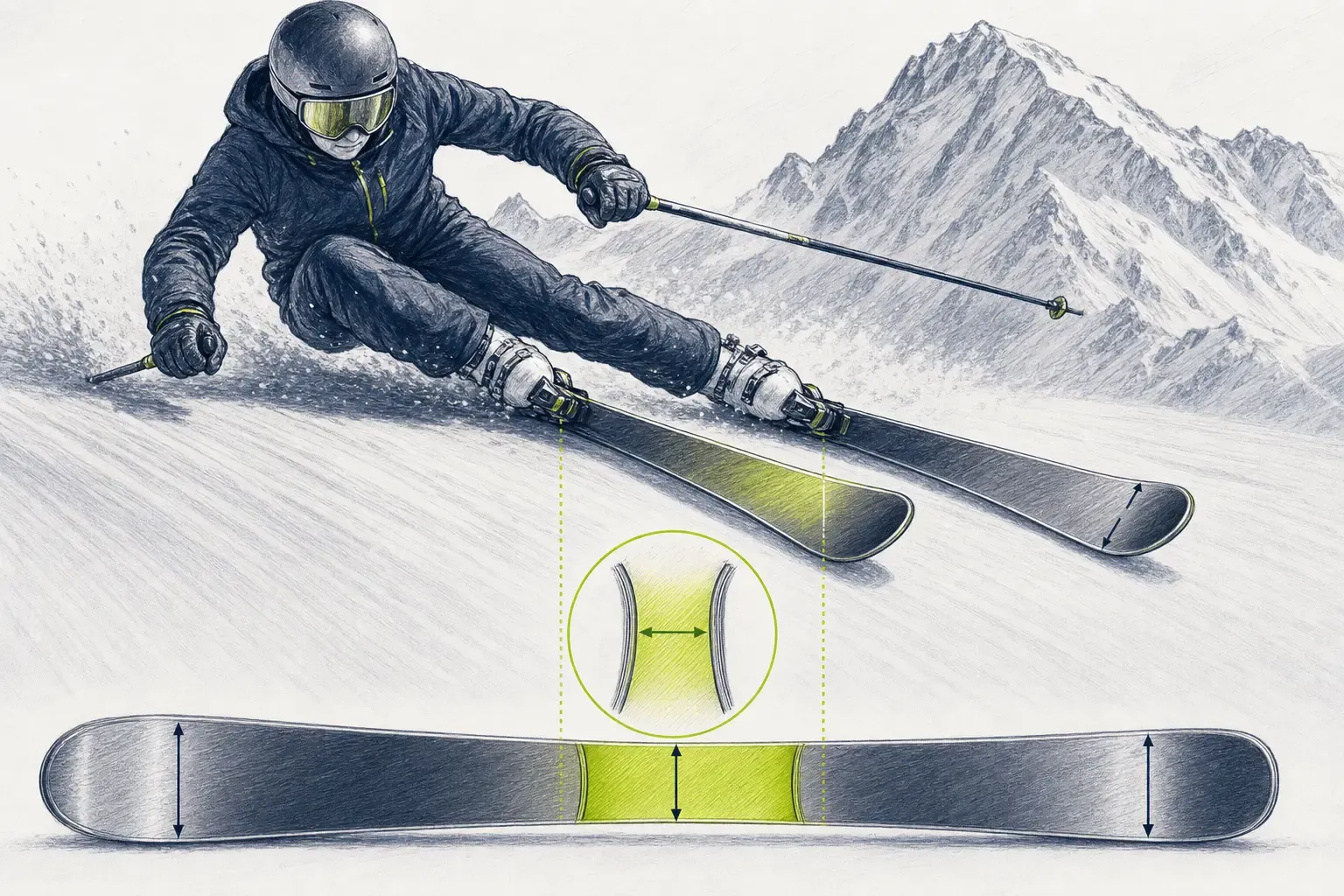
Ski Waist is a general name for the middle part of a ski, but its exact meaning depends on the context. In a technical description of geometry, it most often means ski waist (Engl. waist): the narrowest width of the ski base in the central part of the ski. This is how the term is defined by ISO 6289 as well as by FIS technical documentation.
When ski dimensions are given, three widths in millimeters are usually listed: the tip, the waist, and the tail. The middle value therefore expresses the width of the waist, not half of the ski’s total length. Along with the widths of the tip and tail and their distance from each other, the waist is part of the ski’s sidecut geometry. The width of the waist alone is therefore not enough to determine sidecut radius or ride characteristics.
Three Different Meanings
In practice, the expression “ski waist” can refer to:
1. ski waist – its narrowest point, used in technical dimensions; 2. longitudinal or geometric center – half of a certain measured ski length; 3. the area under the ski boot and binding – a meaning used mainly when describing stance and pressure distribution.
These points do not have to lie exactly at the same spot. Nor can they automatically be confused with the mounting mark on the ski. The mark intended for setting or mounting the binding is the manufacturer’s reference for a specific ski model and length. A binding should be mounted or adjusted by a professional service according to the manufacturer’s instructions; the geometric center of the ski is not a universal mounting point.
The Practical Meaning of Waist Width
Waist width helps describe what a ski was designed for, but it should not be judged separately from the ski’s length, stiffness, sidecut, construction, and profile. In everyday equipment and training practice, a narrower waist is associated mainly with skis intended for groomed and firmer surfaces, while a wider waist is used in models intended also for soft or deeper snow. However, these are not strict categories or a rule that can be used on its own to choose a suitable junior ski.
For a child, it is necessary to take into account height, weight, strength, motor skill level, speed, terrain, and discipline. A ski that is too demanding, too stiff, or the wrong length can slow learning down regardless of the correctly chosen waist width.
“Stay centered on the ski”
In coaching language, this instruction does not mean that a child should stand motionless over one point. It describes functional balance, in which the skier can load the ski through the ski boot without long-term falling backward or excessively pushing the body forward. Balance changes during the turn depending on speed, slope, forces, and the phase of the turn.
A common mistake is to explain the “center” only as the position of the shoulders or by telling the skier to push the knees forward. The coach watches the whole movement pattern: foot support in the ski boot, the work of the ankles and legs, torso stability, and the ability to smoothly direct pressure. For children, simple movement tasks and feedback are often more suitable than searching for one supposedly correct static stance.
Race context
FIS uses a precisely defined ski waist width as one of the controlled geometric parameters of racing skis. Requirements differ by discipline and category and may change between seasons. When assessing equipment, it is therefore necessary to follow the current FIS specification for the relevant season; for the 2026/27 season, FIS published separate technical specifications valid from July 2026.
Sources and further reading
- FIS – Specifications for Alpine Competition Equipment 2026/27, document section
- FIS – Specifications for Alpine Competition Equipment 2025/26, edition 14. July 2025
- FIS – Specifications for Alpine Competition Equipment 2025/26, definition and measurement of ski waist width
- ISO – ISO 6289:2025 Skis — Vocabulary
- ISO 6289:2025 – available preview of the terminology standard
- ISO 6289:2003 – definitions of ski waist, tip, and tail widths