What shin guards are
Shin guards are rigid outer shields that slalom skiers fasten to the front of the lower leg with straps, usually over a ski suit. Their job is to spread and soften the impact of a flexible slalom pole. The outer rigid shell is usually complemented by a softer inner layer that rests against the leg.
This is above all a slalom protective item, not a standard part of children's ski equipment. The guards themselves do not prevent falls, do not correct a bad line, and do not provide complete protection against bruising or knee injury.
When a young skier needs them
Shin guards are practically useful in training and races on long slalom poles, when a pole can strike the shin after being deflected. However, contact with the pole is not the goal of skiing nor proof of correct technique. The decisive factors are a purposeful line, balance, and the right timing of the turn.
For the first exercises between cones, brushes or short poles, shin guards are usually not needed. A coach should decide whether to use them based on the type of course, height, technical level and how the child passes through the gates. In training practice, full slalom poles and protective equipment are introduced gradually; age alone is not a sufficient criterion.
Shin guards are used mainly together with other slalom protection, such as pole guards on the hands. However, they do not replace a helmet or any other equipment required by the rules of a given event. FIS sets the helmet requirement for its alpine events and publishes the current competition requirements in the ICR rules and in the competition equipment specifications.
How they should fit
Size is chosen according to the actual length of the lower leg in the ski boot, not just the manufacturer's age label. The guard should cover the front of the shin from above the top edge of the ski boot down toward the knee. It must not press on the kneecap, get in the way of bending the knee, or rest awkwardly against the ski boot shell.
Before use, try the full kit in a basic skiing stance, in a deeper bend, and while walking. The shield should stay centred and the straps should hold without squeezing the leg too tightly. A guard that is too long can hit the knee or the boot; one that is too short leaves part of the shin exposed. A loose shield can twist when it hits the pole.
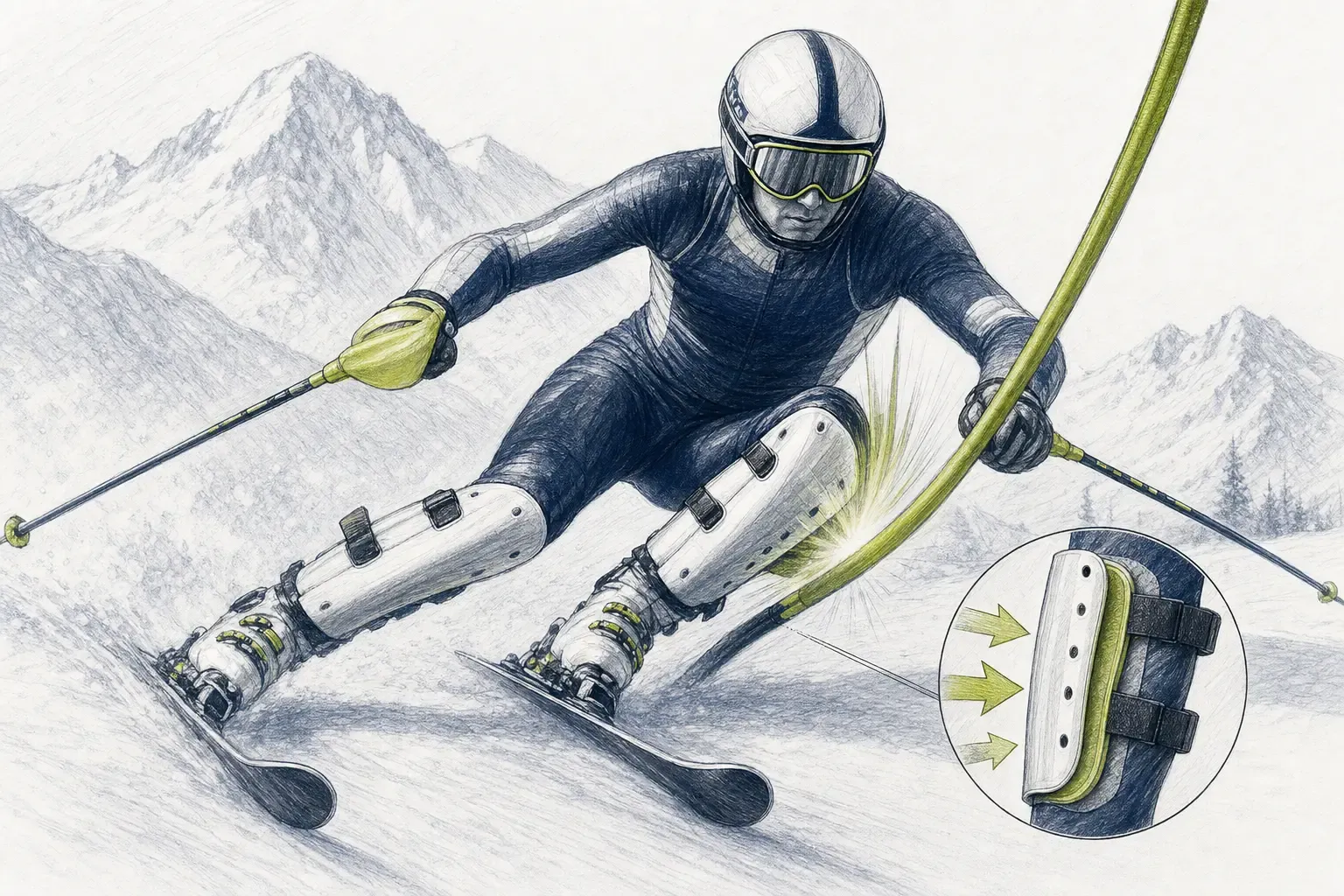
Check regularly for cracks, sharp edges, damaged inner lining, and worn buckles or straps. After a hard impact, the guard should be inspected even if the damage is not obvious at first glance.
Important distinction in FIS rules
A classic slalom guard fastened on the outside of the suit should not be confused with an additional rigid part inserted into the ski boot or coming from inside it. FIS banned additional rigid parts used as shin guards from the 2025/26 season inside the ski boot. The reason was the effect on the boot's mechanical properties and the related safety risk.
In case of a medical issue, FIS specifications allow only approved soft and fully flexible padding, for example made of gel or foam, with limited dimensions. Such an adjustment cannot be improvised at the last minute before the start. It must comply with the current rules and the relevant FIS approval procedure.
For the 2026/27 season, the current equipment specifications are available among the official FIS documents. For any unusual guard construction, for any part extending into the ski boot, or at international races, always check the latest wording of the rules.
Typical mistakes and the coach’s view
The most common mistake is buying oversized guards “for later.” Protective gear must fit the child’s current equipment. Another problem is fastening it too loosely, twisted straps, putting it on over items in the pockets of the race suit, or continuing to use a cracked shield.
From a training point of view, the guard should not encourage the child to deliberately kick the poles. If a young skier seeks every contact, it may be hiding a late turn initiation, too direct a line, or a loss of balance. The coach therefore first teaches a safe, smooth pass and only then appropriate contact with the full slalom pole.
Sources and further reading
- FIS – Alpine Skiing Documents: current ICR rules and documents for the 2026/27 season
- FIS – Specifications for Alpine Competition Equipment 2026/27, download section
- FIS – Specifications for Alpine Competition Equipment 2025/2026, article 3.5.4 Shin Pads
- FIS – Council approves increased prize money, changes to discipline-specific regulations
- FIS – Alpine Meeting: Focus on Athlete Safety and Season Outlook
- FIS – Alpine Ski World Cup Race Directors Peter Gerdol and Markus Waldner look ahead
- U.S. Ski & Snowboard – Rules & Equipment