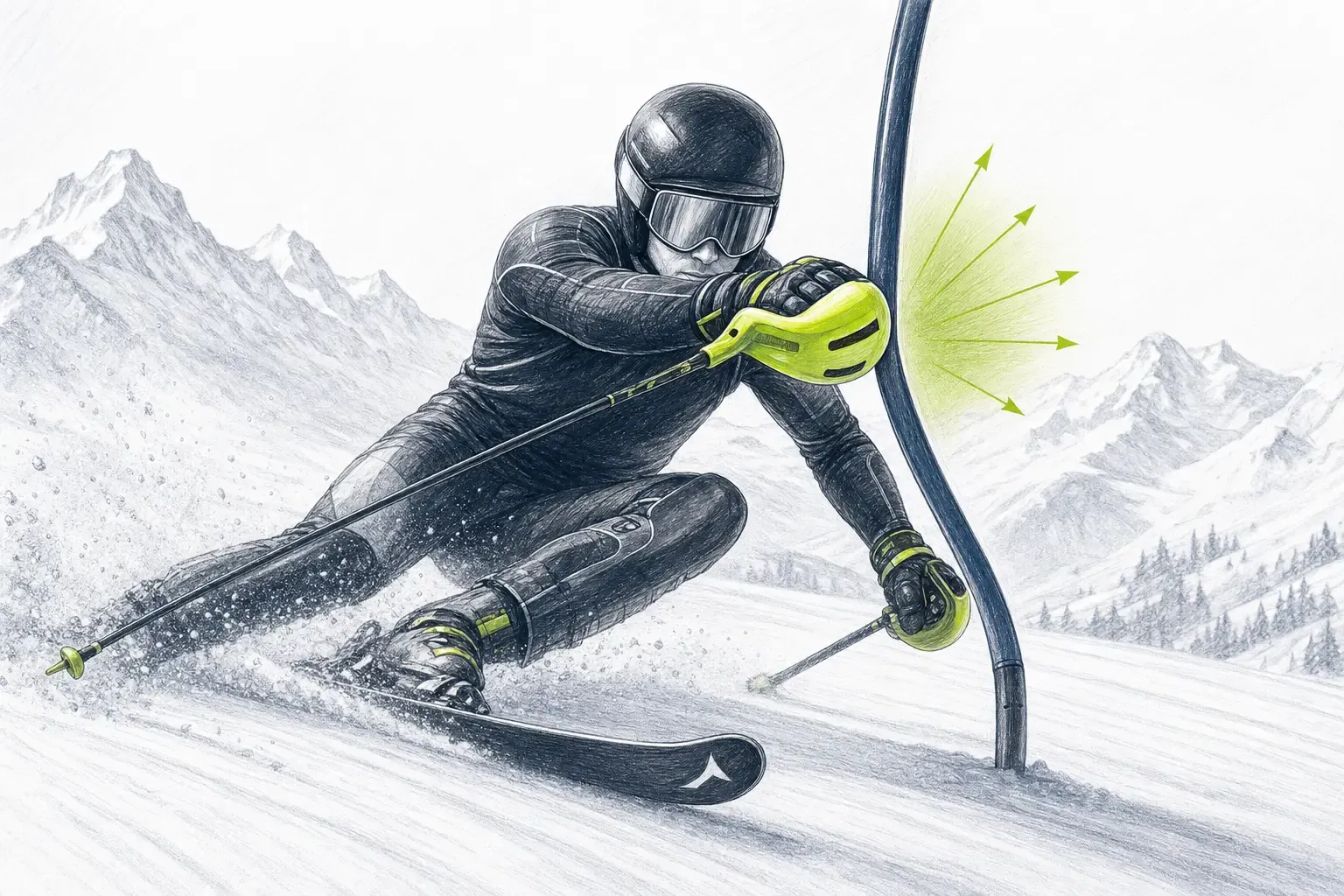
Hand guards (eng. hand guards) are rigid shaped covers attached to the grip or upper part of the slalom pole. They sit in front of the skier’s hand and, on contact with a flexible slalom pole, help protect the fingers, knuckles, and part of the back of the hand.
They are not part of the glove or a substitute for an forearm guard. They are an accessory for the ski pole intended mainly for slalom training and racing.
What are they for
In modern slalom technique, the racer may push the flexible gate pole away with the hand and pole to pass as close as possible to the correct line. This way of passing is called cross-blocking or cross-blocking. The guard creates a barrier between the hand and the pole and spreads the contact over a larger area.
However, the guard does not guarantee protection against every injury. It does not cover the whole wrist or forearm and will not help in the event of a bad fall, catching the pole, or an improper hand position. The racer therefore still needs suitable ski gloves and, depending on the level of training, other slalom protectors as well.
When does a child need them
The key factor is not age itself, but the type of course and the way the gates are passed. A child who skis between brushes, short poles, or practices slalom without direct contact usually does not need hand guards. They become useful when moving on to full-size flexible poles and during guided practice of blocking.
An older U.S. Ski & Snowboard educational material mentions adding hand guards at around the age of 12 when moving to cross-blocking. However, this is not a FIS rule or a universal age limit. Motor skills, body height, strength, experience, and coaching approach differ significantly among children.
In training practice, hand guards should not be used as a signal that a child should start hitting every gate. First comes learning the correct line, a stable stance, outside ski work, and hand position. Contact with the pole is the result of a tight and correctly timed run, not the main goal of the turn.
Selection, fitting, and checking
The guard must be compatible with the specific grip and pole diameter. After the glove is put on, it should cover the hand without pressing on the fingers, limiting the grip, or getting in the way of the strap. A guard that is too small leaves the fingers exposed; one that is too large can make pole handling harder.
Installation should follow the manufacturer’s instructions and use the designated fastening parts. Drilling, shortening, or combining incompatible parts on your own can weaken the grip or the guard itself. For children’s equipment, proper fitting should be checked by a coach, a specialist retailer, or a service technician.
Before training, it is especially important to check:
- that screws and clamps are firmly tightened,
- the correct position of the cover in front of the hand,
- enough space for the glove and fingers,
- absence of cracks, sharp edges, and significant deformation,
- free and natural handling of the pole.
After a hard impact, a recheck is recommended. A damaged guard should not be repaired with makeshift tape or glue if the manufacturer does not explicitly allow it.
Typical mistakes
A common misunderstanding is confusing a hand guard with an forearm guard. A pole guard protects the hand mainly, while a separate forearm guard covers a different area. Another mistake is leaving slalom guards on the poles for every type of skiing. Many racers therefore use one set of poles with slalom guards and another without them for giant slalom, free skiing, or conditioning drills.
Hand guards cannot be considered mandatory based on age category alone. In competition, always check the current rules of FIS, the national federation, and the specific event. FIS publishes technical specifications for competition equipment for each season; for the 2026/27 season, the valid specifications were issued in July 2026.
Coach’s view
The coach watches whether the child really needs the guard, whether it fits properly, and whether it changes the natural grip on the pole. More important than aggressive contact with the gate is a safe hand position in front of the body and a precise line. The guard should support slalom technique the child already has, not hide its shortcomings.
Sources and further reading
- FIS – Specifications for Alpine Competition Equipment 2026/27, documents valid from July 2026
- FIS – Specifications for Alpine Competition Equipment 2025/2026, updated version from October 13 2025
- U.S. Ski & Snowboard – 2026 Alpine Competition Guide
- U.S. Ski & Snowboard – 2026 Alpine Competition Guide, full PDF
- U.S. Ski & Snowboard – Equipment: poles and protective gear for young racers
- U.S. Ski & Snowboard – Rules & Equipment, official rules hub
- U.S. Ski & Snowboard – Alpine resources and current competition documents