What is a slalom chin guard
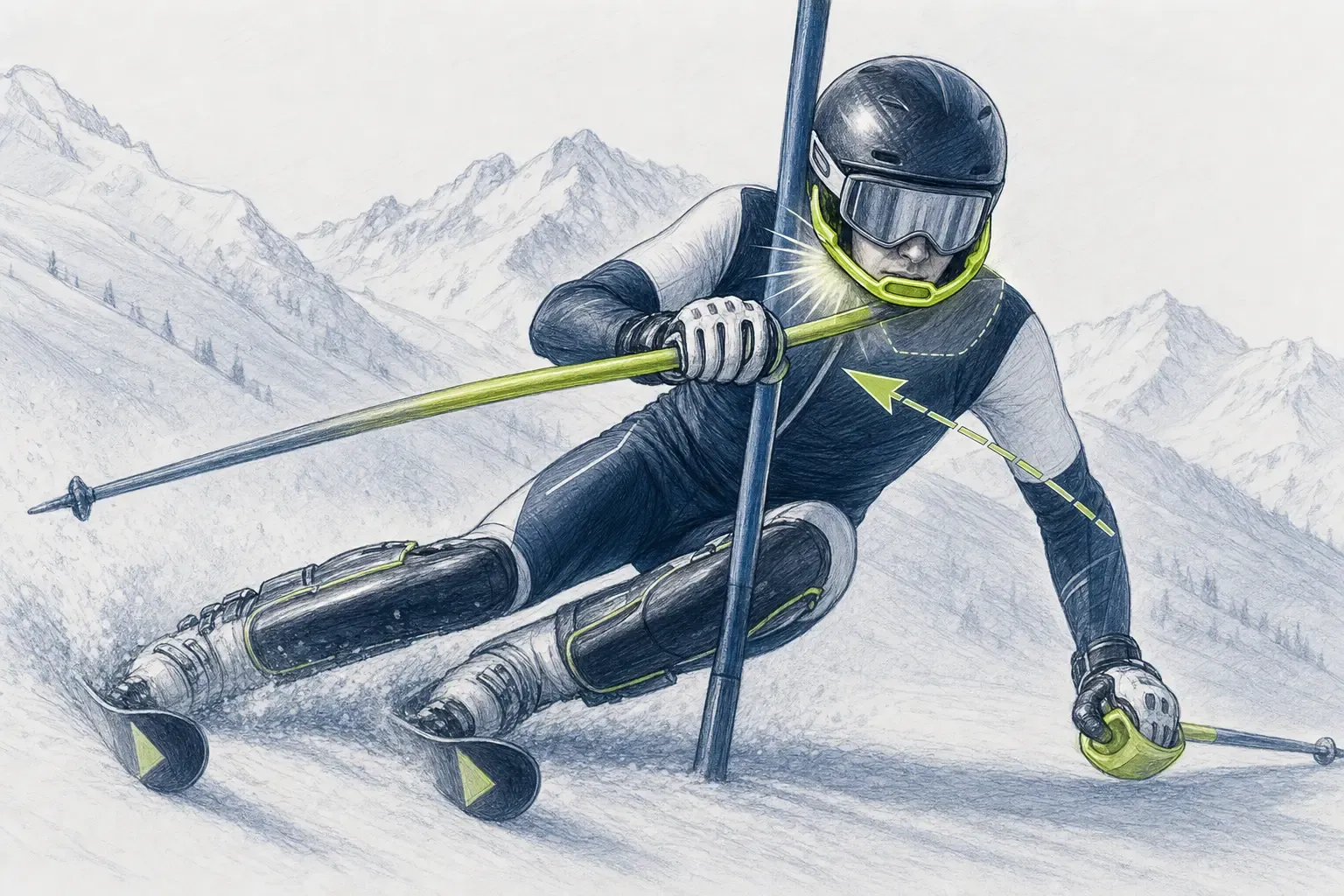
Slalom chin guard (in English chin guard) is a rigid bar attached to the front of a slalom helmet. It sits in front of the chin, mouth, and lower part of the face. Its job is to limit a direct hit from a slalom pole to the face when the skier deflects it with the body or hands while passing a gate.
It is not the strap under the chin that holds the helmet on the head. The chin guard is a separate removable accessory and may only be used in the way specified by the helmet manufacturer.
When it matters
The guard is used mainly when skiing on full articulated slalom poles and when using gate-blocking technique. A deflected pole can move through the space in front of the skier’s body and hit the helmet or face. Properly positioned protection creates a solid barrier in front of the lower part of the face.
For children, its use should not be decided only by age. What matters most is:
- the type of poles and training drill,
- speed and confidence while skiing,
- the distance of the track from the gate,
- the way the pole is blocked,
- the ability to maintain a stable stance and line of sight.
When skiing between brushes, short poles, or without deliberate contact with the gate, the chin guard may have no practical purpose. But once the coach starts adding full slalom poles and contact with them, face protection becomes an important part of slalom equipment. It is a training practice, not a universal age rule.
Rules and helmet
FIS issues separate specifications for competition equipment for each season; the document for the 2026/27 season is valid from July 2026. Before races, always check the current FIS rules, the national federation rules, and the event regulations.
The regulations mainly set requirements for the helmet itself. Slalom has a special regime compared with speed events and giant slalom; for example, soft ear coverage is, according to the cited competition rules, allowed only for slalom helmets. A chin guard is a slalom accessory, not a replacement for a certified, properly fitting helmet. It is also not a universally mandatory part of the equipment for every child skiing a slalom course.
Selection and mounting
The guard must be explicitly compatible with the specific helmet model and size. Similar-looking holes or screws do not mean that products from different brands and model lines can be combined freely. No new holes may be drilled into the helmet shell, and no other modifications may be made without permission.
Installation must be carried out according to the manufacturer’s instructions and with the specified connecting parts. After fitting, make sure that the protection:
- does not restrict the field of view or the position of the goggles,
- does not touch the face in a normal stance,
- does not alter the correct fit of the helmet,
- is firmly attached and has no loose parts.
It is advisable to check it before first use, regularly during the season, and after a significant impact. Assessment of a damaged helmet or protector belongs to the manufacturer, an authorized service center, or a qualified technician; the absence of a visible crack alone may not confirm that the equipment is safe.
Typical mistakes and misconceptions
A common mistake is the belief that chin protection shields the entire face or prevents every injury to the teeth and head. It is an additional barrier against typical contact with a slalom pole, not complete protection against a fall, collision, or impact with great force.
Also unsuitable are improvised fastening, combining incompatible parts, or using the protector as a substitute for technical readiness. A child should not be taught to block full gates tightly just because they have a protector. First, they need to master balance, ski control, line choice, hand work, and safe passage through the gate.
Coach’s view
The coach selects protection according to the specific task on the slope. Contact with a full gate should be introduced gradually and only when the young skier can handle it without closing their eyes, turning their head away, or losing their basic stance. Chin protection reduces the face’s exposure to a direct hit, but it does not replace the correct line, timing, and appropriate progression.
Sources and further reading
- FIS – Specifications for Alpine Competition Equipment 2026/27, document page
- FIS – Specifications for Alpine Competition Equipment 2025/2026, update 13. 10. 2025
- FIS – Specifications for Alpine Competition Equipment 2025/2026, edition 14. 7. 2025
- U.S. Ski & Snowboard – 2026 Alpine Competition Guide
- U.S. Ski & Snowboard – 2026 Alpine Competition Guide, PDF
- U.S. Ski & Snowboard – Alpine Equipment and Protective Gear