What is a back protector
Back protector (back protector) is a personal protective item worn on the back. Its job is to absorb and spread part of the energy in a direct impact, for example when landing on hard snow or hitting an object. It is not a brace and cannot mechanically prevent every movement of the spine.
In skiing, soft protectors made of impact-reactive material as well as designs with a firmer outer shell are used. Appearance or hardness alone do not determine which product offers better protection. What matters are the test results, intended use, correct size and how it sits on the body.
What it protects against – and what it cannot guarantee
A protector is aimed mainly at direct mechanical impact to the back. The International Society for Snow Sports Safety notes that it can help with bruises and similar contact injuries, but evidence that it prevents serious spinal fractures is limited. Such injuries can also result from compression of the spine, a sudden bend forward or backward, rotation, or a combination of several forces that a protector cannot eliminate.
So it is not correct to say that a protector makes skiing safe or that it protects the entire spine in every situation. It is only one layer of protection alongside appropriate speed, technical skill, suitable terrain, a safely set course and coach supervision.
Standard EN 1621-2
For back protectors, FIS refers to certification under the current standard EN 1621-2. The valid version EN 1621-2:2014 sets requirements for coverage, impact testing, sizes, ergonomics, health safety and labelling.
It is important to understand the origin of the standard, however: EN 1621-2 was created for motorcycle back protectors, not specifically for skiing. According to the ISSS working group, there is as yet no separate general standard for protectors intended solely for snow sports. Certification under EN 1621-2 is therefore important and verifiable information about product testing, not a guarantee of protection in every kind of skiing fall.
When buying, the label protector or back pad is not enough. On the product and in the instructions, check the specific standard, declared purpose, size and the manufacturer’s instructions.
How the protector should fit a child
The right size is not chosen by age alone. Manufacturers mainly use body measurements, and size charts can vary between brands. The protector must follow the natural curve of the back, fit close to the body and stay roughly centred during movement.
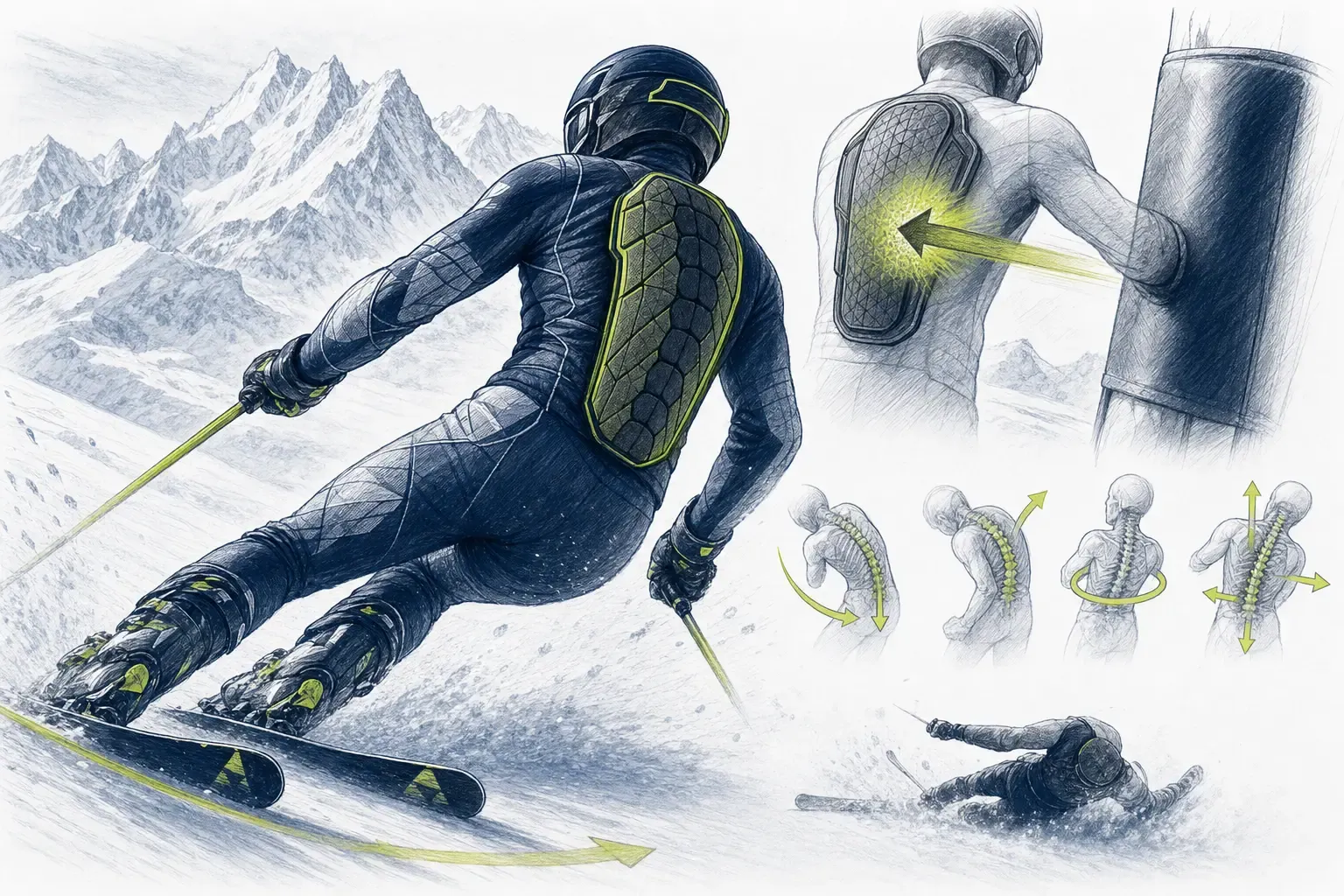
In training practice, fit is also checked in skiing stance: when bending, leaning farther forward, rotating the torso and working with poles. The top edge should not hit the helmet or press into the neck, the lower part should not restrict the child when bending, and the protector should not shift or twist significantly. The straps should keep the product in place without restricting breathing.
Buying a protector that is much too large, hoping the child will grow into it, is a mistake. Excess length or looseness can worsen fit and range of motion. The size should be checked after the child grows, after changing a ski jacket or one-piece suit, and always according to the instructions of the specific manufacturer.
After a strong impact, the protector should be inspected and handled according to the manufacturer’s instructions. Hidden damage cannot be reliably ruled out by sight alone. The product should not be shortened, drilled into, heat-shaped or otherwise modified on your own.
Competition context
FIS considers a back protector to be additional protective gear. In the detailed, verifiable FIS specifications for the 2025/26 season, it was required to follow the curvature of the spine, lie flat against the body, and have an upper edge no higher than the area of the seventh cervical vertebra C7. The maximum thickness was 45 mm, the edges were to taper, and aerodynamic shaping was prohibited. It was worn under the race suit in competitions. For children up to 12 years old and categories U14 and U16, FIS recommended the correct size and certification according to the latest EN 1621-2.
FIS has already published the specifications for the 2026/27 season, valid from July 2026. Before any specific race, you should therefore check the current FIS document, national rules, and the event regulations; older club information may not be enough.
Typical mistakes and the coach's view
The most common misunderstanding is the belief that the harder, thicker, or larger the protector is, the safer it automatically is. Another problem is the wrong size, the protector shifting, limiting a basic stance, or wearing a damaged product.
The coach watches mainly whether the child can move naturally, breathe, take a race stance, and react safely to changes in balance. The protector should not be used as a reason to increase speed, course difficulty, or jump size too early. Its use should be part of a broader safety system, not a replacement for technical preparation and an appropriate training approach.
Sources and further reading
- FIS – Specifications for Alpine Competition Equipment 2026–27, document index
- FIS – Alpine Skiing Documents: current ICR and rules
- FIS – Specifications for Alpine Competition Equipment 2025/2026
- International Society for Snowsports Safety – Back Protectors
- DIN Media – DIN EN 1621-2:2014-05
- NEN – NEN-EN 1621-2:2014
- British Standards Institution – BS EN 1621-2:2014
- AFNOR – NF EN 1621-2