What waxing is
Waxing means applying glide wax to the ski base and then finishing it with a scraper and brushes. The goal is to achieve proper glide, even ski behavior, and keep the base in good condition.
On downhill skis, the entire base is waxed. This is not about climbing waxes used in classic cross-country skiing. Waxing is also not edge grinding or repairing base damage - these service tasks are related, but each has a different function.
Why wax matters
Snow is not always the same. Its temperature, moisture, crystal size and shape, and degree of transformation into technical, old, or spring snow all change. The base can therefore feel fast, slow, or uneven on different surfaces. A suitably chosen and properly finished wax reduces unwanted friction and helps skis speed up and slow down more predictably.
For a child, that does not mean only higher speed. A ski with a very dry or neglected base can catch unpleasantly on flat sections and change behavior in turns. Smooth glide makes it easier to keep balance, link turns, and move on a gentle slope.
Grayish-white spots, especially near the edges, may point to a dry or worn base. Color alone is not an exact diagnosis, though: dirt, mechanical damage, or poorly finished servicing can look similar.
Basic waxing methods
Hot waxing uses solid wax and a waxing iron. The melted wax is spread evenly over the base, left to cool, and then the excess is removed with a plastic scraper. This is followed by brushing, which reveals the base structure.
Liquid and rub-on waxes are applied without an iron. They are practical for ongoing care and simple preparation before training, but the application method, drying, and final brushing all differ depending on the product. The manufacturer’s instructions take priority over any general guide.
Waxes are chosen according to the conditions and the product’s intended use. The temperature range on the package may refer to snow or air, so it needs to be read carefully. A universal rule based only on the current air temperature is not reliable.
Basic procedure
For regular hot waxing, the ski is first securely fixed in place, dried, and checked. Dirt is mechanically removed from the base; a chemical cleaner is used only when needed and when it is suitable for that base and the next wax.
The waxing iron is set according to the wax manufacturer’s instructions. It should move smoothly and must not stay in one place. Wax smoking, a strong smell, or overheating of the base means the procedure is wrong. There is no single iron temperature suitable for all waxes.
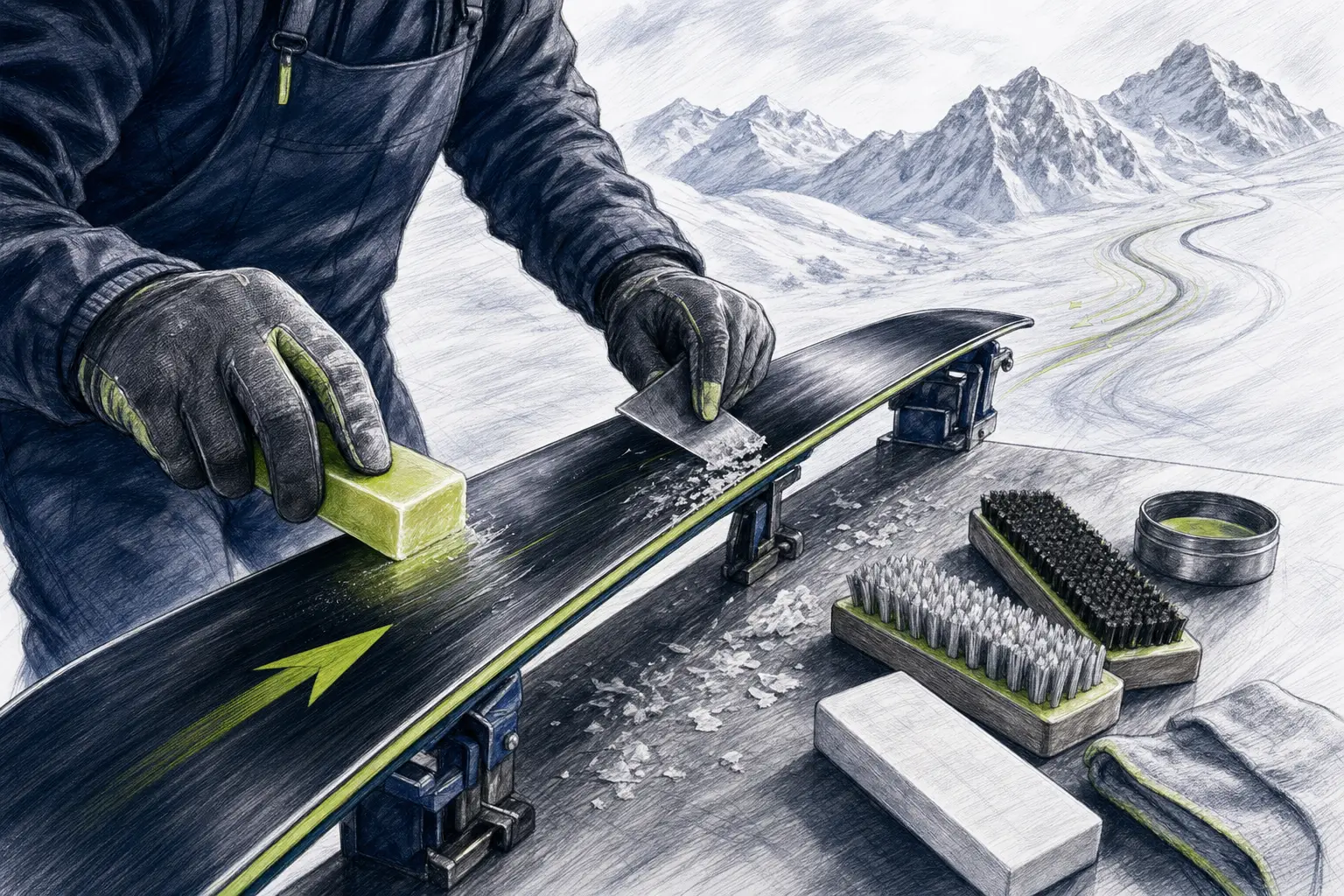
After cooling, the excess wax is removed with a plastic scraper. The groove and the area around the edges are cleaned thoroughly as well. The base is then brushed, usually from tip to tail, with brushes intended for the wax used and the stage of the work.
A finished ski should not have a thick visible layer of wax on the base. Wax left on the surface can cover the structure, trap dirt, and worsen glide. The idea that more wax automatically means a faster ski is a common misunderstanding.
Children and safety
Waxing can be a useful part of ski education. A child learns to care for equipment, notice the condition of the base, and distinguish servicing from binding adjustment. The right level of involvement depends on age, motor skills, and experience: a younger skier can brush or help with a plastic scraper under supervision, but an adult or trained service technician should handle the hot iron and chemical products.
The workspace should be stable and well ventilated. The iron must not come into contact with the skin, the plastic parts of the bindings, or the power cord. Use an iron designed for ski servicing; a household iron with inaccurate temperature control increases the risk of damaging the base. Binding adjustment and checking are not part of waxing and belong to qualified servicing.
Waxing frequency cannot be determined by a single number of ski days. It depends on snow hardness and roughness, how long you ski, the condition of the base, how the skis are stored, and the product used. For children’s training skis, regular checks are more sensible than a fixed universal interval.
Race skiing and the ban on fluorine
FIS rule: According to the general FIS rules, the use of fluorinated waxes and tuning products containing fluorine is prohibited in all disciplines and at all FIS levels. Using such a product in competition can lead to disqualification. FIS fully implemented the ban starting with the 2023/2024 season and conducts equipment checks at selected events.
At children’s or national races, you must also check the rules of the relevant federation and the specific competition. Club practice should use only products clearly marked as fluorine-free and keep work tools clean. Old waxes without a clear composition are not suitable for race preparation.
In racing, it is not just the name or stated temperature range of the wax that matters. The result is affected by the condition and structure of the base, the application method, cooling, scraping, brushing, and the current snow. For young racers, servicing should support safe and fair performance, not replace technical development.
Coach’s view
The coach watches mainly whether both skis glide similarly, whether the base is not significantly damaged, and whether the servicing matches the child’s level. An unevenly prepared pair can distort feedback: the child then blames technique, even though one ski accelerates or holds back differently.
For most children’s training, a high-quality basic fluorine-free wax and careful finishing of the base are enough. Fine race tuning matters only when the ski is technically sound and the servicing is done by an experienced person. Waxing cannot fix a wavy base, unsuitable structure, damaged edges, or incorrectly adjusted bindings.
Sources and further reading
- FIS – Alpine Skiing Documents: current rules and information on fluorine waxes
- FIS – International Competition Rules, article 222.8: ban on fluorinated waxes
- FIS – Expansion of fluorine checks after the first season of the ban
- FIS – Information on introducing the ban on fluorine waxes from the 2023/2024 season
- FIS – International Competition Rules Cross-Country 2025: control of fluorinated waxes
- Swix – BP77 Base Prep Hard: base wax for preparing downhill, slalom, and giant slalom skis
- FIS – General Regulations: library of current general documents