What is split time
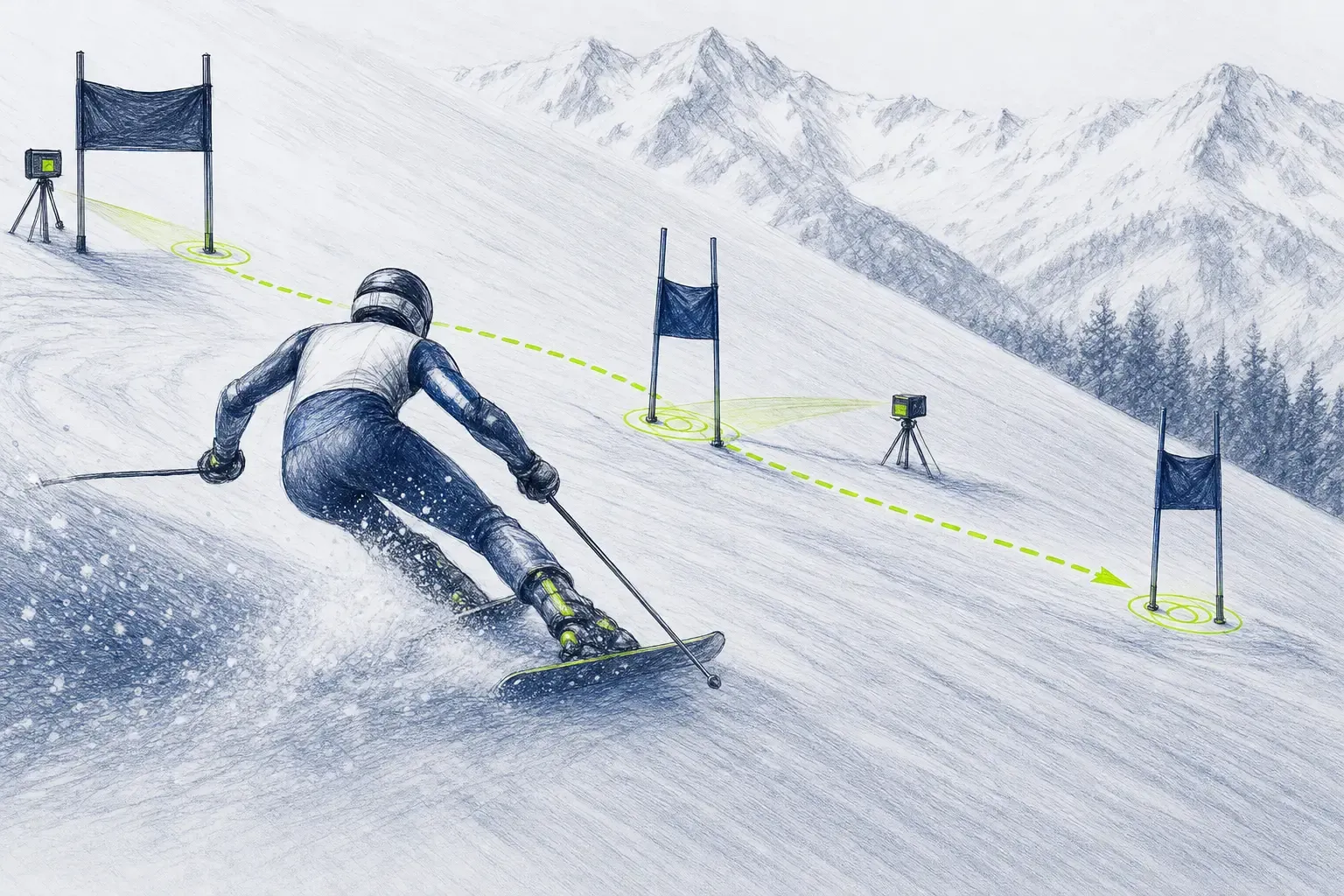
Split time (in English intermediate time or split time) is the time measured from the start of a racer to a designated split point on the course. It is therefore usually a cumulative time: the first split shows the time from the start to the first point, the second split the time from the start to the second point, and so on.
The split point is equipped with a device that records the racer’s pass. The timing system, working with real time, then determines the difference between the start impulse and the impulse at the relevant point. At official events, the timing follows FIS rules, the relevant technical manual, and the requirements for approved equipment.
Split time, sector time, and time difference
These three terms are often confused:
- Split time is the time from the start to a specific point.
- Sector time is the time between two consecutive points.
- Time difference shows the lead or deficit relative to a comparison racer, usually the current leader.
If a skier’s first split is 24,37 seconds and the second is 52,91 seconds, their time in the sector between those points is 28,54 seconds. A +0,42 reading on the screen usually means they were 0,42 seconds slower than the racer being compared. It does not mean their split time was 0,42 seconds. The way it is displayed may depend on the discipline, round, and the results system used. In the second run, the graphic may also show the running total of both runs.
Meaning in races
Split times help show which part of the course a racer was gaining or losing time on. But on their own, they do not determine the final ranking. The official result is based on a validly recorded finish time under the rules of the given discipline. A racer may have a recorded split time, but if they later do not finish the course or their run is not valid, the split time does not secure a placing for them.
The fastest split time does not necessarily lead to the fastest final result. An aggressive run through the upper section can spoil the entry into the next section, reduce exit speed, or increase the risk of a mistake. A split time must therefore be evaluated together with what follows later in the run.
Coach’s view
In training practice, it is more useful to work with several split times and the section times derived from them than with just one figure. A cumulative split time shows that a loss has already occurred, but only dividing the course into sections helps pinpoint more precisely where it happened. However, the numbers alone do not reliably reveal the cause. The coach therefore combines them with video, observation of the line, rhythm, balance, the passage through terrain changes, and exit speed.
You need to compare the same course, the same run, and the same split point. Changes in snow, wind, visibility, the tracked line, and course preparation can all affect the result. A difference of a few tenths is therefore not automatic proof of better or worse technique.
Split times with children
For young skiers, a split time is a supporting figure, not the main goal of the run. Especially with beginners and younger children, the priority is safe ski control, balance, proper completion of the course, and finishing the run. The effort to gain time by forcing the line straight can lead to loss of control or a bad approach to the next gate.
Appropriate feedback is specific: a child may learn that it was faster in a smooth section, but lost time after a late approach into a combination. The coach also takes into account the child’s age, ski level, and ability to understand time differences. Tenths of a second matter only when they can be linked to an observable and safely correctable part of the run.
A typical mistake is to judge the whole performance by a single green or red figure on the display. A split time is a diagnostic tool. It does not describe the quality of the run or the racer without context.
Sources and further reading
- FIS – Timing & Data; current timing manuals, data manuals, and the list of approved equipment
- FIS – Alpine Skiing Documents; International Competition Rules 2026/2027
- FIS – Alpine Skiing Timing Booklet, version 2.55; reference technical document
- U.S. Ski & Snowboard – Alpine Competition Officials Education Resources
- U.S. Ski & Snowboard – 2026 Alpine Competition Guide
- U.S. Ski & Snowboard – Timing & Calculations; split times and timing records
- FIS – Timing Booklet for Snowboard and Freestyle, version 1.5; definition of intermediate times in FIS disciplines