Definition
Time loss is the difference between the skier’s measured time and the reference time. In intermediate standings, the reference is usually the fastest racer who has already started; in final standings, it is usually the winner or the best valid time of the given run.
Mathematically:
time loss = skier’s time − reference time
If a skier records a time of 52,43 s and the reference time is 51,70 s, their loss is +0,73 s. The plus sign means a slower time. If a skier is faster than the reference at a split, the time difference may be shown with a minus sign; more precisely, we speak of a time lead or gain.
Time loss is not a penalty or an additional added sanction. It is only a calculated difference between two measured times. A racer without a valid classified time, for example with DNS, DNF or DSQ status, does not have a final time loss comparable to classified racers.
Time loss in results
In FIS alpine skiing, result times are shown to hundredths of a second. If the timing system records thousandths as well, the extra digits are handled according to timing rules when the result is produced, not by ordinary mathematical rounding. Official races use electronic timing with a primary and backup system; hand timing serves as an additional safeguard in case of failure.
In races with one run, the loss is calculated from the time of that run. In slalom and giant slalom, which are run over two runs in the standard format, the final loss is based on the sum of the valid times from both runs. The loss in the first run therefore does not have to be the same as the loss in the final standings.
Absolute loss should always be read together with the length and character of the course. One second on a short kids’ slalom means a different relative difference than one second in a long downhill race. For comparing different courses, a coach can use a percentage difference as a guide, but it does not replace the official result.
A split time is not the time for one section
The split time shown on course is usually the cumulative time from the start. The value +0,50 s at the second split therefore does not mean the skier lost half a second only in the second section.
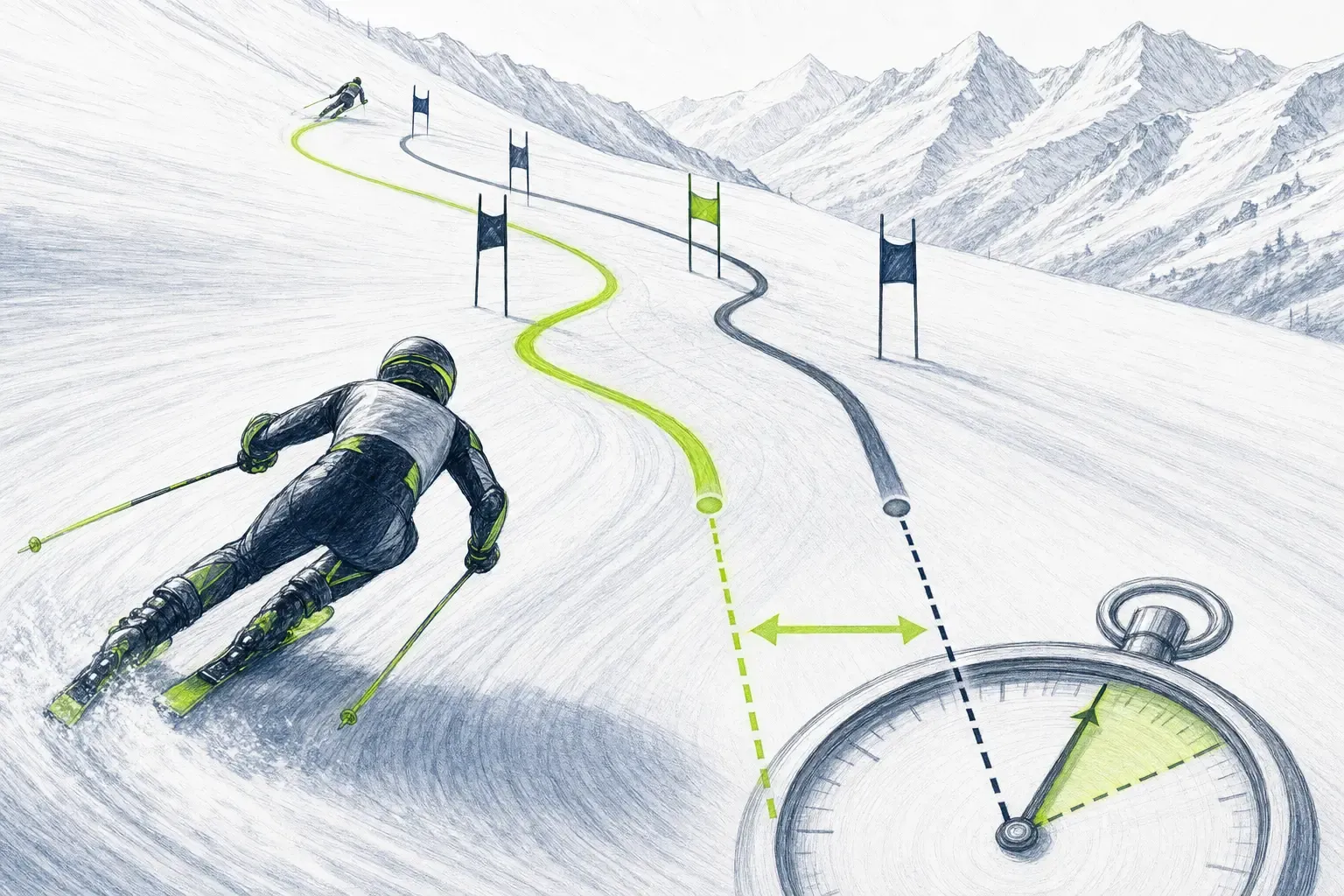
If the loss at the first split was +0,20 s and at the second +0,55 s, then between those points the difference to the reference increased by about 0,35 s. If the loss changes from +0,55 s to +0,40 s, the skier gained 0,15 s on the reference in that section. Detailed timing between individual gates gives a more accurate picture than one or two split times.
Even then, you cannot identify the exact technical mistake just from the number. A loss of speed at the end of one turn may show up more strongly only in the next section, because it affects the approach speed.
Why time loss occurs
The final time is influenced mainly by the relationship between speed and the chosen line. A shorter line is not automatically faster if it requires hard braking or does not allow the skier to stay in control. Likewise, the highest possible entry speed does not guarantee the best time if the skier then takes a longer line or disperses energy too much.
The comparison can also be affected by a rough course, changing snow, wind, visibility, start order, or different conditions on a repeated run. Time therefore is not, by itself, a diagnosis of technique.
Children’s and training context
In training practice, time loss is useful only when the child has a clear reference and a suitable task. For younger or less experienced skiers, safe handling of the course, correct passage of the gates, balance, and repeatability of movement take priority over chasing hundredths.
A child’s time is best compared mainly:
- with their own runs in similar conditions,
- by individual sections, not just at the finish,
- together with video or coach observation,
- taking age, experience, physical development, and motor development into account.
One fast run does not necessarily mean stable improvement, and one big loss does not necessarily prove a decline in technique. Training measurement with a phone, watch, GNSS device, or manual stopwatch can help with orientation, but it cannot be confused with official timing. Accuracy and the measurement method must match the differences the coach wants to evaluate.
Coach’s view
The coach first checks, against whom and at which point on the course the loss is calculated. Then they watch where the gap increases and connect the time figure with the line, speed, rhythm, terrain, and the skier’s reaction. Only then do they set one appropriate training task and verify its effect over several runs.
A common mistake is to attribute the whole loss to one visible error or to ask the child simply to go faster. A more useful question is: At which section did the difference change, and what in the run explains that change?
Sources and further reading
- FIS – Timing & Data; current timing document library including Alpine Timing Booklet version 2.67 of 16 June 2026
- FIS – Alpine Skiing Timing Booklet, version 2.65, 31 October 2025
- U.S. Ski & Snowboard – 2026 Alpine Competition Guide
- Federolf – Quantifying instantaneous performance in alpine ski racing, Journal of Sports Sciences
- Spörri and colleagues – The role of path length- and speed-related factors for the enhancement of section performance in alpine giant slalom
- Fasel and colleagues – A Magnet-Based Timing System to Detect Gate Crossings in Alpine Ski Racing, Sensors
- Gilgien and colleagues – Methodological and Practical Considerations Associated With Assessment of Alpine Skiing Performance Using Global Navigation Satellite Systems
- Time Analysis in Men’s Slalom of Alpine Skiing, Journal of High Performance Sport
- Chollet and colleagues – The velocity barrier in giant slalom skiing: An experimental proof of concept