What is a closed gate
Closed gate is a slalom gate whose two poles are set roughly in the fall line: the outside pole stands lower down the slope than the pole around which the racer changes direction. In English rules and coaching materials, the terms vertical gate or closed gateare used. In an open, horizontal gate, the poles are placed more across the slope.
The word “closed” does not mean that the gate is blocked, narrower, or closed to pass through. It describes its orientation on the slope. Current FIS rules distinguish between horizontal — open and vertical — closed gates, as well as hairpins, vertical combinations, and delay combinations.
One gate is not the whole combination
A closed gate is one gate. Several closed gates in a row can form a hairpin or a vertical combination. These terms are therefore not synonyms.
A closed gate can also appear on its own. The course setter may use it to change the rhythm, move the line to another part of the slope, or adapt the course to the space and snow conditions. In slalom combinations, it leads the racer into a quick series of direction changes.
It should not be confused with delay gate (delay gate). A delay combination has a different geometry and function: it creates a more pronounced change in the course line. During inspection, the racer must identify not only the position of the individual poles, but also which gate they belong to.
Correct passage
At a classic two-pole gate, the connection between the two poles forms an imaginary gate line. To pass correctly, the tips of both skis and both feet of the racer must cross this line in the prescribed way. In races with single-pole slalom, the passage is judged according to the position of the turning pole and the natural racing line; the exact assessment follows the valid competition rules. Incorrect passage or missing a gate is a gate fault and may lead to disqualification.
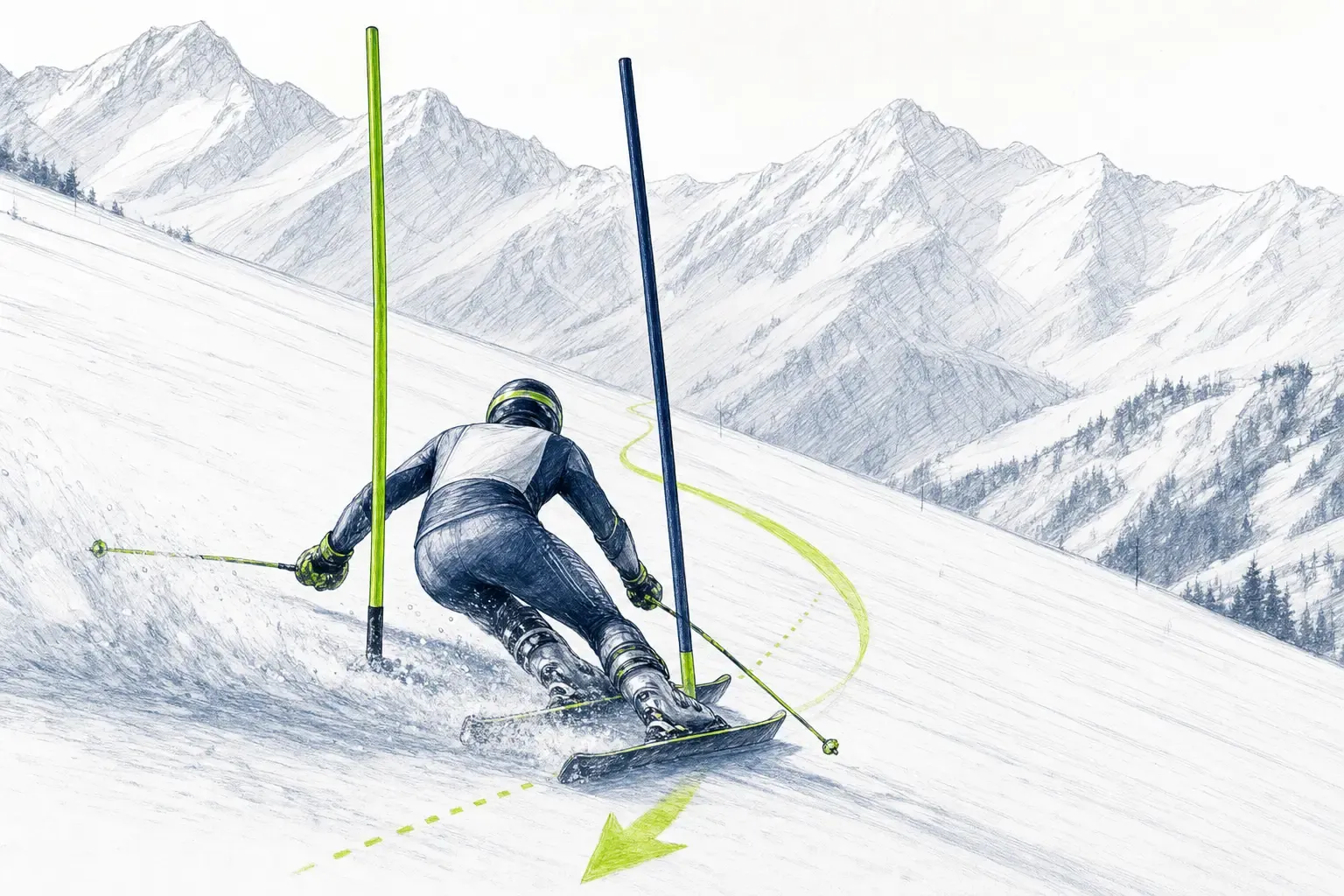
The racer should therefore not rely only on whether they “fit between the two poles.” They must correctly identify the turning pole, the order of the gates, and the direction of the next passage.
Meaning for technique and rhythm
A closed gate requires early recognition of the line and precise preparation for the next change of direction. In a vertical combination, stimuli come one after another very quickly and there is little room for extra correction. A late entry into the first gate often carries through the whole combination: the skier remains below the optimal line, starts braking, or passes the next pole on the wrong side.
The goal is not to hit the pole as hard as possible. Contact with the pole may be a result of a short racing line, but by itself it does not prove a correct or fast run. Especially with children, balance, the correct sequence of gates, and control of direction take priority.
Children’s and training context
In children’s training, closed gates are introduced gradually according to skiing level, motor maturity, terrain, and the child’s ability to orient on the course. The spacing and difficulty of the combination should not be mechanically copied from courses for adult racers. Official course-setting methods emphasize adapting the spacing to the age, developmental stage, and abilities of the skiers.
A beginner first learns to recognize which pole determines the arc and to complete the combination safely in the correct order. Only then does it make sense to shorten the line, increase the rhythm of the turns, or practice active pole pushing.
Typical mistakes
- confusing a closed gate with a delayed gate,
- watching the pair of poles instead of the turning pole and the next direction of the course,
- starting the turn too late before entering the combination,
- suddenly braking at the first pole and then losing rhythm,
- trying to hit the pole at any cost,
- the belief that a closed gate automatically means the whole vertical combination.
Coach’s view
During inspection, the coach should guide the young skier with three questions: Which pole determines the arc? Where am I entering the gate from? Where does its exit lead? In a vertical combination, a readable entry and maintaining rhythm are more important than aggressively passing the first pole. However, the specific line always depends on the slope, surface, spacing, speed, and the skier’s technical level; there is no universal training rule.
Sources and further reading
- FIS – Alpine Documents: current International Competition Rules and technical documents for the season 2026/27
- FIS – International Competition Rules for Alpine Skiing, edition 1 July 2025; diagrams of horizontal and vertical gates
- U.S. Ski & Snowboard – 2026 Alpine Competition Guide
- U.S. Ski & Snowboard – Course Setting Manual; open and closed gates, building children’s courses
- FIS – official result record applying the rule for incorrect passage of a gate
- FIS – official result record applying the rule for a gate fault