What is canting
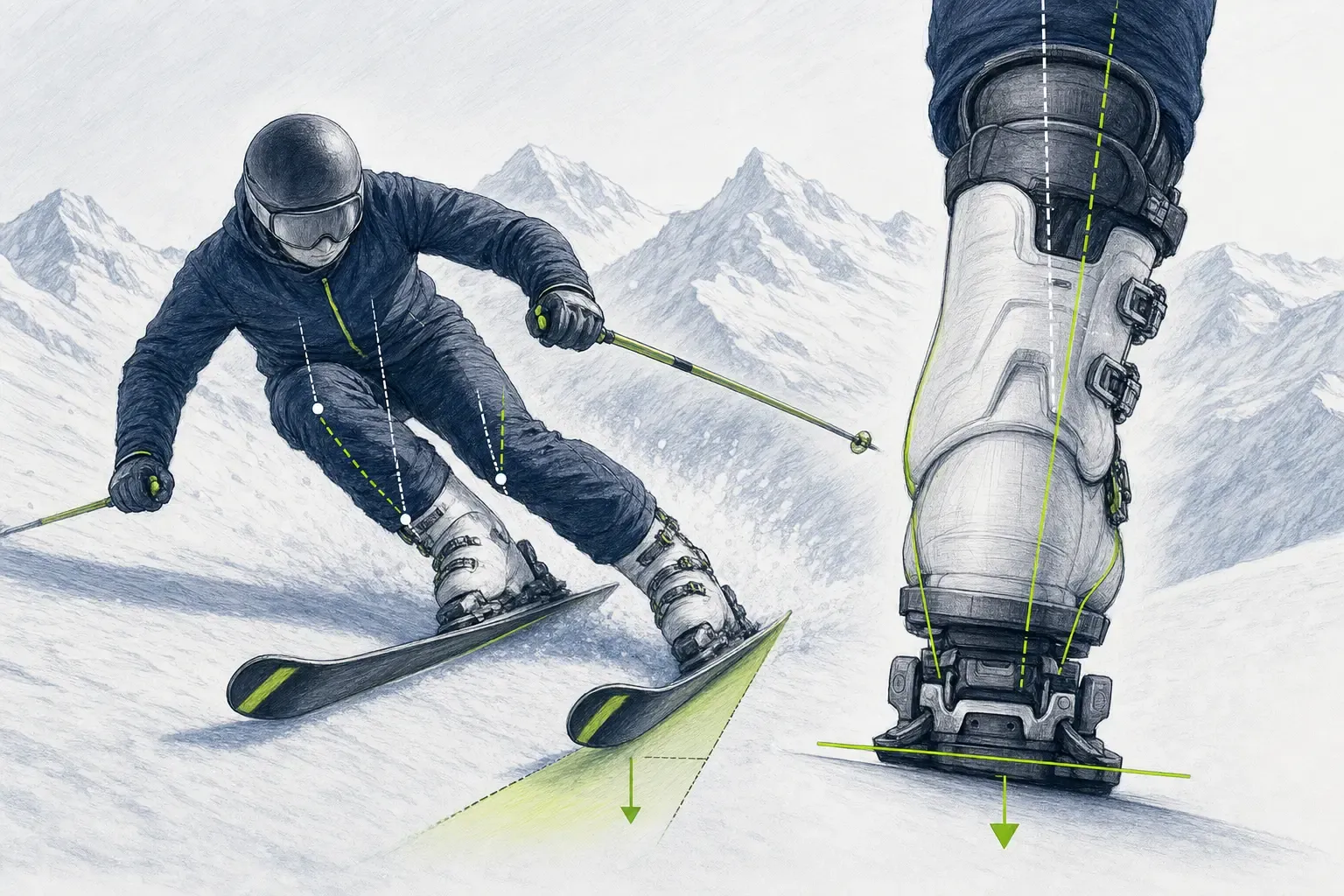
Canting is a side adjustment of the ski boot’s position relative to the ski. In the precise bootfitting sense, it changes the angle at which the lower shell rests in the binding. The goal is to adapt the boot – binding – ski system to the skier’s individual lower-leg alignment so the skier can stand balanced and control both edges without unnecessary compensatory movements.
Canting does not change the shape of the legs or treat an orthopedic problem. It adjusts the interface between the skier and the ski.
Canting is not cuff adjustment
The term is often used imprecisely. The eccentric screws at the ankle, often labeled on the boot with the word “canting,” usually adjust the cuff’s side tilt (cuff alignment). They align the cuff with the direction of the lower leg, while the lower shell and sole remain unchanged relative to the binding.
With true sole canting, the angle of the entire boot relative to the ski changes. A professional technician may work with diagnostic wedges or professionally machine the shell’s contact surfaces. After the adjustment, they must restore the prescribed geometry of the boot toe and heel and check its correct seating and function in the binding.
Practical significance
Incorrect side alignment can contribute to a skier:
- having one or both skis in the neutral stance unintentionally on edge,
- loading one side of the foot more easily,
- finding it harder to edge or release the ski on one side,
- creating different turn shapes despite a similar movement intention,
- compensating with the knees, pelvis, or torso.
These signs alone do not confirm the need for canting. Similar asymmetry can be caused by technique, an incorrect boot size, foot movement inside the shell, an incorrectly adjusted cuff, different ankle mobility, a leg-length difference, or fatigue.
Training practice: first check the boot size and shape, foot stability, cuff position, and basic technical habits. Only then does it make sense to assess an adjustment to the sole. Static workshop measurements should be supplemented by observing skiing, because a standing posture without movement may not show how the skier works under load and while edging.
Canting in children
For a child skier, canting is not a routine preventive adjustment. Body proportions, strength, coordination, and movement habits all change as children grow. So a noticeable knee position while standing cannot automatically be considered a boot-fitting error.
Assessment makes sense mainly when an asymmetry keeps recurring over time, which the coach notices in different drills and conditions even after checking whether the boots fit properly. The adjustment must match the child’s age, ski level, and current equipment. After the foot grows, the boots are replaced, or the technique changes significantly, the setup should be reviewed again.
Neither a parent nor a coach should insert loose wedges under the boot or binding without expert supervision. Such an intervention can change the boot’s position, the release function of the binding, and in race equipment also the dimensions covered by the rules.
Race context and the coach’s view
In racing, precise lateral setup can help the racer create comparable edge contact on both sides and reduce movements used to compensate for unsuitable equipment alignment. It is not a replacement for balance, coordination, or turn-shaping technique.
A coach should look for a recurring pattern, not judge a single turn or a photo of the stance. It is useful to compare right and left turns, skiing on one ski, gliding on a flat surface, and the ability to release the edges smoothly. The final decision on an adjustment belongs to an expert who assesses the foot, lower leg, full stance, and the boot’s compatibility with the binding.
Safety rule: grinding or milling the sole, adding fixed canting elements, and interventions that affect the boot-to-binding interface may only be done by a qualified technician, according to the design of the specific boot, the manufacturer’s requirements, and valid technical or competition rules.
Sources and further reading
- Atomic Boothub – Cuff alignment and Sole canting
- Atomic Alpine Race Catalogue 2024/25 – professional tools for assessing and adjusting canting
- U.S. Ski & Snowboard – Level 100 Alpine Manual
- PSIA-AASI – Adaptive Snowsports Instruction Manual
- PSIA-AASI – interview with expert bootfitter Matt Schiller
- Rossignol – technical data for a ski boot with adjustable canting
- U.S. Ski & Snowboard – Alpine Equipment Regulations
- PSIA-AASI – the importance of professional lateral boot alignment