What is binding release force
Binding release force is a common but technically simplified term for the load at which the binding releases the ski boot. Standards work primarily with release torque: in a standard downhill binding, the main focus is on sideways toe release and upward heel release. Torque depends on both the force applied and the distance at which it acts, so binding settings cannot be described by one simple force in newtons. ISO 8061 sets out the method for selecting recommended release torques, and ISO 9462:2023 the requirements and test methods for downhill bindings for children, juniors, and adults.
The goal of adjustable release is a compromise: the binding should hold the boot reliably under the loads that occur while skiing, but release it once the specified release load is reached. Even a correctly set binding cannot guarantee release in every fall or rule out injury. The direction, speed, and course of the load vary greatly in falls.
What the number on the scale means
The number visible at the toe and heel of the binding is commonly called the DIN value or release setting. It is not a force unit or a directly measured release torque value. It is the adjustment value of the mechanism, according to which the binding is set before the functional test. Manufacturers’ technical service manuals distinguish between the visual scale value and the actual release torque measured by a test device.
The initial setting is determined according to a standardized procedure from several items, especially:
- the skier’s body weight and height,
- age category,
- the skier type classification used by the service procedure,
- the boot sole length, not just its mondo point size,
- the properties and adjustment range of the specific binding.
Weight alone is not enough. Two skiers of the same weight may have different recommended values, for example because of different height, age, skiing style, or boot sole length. The skier type classification is not a sign of technical ability or courage; in the service procedure it expresses the character of skiing and the chosen balance between the binding’s ability to hold the boot and its ability to release.
Adjustment is not just turning a screw
Rule of safe service practice: the setting should be carried out and checked as a whole on the specific system ski–binding–boot. The technician must verify the boot-binding compatibility, the correct heel position and pressure, the condition of the sliding and contact surfaces, and then the function of the binding. The test device measures release torques; if the result does not match the prescribed range, the technician looks for the cause and adjusts the setting or removes the equipment from use according to the service procedure. Binding product tests also use standardized test soles according to ISO 9838.
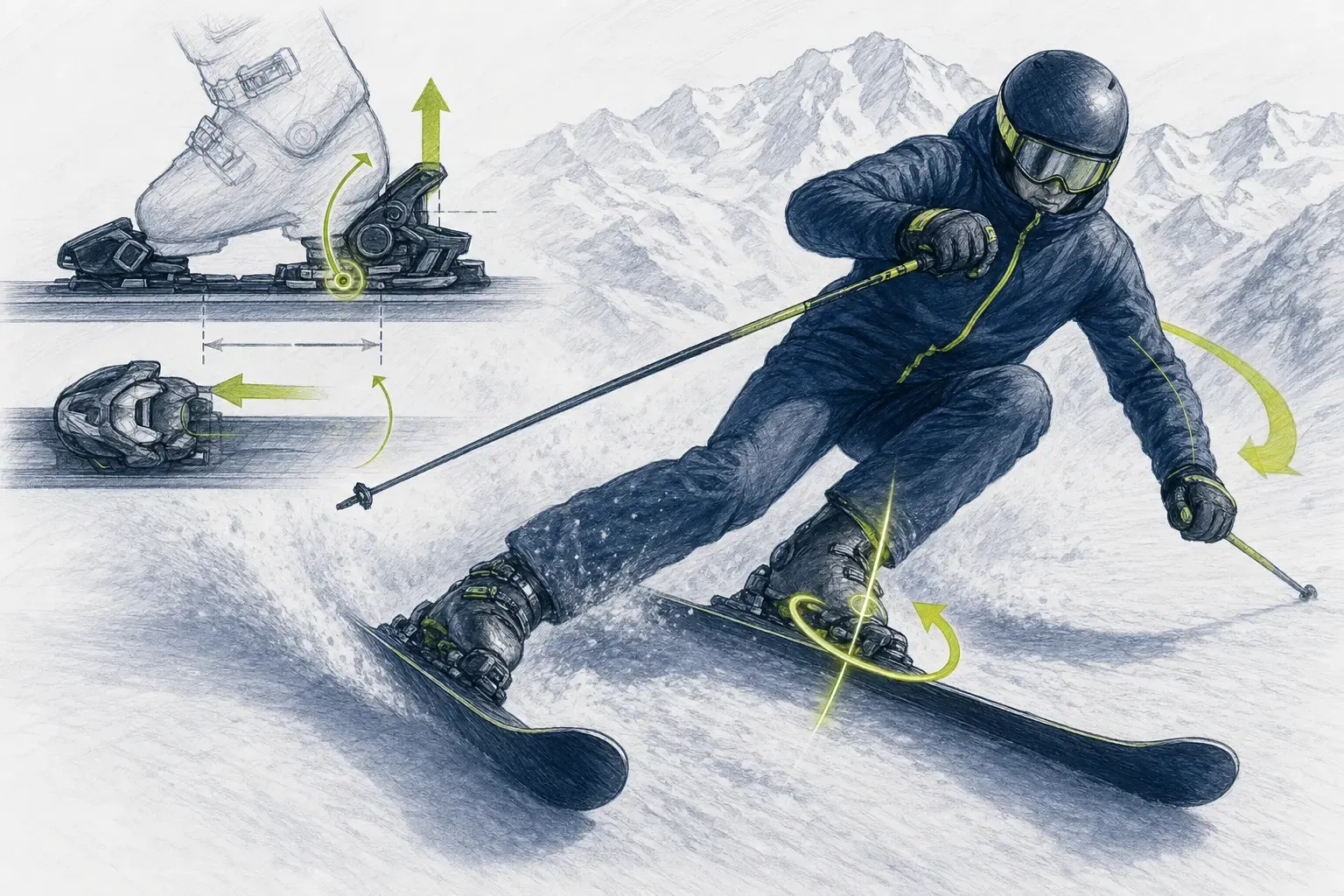
Actual release can be affected by a worn or incompatible boot sole, incorrect heel adjustment, dirt, ice, or a mechanism fault. That is why it is not safe to transfer a number from an old binding to a new one, copy a sibling's setting, or determine it using only an online calculator. Heel pre-tension or heel pressure is also not a release value, and the relevant adjustment elements must not be confused.
Children and young racers
For a child, you need to work with current data. Growth, weight changes, new boots, or a change in shell length may mean a new adjustment and test are needed. The binding must have the right range for the given child; an adult or racing binding is not suitable just because it allows the required number to be set at the lower edge of the scale.
Racing skiing brings higher speeds and dynamic loads, but the label “racer” does not automatically mean a maximum or arbitrarily increased setting. Too low a setting can contribute to unwanted release, while too high a setting reduces the binding's ability to release the boot under load. The decision therefore belongs to a qualified technician based on a standardized procedure, a functional test, skier data, and the manufacturer's instructions.
Typical mistakes
- “DIN is a force.” No. It is an adjustment value; the release torque is checked.
- “It is enough to know the weight.” Not enough; more data are involved, including the boot shell length.
- “The binding must release with every fall.” It does not have to. Not every fall creates the relevant direction and magnitude of load.
- “If the binding released unexpectedly, the number needs to be increased.” First, the cause, compatibility, setting, and technical condition need to be checked.
- “The same number means the same function on every binding.” Only measurement confirms the function of a specific system.
Coach's view
A coach does not estimate the release value on the slope. In training practice, they mainly watch for repeated unwanted releases, problems stepping the boot in, snow or ice under the sole, and changes in the child's equipment. If improper function is suspected, the skier stops training and hands the binding over to service; adjustment screws are not changed as a quick fix between runs.
The principles mentioned apply to alpine bindings. Ski touring and touring bindings have special designs and are covered by a separate ISO 13992 standard; procedures therefore cannot be transferred automatically between different binding categories.
Sources and further reading
- ISO 9462:2023 – Alpine ski-bindings — Requirements and test methods
- ISO 8061:2019 – Alpine ski-bindings — Selection of release torques values
- ISO 9838:2023 – Alpine and touring ski-bindings — Test soles for ski-binding tests
- ISO 13992:2014 – Alpine touring ski-bindings — Requirements and test methods
- ISO/TC 83/SC 4 – Snowsports equipment, catalog of standards
- Salomon Alpine Binding Technical Manual – Binding release value selection and adjustment
- Salomon, Atomic and Armada Shop Practice Manual 2020/2021