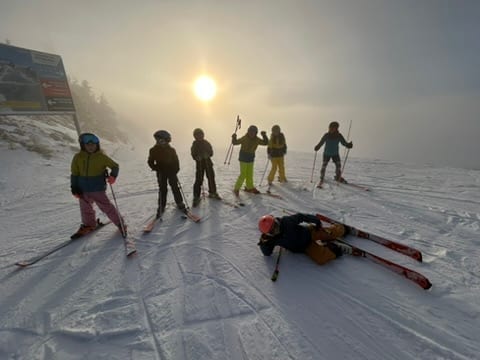
When a child arrives on the slope tired, hungry, with wet gloves and ski boots that hurt, the coach can no longer save much. By contrast, a child who arrives calm, fed, and with working gear can spend its energy on what matters — movement, learning, and skiing.
Dry the gear. Check the equipment. Go to bed on time. Don’t rush in the morning. Give the child a proper meal and water. And then let the coach do the job.
1. The evening before training: get rid of the morning rush
In the morning before heading out to ski, it is not the right time to find out that the second glove is missing, the goggles are in the other car, or the ski boot stayed wet after the last training session.
Five minutes of checking the evening before can save half an hour of stress in the morning.
Are both skis at home? Is the binding free of visible damage? Does the child have the correct poles, if they need them for training?
Leave them open and dry. If the child mentioned pressure or pain, do not deal with it for the first time under the lift.
Check that they are ready, clean, and without obvious damage. Goggles belong in a case, not loose between ski edges.
Wet gloves can end a child’s training very quickly. For younger children, a spare pair is one of the most practical things in the backpack.
If you are not sure about clothing, we have a separate guide How to dress a child for skiing. For equipment, this article will also help How to choose skis and ski boots for a child.
2. Sleep is not a bonus. It is part of preparation
At training, we want coordination, attention, decision-making, emotional regulation, and the willingness to try a new movement from a child. All of these things are harder when the child is clearly sleep-deprived.
The CDC gives as a general recommendation about 10–13 hours of sleep per day for children aged 3–5 years, 9–12 hours for children 6–12 years, and 8–10 hours for teenagers 13–17 years. This is not a training standard or a stopwatch for every child, but a good guideline for parents.
If we know the departure for a camp or training session is early in the morning, try moving the evening routine earlier. On the slope, we can’t make up for sleep debt with a technical tip or an energy bar.
If a child slept badly one night, they do not necessarily have to skip training. It is helpful to tell the coach, though. They can better understand why the child is reacting more slowly, is more irritable, or their technique falls apart sooner than usual.
3. In the morning: normal food, water, and no experiments
There is no need to create a special “sports” meal plan for ski training. It is more important that the child does not come hungry and that the food they get is familiar and well tolerated.
The American Academy of Pediatrics via HealthyChildren recommends thinking about food and hydration before the activity even begins and reminds parents that children should drink before, during, and after sports activity. During longer or more intense training, regular fluid intake becomes more important.
Practically, this means for parents:
- the child should have a normal meal before training, appropriate to the departure time,
- they should have water in the car or bus,
- for a longer day, pack a simple snack they already know,
- do not try a new sweet drink, gel, or “miracle” bar for the first time on the day of training,
- for a regular one-day training session, there is no need to turn nutrition into a science.
If a child refuses a big breakfast in the morning, do not force food into them just because “athletes have to.” A sensible plan based on the departure time and what the child usually handles is better.
4. Adjust clothing to the child, not just the thermometer
A forecast is a starting point, not the final verdict. The same minus five degrees can feel completely different in sunshine and calm than in wind, fog, and on the chairlift.
Likewise, two children in the same group may not need identical layers. One sweats quickly, the other has cold hands. That is why it makes sense to check after the first training block whether the child is dry and comfortable.
The most important thing is to avoid two extremes: freezing and overheating with sweaty clothes. More layers do not automatically mean more comfort.
5. The gear should be ready for training, not just “kind of usable”
The most common problem is not that a parent bought the wrong color of skis. It is a small thing that limits a child on every run: boots that are too big, an unfastened buckle, fogged-up goggles, a wet glove, a damaged strap, or bindings set without expert checking.
Before the first training session of the season — and after any major change in equipment — it is worth doing a full check. For bindings and boots, it is wiser to use professional service than the home method of “well, last year it was on five.”
Dry the gear, check buckles and straps, clean the goggles, look for visible damage, measure the foot, and make sure the child has not outgrown the equipment.
Adjusting and checking the bindings, mounting, servicing damaged parts, and dealing with boots that systematically pinch the child or in which the foot is noticeably sliding around.
6. Arrive early, not exactly on time
For an adult, being five minutes late is nothing. For a group of children, it can mean that the coach has already gone to the lift, one child is changing in a panic, and the others are waiting.
A good goal is to arrive with time for the toilet, changing shoes, adjusting the helmet, one last sip of water, and a calm handover of the child. Not with so much extra time that the child 40 minutes freezing in the parking lot — but early enough that training does not start with a sprint across the resort.
Loko note: When a parent is shouting “quick, quick, quick” even before the first run, the child arrives at training already mentally in the red zone. Five spare minutes are often a better sports aid than anything from an online shop.
7. The coach needs to know things they cannot see from a distance
A short note before training can be very helpful. For example:
- the child did not sleep much last night,
- does not feel quite like themselves,
- after the last fall, they are afraid of a specific slope or speed,
- the boot is hurting them,
- they have had a demanding day or another sports load,
- they are coming back after a longer break.
There is no need to turn this into a five-minute briefing in front of the whole group. One sentence is often enough. The coach can then better tell whether the child needs a technical correction, an easier task, or just a little time.
If the child has a health problem, pain, or illness that may affect safety or the ability to train, that is no longer a question of “gritting their teeth.” The decision about participation belongs to the parent and, depending on the situation, to the medical professional; the coach needs to know the important thing.
8. Before training, do not create a second coach
The car ride to the slope is not the ideal time for a last lecture about the outside ski, the hands, and starting the turn on time.
The child should receive a technical task from the coach in a specific situation on the snow. Before training, a parent can help much more with calm, organization, and simple encouragement.
Instead of:
„Today, mainly go forward and finally really press on the outside ski.“
it is enough:
„Enjoy the training. Listen to the coach and try to do one thing a little better today.“
9. After training, do not ask only about the result
The Australian Sports Commission recommends that parents of young athletes stay positive regardless of the outcome, have realistic expectations, and support self-reflection after activity with questions like „How did it go today?“ or „What would you improve next time?“.
In children’s skiing, we find a similar principle works well. The first question after training does not have to be „How many times did you fall?“ or „Were you the fastest?“.
Try instead:
- What did you enjoy today?
- What new things did you try?
- Which run did you like best?
- Was anything difficult?
- What would you like to try next time?
Questions like these give the child space to talk about training as a process, not as a test they must pass successfully every day.
If this is in order, the parent has already done a big part of the work. On the slope, the child can then focus on skiing and the coach on the training — exactly as it should be.
Sources and methodical references:
CDC — About Sleep (recommended sleep duration by age).
American Academy of Pediatrics / HealthyChildren — Choose Water for Healthy Hydration a Sports Nutrition for Busy Families.
Australian Sports Commission — Nurturing a child’s sporting development.
Practical recommendations for training organization are club methodology of SKI Lokomotíva; they are not medical guidance.