What is the exit from the gate
Exit from the gate is the section of skiing immediately after passing the gate. In it, the skier finishes the necessary change of direction, gradually releases pressure and edge angle on the skis, and moves into the transition to the next turn. The boundaries of this section are not fixed: they depend on the discipline, gate setting, slope angle, terrain, speed, and the chosen line.
The exit must not be confused with the actual correct passage through the gate. FIS rules determine when a gate has been passed legally - the decisive factor is the passage of the tips of both skis and both feet through the relevant gate line. However, FIS does not assess the term exit from the gate as a separate technical element. It is mainly a coaching term for the quality of skiing after passing the gate.
What a good exit looks like
In an effective exit, the racer stays balanced and his movement continues toward the next gate without unnecessary braking or extra completion of the turn. The skis can be smoothly released from the edges and directed into the next turn. At the same time, the skier no longer follows the pole he has passed, but reads the space and the next gates.
The gate is a reference point on the course, not a place where the turn must start or suddenly finish. In many situations, it is advantageous to complete a significant part of the direction change before the gate or around it, so that there is room under it to release the skis. The exact solution, however, depends on the course. A steep section, a closed gate, a combination, a terrain bump, or hard ruts may require different timing.
A quality exit is shown mainly by the fact that the skier:
- does not have to brake sharply under the gate or push the skis sideways,
- stays supported on the skis and does not lose balance backward or into the turn,
- can smoothly reduce pressure on the finishing outside ski,
- shifts attention and movement toward the next gate in time,
- keeps the rhythm even when the gate setting or terrain changes.
Typical mistakes
The most common problem is a late line. The skier arrives at the gate too straight; most of the change of direction has to be made only under it, and the exit stretches across the slope. The next turn then starts late, and the same mistake can repeat at the following gates.
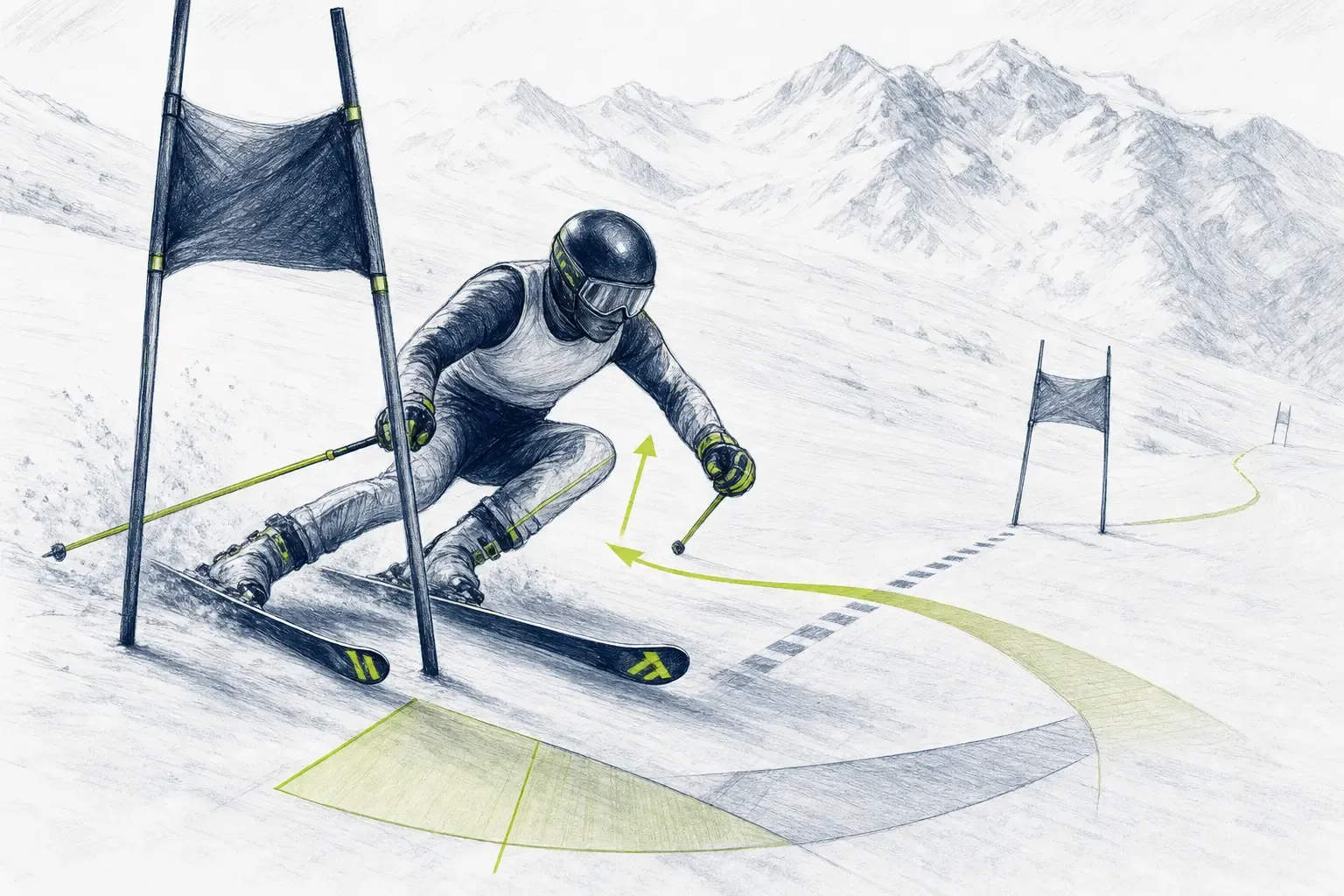
Another mistake is suddenly pushing the skis into a skid after passing the pole. It may briefly help change direction, but it often disturbs balance, rhythm, and preparation for the next turn. A problem is also holding the edges and pressure for too long, overextending the body, or keeping the eyes fixed on the gate already passed.
A tight pass by the pole alone does not prove the correct line. If contact with the gate breaks the stance, unloads the outside ski, or distracts attention from the next turn, the technical result is poor. With later bib numbers, the exit can also be affected by ruts or damaged snow under the gate; the skier therefore does not have to copy the deepest track at any cost.
Children's training
For children, the turn exit is not taught as an isolated body position. The coach first creates a clear task: finish the turn in the planned space, stay balanced, and look toward the next gate. Simple rhythmic courses, corridors, short poles, and marks in the snow are suitable. The course difficulty should match the child’s technical level so that steepness or speed do not trigger a defensive lean back and abrupt braking.
For younger skiers, the overall shape of the turn, rhythm, and line awareness are more important than exact imitation of an adult racer’s position. The ability to time the release of the skis changes with motor development, strength, experience, and speed. That is why there is no single universal position or the same moment of exit for all children.
Coach’s view
The coach does not assess the exit only by the spot at one gate. They watch what it causes in the next two or three turns. A good exit creates time and space for the next change of direction; a poor exit forces the skier to chase the course.
When making corrections, it helps to distinguish the cause from the effect. Hard braking under the gate may be the result of too direct an approach, delayed edging, loss of support on the outside ski, or incorrect reading of the course. A cue to make the exit faster alone is often not enough without adjusting the approach and the shape of the turn.
Sources and further reading
- FIS – Alpine Documents, International Competition Rules (ICR), current edition from 6. July 2026
- U.S. Ski & Snowboard – The Turn Model, Alpine Guide to Ski Fundamentals
- U.S. Ski & Snowboard – Athlete Performance Profile
- U.S. Ski & Snowboard – Corridor, Gate Drills
- Alpine Canada Alpin – Drills & Exercises Handbook
- Alpine Canada Alpin – Long-Term Athlete Development: Technique and Tactics
- Alpine Canada Alpin – Guideline for the Chief of Gates