What the turn entry is
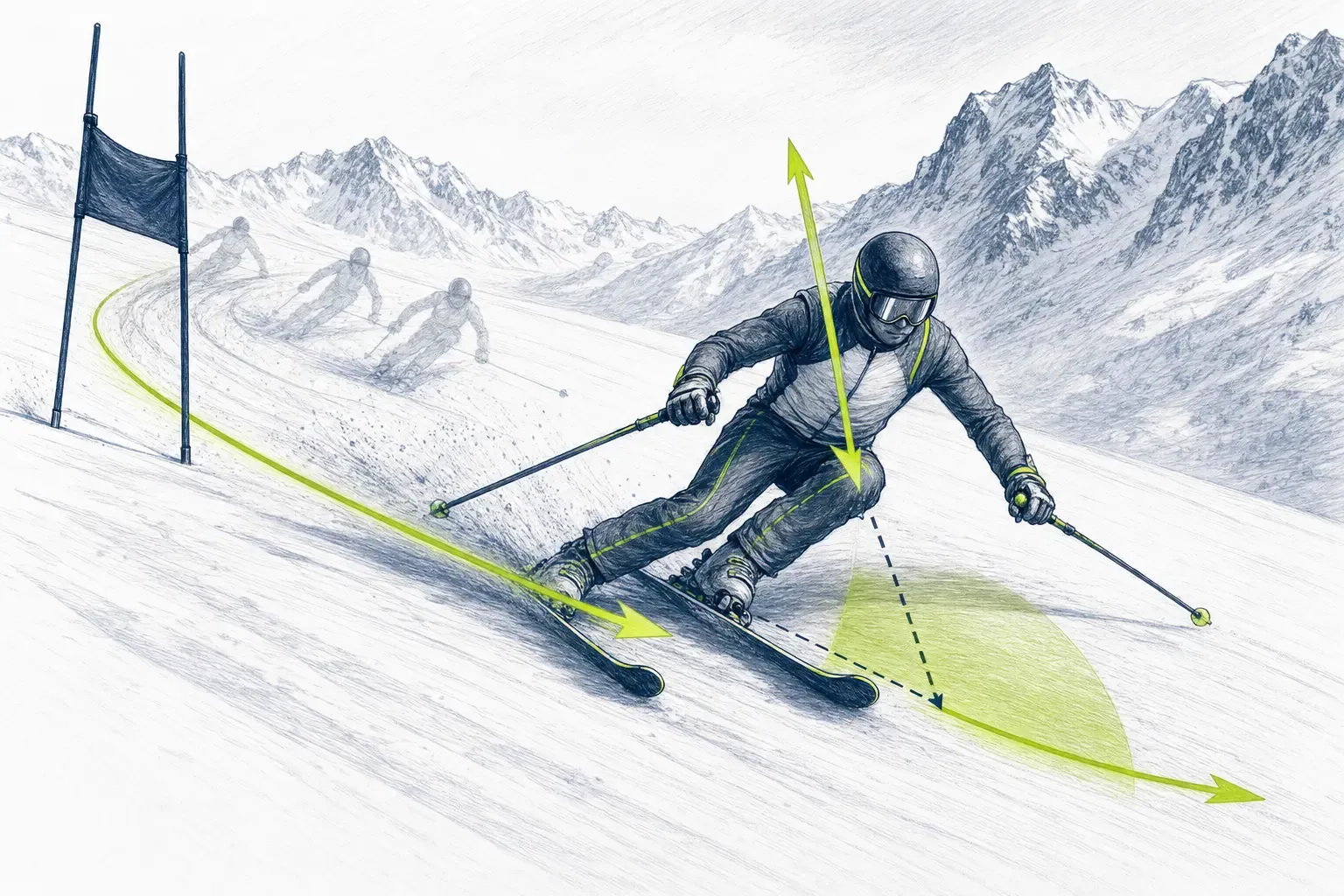
Entering the turn is the opening part of a new ski turn. In it, the skier leaves the support and edges of the previous turn, shifts balance into the new turn and creates the conditions for guiding the skis along a new line.
It is not a precisely separated moment. The end of one turn, the transition between turns and the start of the next one overlap. Older models often divided the turn into entry, guidance and finish, while more modern coaching models emphasize a smooth link between turns without a noticeable pause. It is therefore more useful to understand the entry by its function than by a single fixed point on the slope.
What happens during the entry
The range and timing of movements change depending on the type of turn, but the skier usually coordinates these actions:
- reduces the angle of the old edges and allows the skis to move onto the new edges,
- moves the center of mass across the ski support area toward the inside of the new turn,
- creates balance mainly over the future outside ski,
- uses the feet and legs to tip or steer the skis in the desired direction,
- gradually creates the pressure and edge angle needed for the next part of the turn.
The movements may include flexing, extending, or a combination of both. In a short dynamic turn, the transition is usually quick and the work of the legs under a relatively stable torso plays a bigger role. In a longer turn, the edge change can be calmer and more progressive. The U.S. Ski & Snowboard methodology for developing advanced skiers describes the start of movement from the ankles upward in the movement chain and emphasizes the ability to adapt the entry to the specific situation.
The entry is not always purely carved. On smooth and moderately gentle terrain, a skier may begin the turn by gradually edging the skis. On steep terrain, in narrow space, in soft snow or during a tactical correction, controlled steering or skidding may also be necessary. Separate rotation of the legs relative to a more stable torso is therefore an important skill, not automatically a mistake.
Practical and racing significance
A well-timed entry allows the skis to start changing direction early enough and smoothly. The skier then does not have to handle the entire turn direction with a sharp edge set or braking only below the fall line. The result can be a rounder line, better speed control and more stable support on the outside ski.
In racing skiing, the entry affects where the racer begins to change direction in relation to the gate, how early support is created and whether the skis can be guided without unnecessary slowing. There is, however, no single entry suitable for all disciplines and situations. Slalom, giant slalom, a open passage, a broken gate or a change in slope require different timing and a different ratio of edging, steering and pressure control.
The entry for children
For small and beginning skiers, a clear result is more important than a detailed description of biomechanics. On gentle terrain, the child learns to leave one turn smoothly, look and move into a new direction and gradually gain support on the new outside ski. Teaching should respect motor development, balance level and the child’s ability to concentrate. Development materials from U.S. Ski & Snowboard for younger children favor varied movement experiences, games, appropriate terrain and the gradual building of balance, agility and coordination.
With more advanced children, the coach can monitor whether the edge change comes from the feet and legs, whether the child leans onto the inside ski too early and whether the upper body is unnecessarily twisting the turn. Dominant support on the outside ski does not mean the inside ski must always be lifted or completely unloaded; the load ratio changes depending on the situation.
Typical mistakes and misunderstandings
- Shoulder rotation: the torso pulls the skis into the turn, but this worsens the independent action of the legs and balance.
- Late edge change: the skier stays on the old edge too long, and the new direction is caught up by hard braking.
- Strong upward extension: it can break the skis’ contact with the snow and delay the build-up of support. In some situations, straightening the legs is useful, but it should not be the only learned way to enter the turn.
- Early inside lean: the body moves inside before a firm support on the new outside ski is created.
- Forcing pressure onto the tips: pressure in the front part of the ski can help in some turns, but leaning forward or bending at the waist alone does not replace balanced movement of the whole body.
Coach’s view
The coach does not judge the entry phase only by body position in a single photo. They watch where the edge change happens, the direction of the skis, the smoothness of the balance transfer, the build-up of support on the outside ski, and the resulting shape of the turn. Exercises that can help include garlands, side slipping with ski steering, skiing on a gentle slope with track-like lines, or changing the turn radius. The exercise must match the age, ability, terrain, and current goal; doing it technically well does not by itself guarantee the correct movement will be used in free skiing or in gates.
Sources and further reading
- U.S. Ski & Snowboard – Alpine Training Systems
- U.S. Ski & Snowboard – Athlete Performance Profile
- U.S. Ski & Snowboard – Level 100 Alpine Manual
- U.S. Ski & Snowboard – The Turn Model
- U.S. Ski & Snowboard – Pivot Slips
- U.S. Ski & Snowboard – Outside Ski Dominance
- PSIA-Rocky Mountain-AASI – Alpine Assessment Guide 2025–26
- U.S. Ski & Snowboard – Level 100 Updates and Basic Skiing Drills