What does DSQ mean
DSQ is the results abbreviation of the English word disqualified, that is disqualified. It marks a racer whose performance was not accepted by the jury because of a violation of the competition rules. DSQ can appear next to a racer’s name even when they physically crossed the finish line and the timing system recorded their time.
In two-run disciplines you may also see the notation DSQ1 or DSQ2. The number indicates the run in which the reason for disqualification occurred.
Most common reasons for disqualification
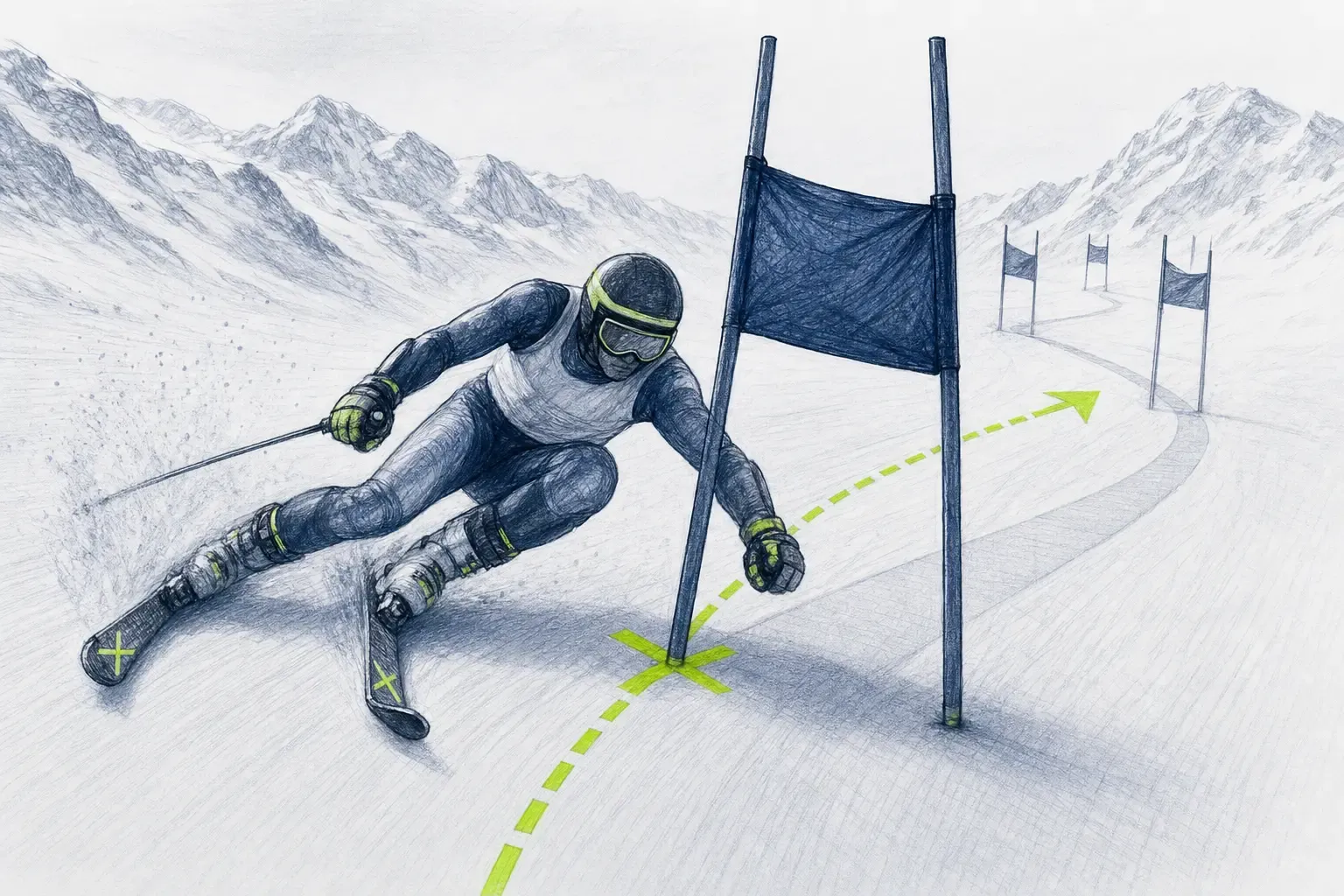
In alpine skiing, a common cause of DSQ is taking the gate incorrectly. A racer must cross the set gate line in the way defined by the rules for the given discipline. It is not enough just to go around the pole or, after a mistake, return to the course in any way. What matters is whether the gate passage was completed correctly.
Disqualification can also be related to other rule violations, for example:
- failing to follow the start rules or the prescribed starting procedure,
- continuing in a way that goes against the competition rules,
- illegal assistance during the race run,
- unsuitable or prohibited race equipment,
- endangering other people or seriously violating safety instructions,
- violating a special rule valid for a specific race.
The exact reason cannot be determined from the DSQ abbreviation alone. It must be found in the official results, the jury announcement, or the disqualification record. In the case of a gate fault, a gate judge’s report may be the basis, but the parent, coach, or timekeeper does not decide on the disqualification. The decision belongs to the relevant competition officials under the applicable rules.
DSQ is not the same as DNF or DNS
These abbreviations are often confused:
- DSQ – disqualified: the racer was disqualified for breaking the rules,
- DNF – did not finish: the racer started, but did not complete the run,
- DNS – did not start: the racer did not start the race run.
A racer who misses a gate and immediately leaves the course may be listed in the results as DNF. If they continue to the finish, or the jury later assesses a specific infringement, DSQ may appear. The result status therefore cannot be reliably determined just by watching the run from the side of the course.
DSQ in children's races
With children, it is important to separate the result decision from evaluating the child. Disqualification does not have to mean intentional cheating or irresponsibility. It is often a technical mistake: a late start to the turn, losing orientation, an incorrect reaction after catching a pole, or uncertainty when returning to the gate.
A younger child may not immediately understand why their time is missing from the results. The coach should briefly show them, where the mistake happened and which rule applied. The explanation should match the child’s age and experience. More helpful than a general “you missed the gate” is naming the specific situation, such as a line that was too direct or a delayed change of direction.
If DSQ is related to equipment, the check should not remain only with the child. Adults also bear appropriate responsibility for preparing race equipment – the parent, the coach, and, if needed, a specialist service. The dimensions, construction, and permitted equipment features must always be checked according to the rules valid for the given age category and competition.
Coach’s view
From a training perspective, DSQ is information, not a punishment. The coach watches whether the cause was a random mistake, a misunderstanding of the rule, or a recurring technical problem. Based on that, they can include practice of a proper gate pass, orientation after a mistake, the start procedure, or deciding when it is no longer safe to continue in the run.
Neither parent nor coach should question the decision based only on a feeling. If the race rules allow a protest or a request for review, the official procedure should be followed within the set deadline. It is also important for the child to see that the rules apply equally to everyone and that one disqualification does not define their skiing level or future sports development.
Sources and further reading
- FIS – official list of abbreviations used in results
- FIS – Alpine Skiing Calendar & Results
- FIS – Live Results: Alpine Skiing
- FIS – example of official results with the DSQ label
- FIS – Specifications for Alpine Competition Equipment 2025/2026
- FIS – Alpine Timing Booklet
- FIS – Timing and Data Technical Report Software: User Manual