What are race points
Race points are a numerical expression of a skier’s performance in a specific race. In the narrower FIS sense, they are points calculated from the time difference between the competitor and the winner. In common usage, however, the same term is often also used for FIS points in the rankings or points earned for placing in a cup series. These values are calculated differently and cannot be confused.
The current FIS rules for the 2026/27 season list separate regulations for FIS points, the ICR international competition rules, and the World Cup rules. This means there is no single universal points system that applies to all ski competitions.
Race points by time
In alpine disciplines, the basic race points referred to in the rules as race points are derived from the skier’s time. The basic form of the calculation is:
P = ((Tx ÷ To) − 1) × F
- P are the race points,
- Tx is the finishing time of the skier being evaluated,
- To is the winner’s time,
- F is the factor for the respective discipline set by the FIS rules.
In two-run disciplines, the final sum of times is used. The winner has zero time loss and therefore receives zero race points. The greater the relative loss to the winner, the higher the number of points. The exact factors, rounding, and conditions for a valid result are set by the current edition of the FIS rules; this is not something that can be changed by the organizer or coach.
Race points themselves do not yet have to be the final FIS points from a given race. To the time points is added race penalty (race penalty), calculated according to the points level and the results of the selected racers in the start and results list. Put simply, better-attended races can have a lower penalty. The winner’s result is therefore usually not zero FIS points, but the race penalty value.
Three different meanings of points
1. Race points
They express the time deficit in a specific race after taking the discipline factor into account. Lower is better. A racer without a valid classified result, for example after not finishing or being disqualified, does not receive a valid points result from the race.
2. Racer’s FIS points
FIS points are a continuously updated performance value for a skier in each discipline. They are created from eligible results according to the rules valid for the given season. Slalom points are therefore not the same data as points in giant slalom, super-G, or downhill.
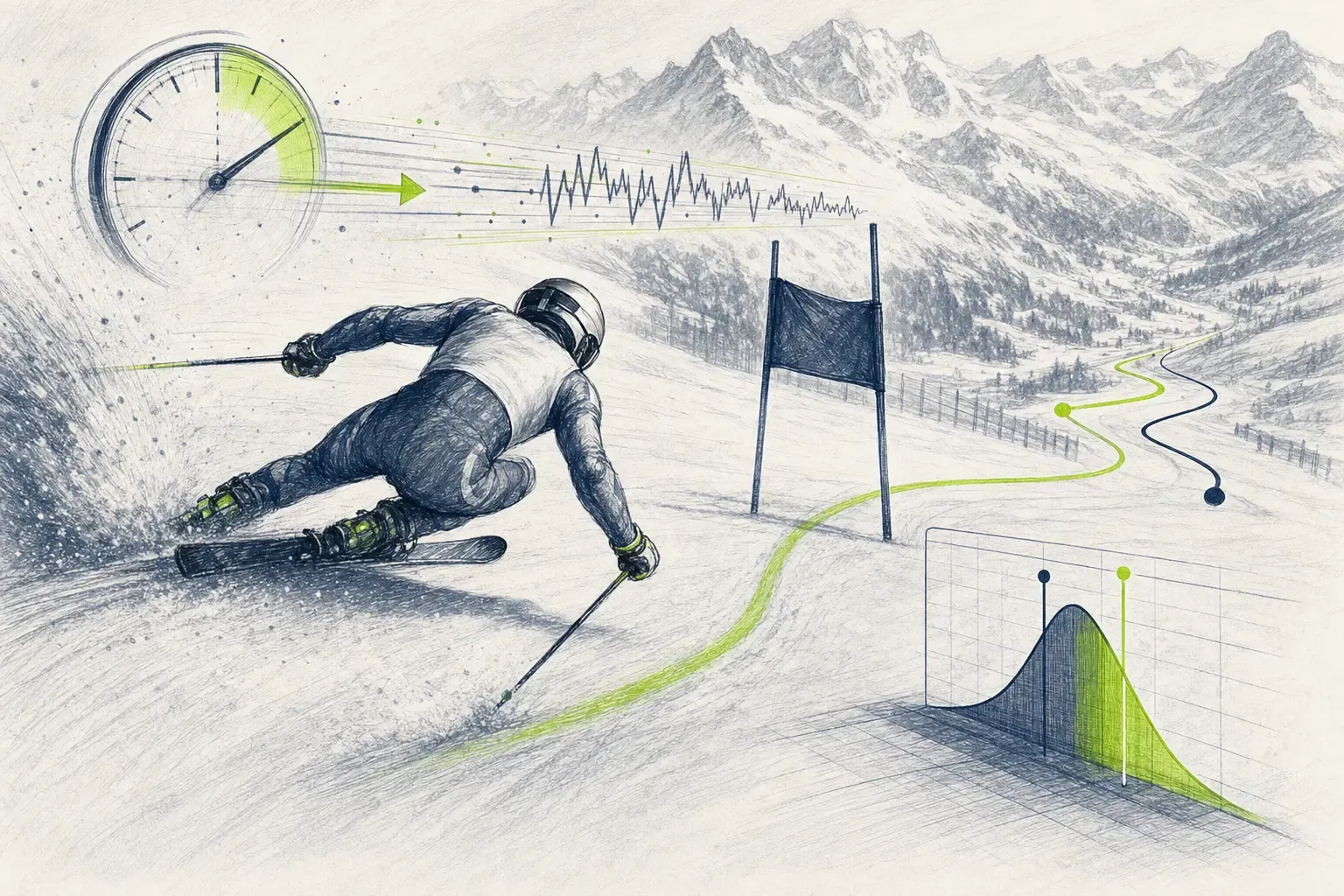
FIS points are used mainly for creating points groups, determining the start order, assessing performance, and setting participation conditions at higher competition levels. Even a skier with the best points does not always get the very first start number: in some groups, the numbers are drawn according to the rules of the specific race.
3. Cup points
Cup points are awarded for placement and added up in the series standings. Here, the opposite logic applies: a higher number of points is better. Official World Cup standings record points in individual disciplines as well as in the overall standings; the Nations Cup is tracked separately as well.
Cup points therefore do not directly express time loss. Two winners can receive the same number of series points, even if one won by a hundredth and the other by several seconds.
Race points in children’s competitions
Children’s and youth races do not have to use the FIS points system. A national federation, regional competition, or series organizer may set its own points system for placement, the number of counted results, tie-break rules, and the conditions for inclusion in the overall standings. The same term can therefore have a different meaning in two series.
When reading results, first find out:
- whether these are time, ranking, or cup points,
- whether a lower or higher value is better,
- which results count toward the standings,
- whether disciplines are evaluated separately,
- according to which competition rules the points are calculated.
Scoring also differs between individual skiing disciplines. Cross-country skiing and para alpine skiing have their own points rules, so the alpine calculation cannot be mechanically transferred to another discipline.
Common misunderstandings
- “I have more points, so I’m better.” That is true for cup points, but not for time points or FIS points.
- “The winner always has zero points.” The winner has zero race points from time loss, but their final FIS points include the race penalty.
- “The same points mean the same performance in every discipline.” Each discipline has its own scoring and a different performance profile.
- “Points show only skiing technique.” The result is also affected by the course, conditions, bib number, competition, tactics, and the race penalty.
- “Every children’s points score is FIS points.” FIS points can be earned only in competitions and under the conditions set by the relevant FIS rules.
Coach’s view
Points are a useful tool for tracking progress, not a complete picture of a child’s performance. A coach evaluates them together with time loss, split times, technique, tactical approach to the course, consistency of performances, and race conditions. For younger skiers, long-term motor and technical development matters more than short-term chasing of points or choosing races only by expected penalty.
When comparing seasons, always check the current rules. FIS issues separate regulations for individual periods and competition levels; this entry is based on documents available as of 2. September 2026.
Sources and further reading
- FIS – Alpine Skiing Documents: current ICR, World Cup Rules and FIS Points Rules
- FIS – Rules for the FIS Alpine Points, edition 2025/26
- FIS – Alpine Skiing World Cup standings 2025/26
- FIS – Alpine Skiing World Cup Nations Cup standings 2025/26
- FIS – Cross-Country Documents and discipline-specific points rules
- FIS – Para Alpine Skiing Documents and points rules
- FIS – World Championships document library