What a results list is
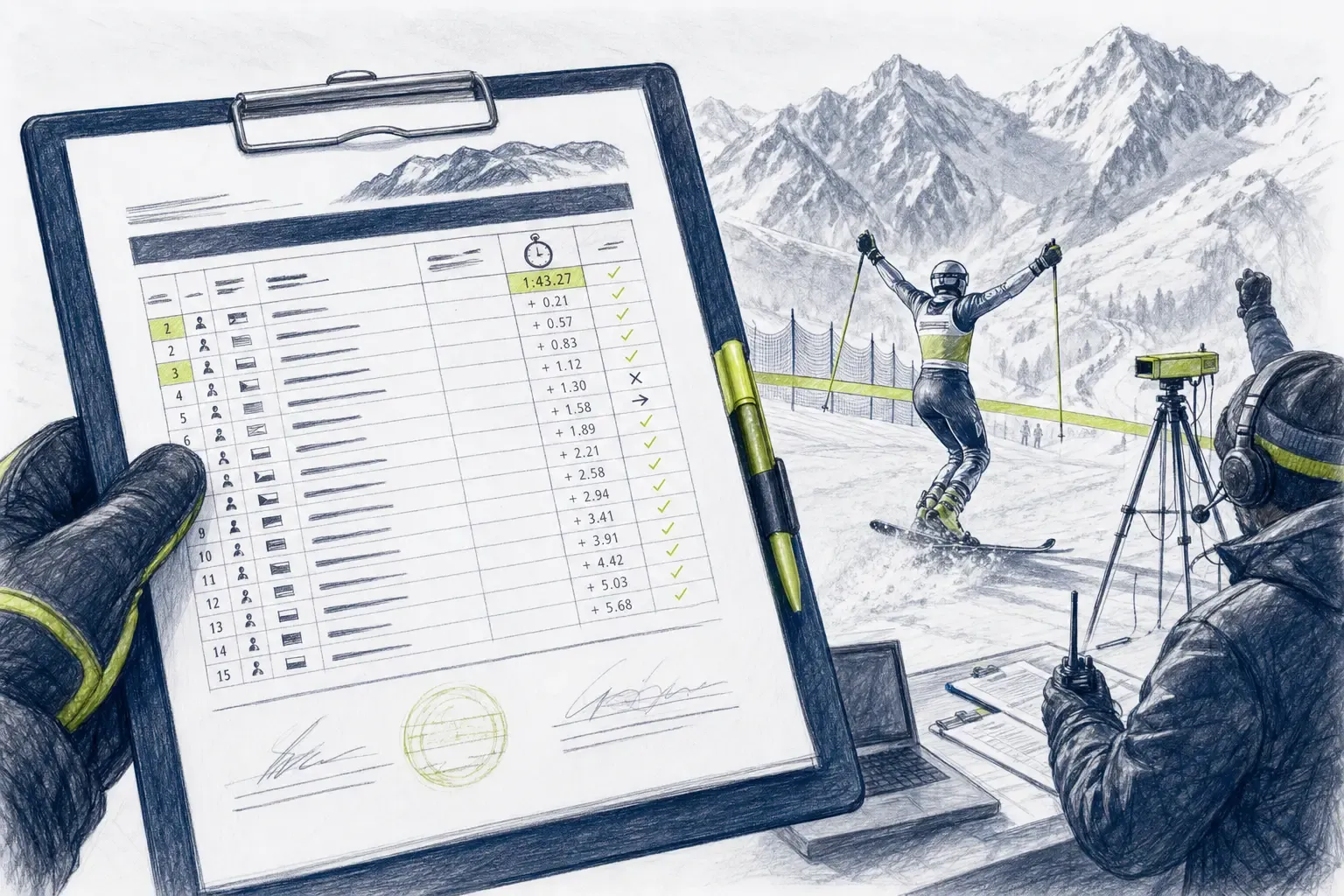
Results list is a document recording the outcome of a ski race according to the rules of the given competition. It contains the ranking of classified racers, their recorded times or points, and data needed to identify the race unambiguously. It is also commonly referred to as a “results sheet.”
In races held under FIS rules, it is compiled based on official timing and jury decisions. The result shown immediately after the finish may still be provisional. It can change after checking gate passage, timing, start, a protest, or another circumstance handled by the jury. Only the official results list confirmed by the prescribed procedure should be considered the final basis for evaluation.
What you can learn from it
The scope of data depends on the level and type of race. An official list usually includes:
- the race name, location, date, and discipline,
- category or gender,
- ranking and start number,
- name, year of birth, club, or national affiliation,
- split time and final time,
- time behind the winner,
- any points score,
- a list of racers without a classified result,
- basic details about the course, jury, timing, and conditions, if required by the competition format.
In a two-run discipline, the final ranking is determined by the result of both runs according to the rules of the race. The time from the first run alone is therefore not yet the final result. In case of equal times, the classification method set by the relevant rules applies.
Most common abbreviations
- DNS – Did Not Start: the racer did not start. In two-run races, it may be stated which run the status refers to.
- DNF – Did Not Finish: the racer started, but did not complete a valid run, for example after a fall, missing a gate, or withdrawing.
- DSQ – Disqualified: the racer was disqualified by the jury’s decision; the results may also state the reason or gate number.
These abbreviations are not rankings. A racer with DNF or DSQ does not have a classified finishing time in that race, although the run may still be an important source of information for the coach.
Time, gap and points are not the same
Time reflects performance on a specific course in specific conditions. The gap shows the difference to the leader or winner. A points value can be used for rankings, seeding or series evaluation, but its meaning depends on the competition rules.
In FIS races, the result points value is calculated according to separate rules; a lower number of FIS points means a better value. FIS points must not be confused with cup points awarded for placement in a series. It is also not correct to compare points from club children’s races with FIS points if they come from different systems.
Children’s race results
Many children’s races are not FIS competitions and follow national, regional or the organizer’s own rules. Results may be divided by year of birth, age category, gender or performance group. A parent should first check in which category the child was evaluated and whether the list records one run or more.
Placement alone does not fully show the quality of the run. It is influenced by the number of starters, the strength of the field, the course profile, snow, visibility, and differences in children’s physical and motor development. Times from different courses, days or categories cannot be directly compared.
Coach’s view
The coach reads the results list together with observations of the run and the race conditions. They track differences between runs, time gaps, performance stability and the reason for DNF or DSQ. With young skiers, it is more useful to name one specific task the child handled well and one appropriate area for improvement than to judge them only by placing.
A common misunderstanding is to take a provisional online table as the final result or to automatically treat DNF as failure. The results list is an accurate record of the competition, not a complete evaluation of ability or long-term development of the skier.
Sources and further reading
- FIS – Alpine Skiing Documents: International Competition Rules and current regulations
- FIS – Timing & Data: timing, data and results documents
- FIS – Rules of the FIS Points 2025/2026
- FIS – Official FIS points lists
- FIS – Precisions and Instructions for Alpine Skiing, Northern Hemisphere 2025/2026
- FIS – Sample database alpine skiing results list