What is sports motivation
Sports motivation refers to the processes that stimulate, guide, and maintain sporting behavior. It influences why a child comes to training, how much effort they put into a task, how they react to a mistake, and whether they want to continue skiing. It is not a fixed personality trait or a synonym for obedience, diligence, or competitive ambition.
Motivation can change depending on age, skill level, relationships within the team, the behavior of the coach and parents, health, or current experiences. One bad training session or a reluctance to head to the slope in the morning does not by itself mean that a child is lazy or unmotivated.
Internal and external reasons
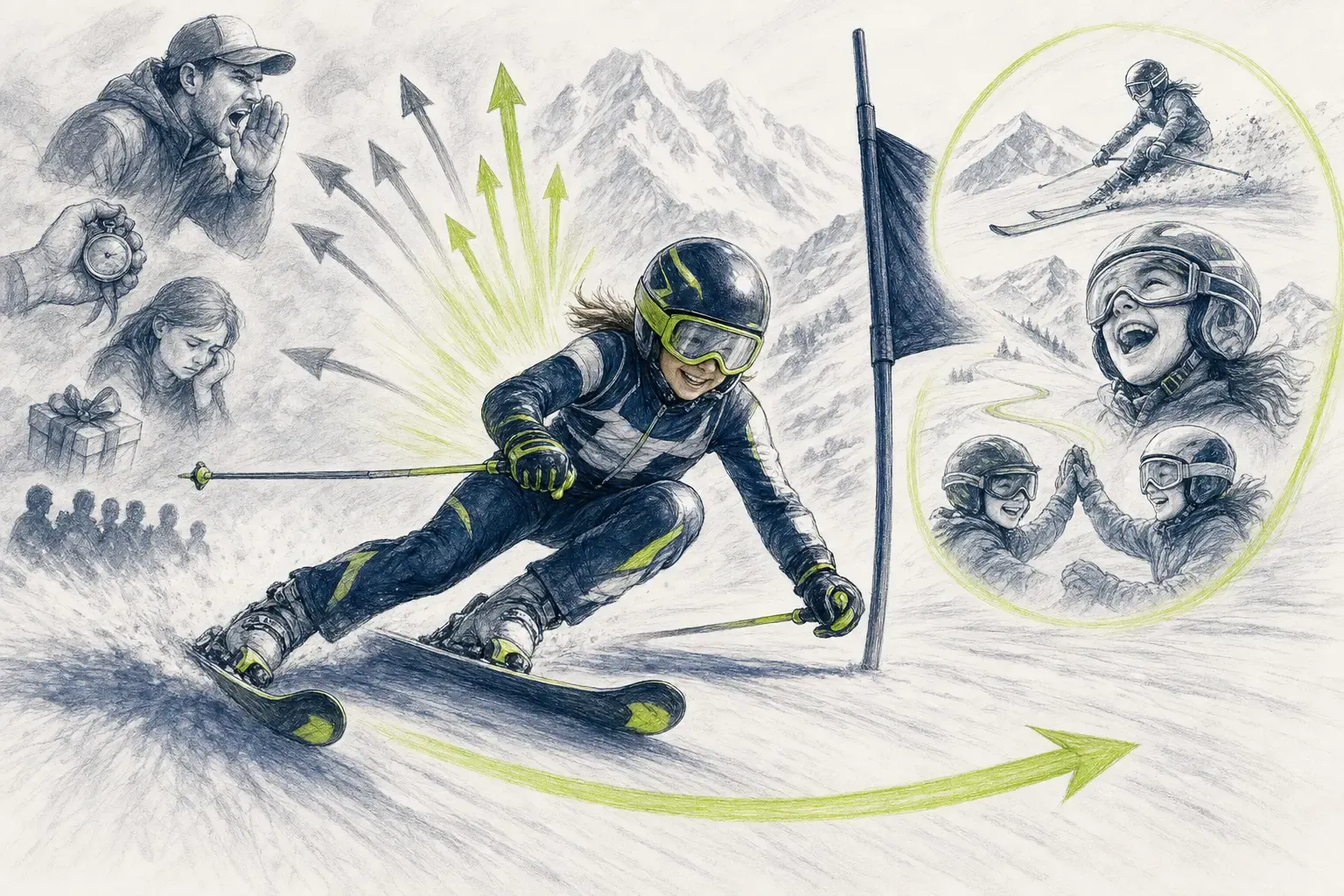
In intrinsic motivation the activity is appealing in itself: the child enjoys speed, movement, turning, competition, or spending time with friends. Extrinsic motivation is linked to consequences such as results, praise, selection, a reward, or fear of disappointing adults.
However, this division is not completely black and white. A young skier may not love every drill, but they can still do it willingly because they understand its importance for safer or more precise skiing. Such motivation is focused on the result beyond the exercise itself, yet the child has adopted it as their own goal. On the other hand, regularly completing tasks only out of fear, guilt, or the threat of losing a place on the team is controlled motivation.
Self-determination theory links better, more independent motivation with the fulfillment of three psychological needs:
- autonomy – the child has an appropriate sense of choice and understands why they are doing the task,
- competence – they experience manageable challenges and can recognize their own progress,
- relatedness – they feel accepted, safe, and a sense of belonging with the coach and the team.
Autonomy does not mean that the child decides safety rules or the whole training session on their own. The coach remains responsible for organizing and setting appropriate tasks. However, they can explain the purpose, offer limited choice, or give the skier space to name what they felt while skiing.
The importance in children’s skiing
Ski training includes changing weather, waiting, repeated exercises, falls, fear, and comparing results. Motivation therefore does not come only from the appeal of racing. What matters is whether the child experiences learning, an appropriate challenge, relationships in the group, and clear progress.
For younger children, it is often best to teach through play, imagery-based tasks, short challenges, and frequent changes of activity. As children get older, you can explain the technical intention more, involve the skier in evaluating the run, and set process goals together. This is a coaching practice, not a universal rule: motor skill level, experience, emotional maturity, and the specific situation are what matter.
The official U.S. Ski & Snowboard athlete development system highlights not only long-term performance development but also preserving the joy of sport. This is a reminder that the result in one age group should not be the only measure of success in a children’s program.
Systematic reviews link young people’s continued participation in sport not only to motivation, but also to perceived competence, enjoyment of sport, social support, and the environment created by the coach. However, leaving sport does not have a single cause: it can also be related to time demands, school, finances, health, or changing interests.
Coach’s View
Supportive coaching practice may include:
- giving a task with a clear explanation appropriate for the child’s age,
- goals focused on the activity, such as timing of movement or smoothness of turns,
- comparing performance mainly with the same skier’s previous run,
- feedback that names a specific element done well and the next step,
- the chance to ask a question, express concern, or admit misunderstanding without being mocked,
- appropriate decision-making, for example choosing between two safe exercises,
- building teamwork and a sense of belonging in the squad.
Praise, a medal, or a result goal are not automatically harmful. The problem arises when they completely overshadow learning and the child’s own reasons for doing sport. The sentence “today you kept your rhythm even after a mistake” gives more precise information than the vague “you have talent.” Result goals have their place in racing skiing, but time, placing, or selection cannot be fully controlled. A process goal gives the skier a task they can influence even in difficult conditions.
The Parent’s Role
A parent influences the meaning a child gives to training and races. After a run, the parent can first ask what the child experienced, learned, or needs, instead of immediately judging time and placing. Coach and parent should not give conflicting technical instructions or use withdrawing support, shame, or comparisons with siblings as a motivational tool.
Peers are also part of the motivational environment. Research on young athletes points to a link between peer support, the fulfillment of psychological needs, intrinsic motivation, and continued participation in sport.
Common Misunderstandings
- A motivated child must want to win. A child can be strongly motivated to improve, even if race results are not the main reason they ski.
- Pressure always improves performance. In the short term, it may lead to compliance or greater effort, but it is not automatically a motivation that can be sustained long term.
- Fun means training without demands. Joy can also come from focus, mastering a difficult task, and visible progress.
- A drop in motivation should be addressed with another reward. First, the cause should be sought: excessive difficulty, fear, fatigue, conflict, pain, unclear expectations, or a missing sense of progress.
Long-term exhaustion, devaluing sport, and a feeling of declining performance are among the monitored components of sports burnout. Research also points out that both the causes and the options for intervention are multidimensional. A coach should not make a psychological diagnosis. If anxiety, strong resistance, sleep disorders, physical problems, or loss of interest persist, communication with a parent and, depending on the situation, help from a qualified professional are needed.
Good sports motivation does not show itself through constant excitement, but through a young skier gradually taking on appropriate responsibility for learning, understanding their goals, and being able to train in a safe and supportive environment.
Sources and further reading
- Zhang et al. – Why do students drop out of regular sport in late adolescent? Systematic review (Frontiers in Public Health, 2024)
- Hu et al. – Predictors of Persistent Participation in Youth Sport: A Systematic Review and Meta-Analysis (Frontiers in Psychology, 2022)
- Groenewal, Putrino, Norman – Burnout and Motivation in Sport (Psychiatric Clinics of North America, 2021)
- Wilczyńska et al. – Burnout and Mental Interventions among Youth Athletes: A Systematic Review and Meta-Analysis (2022)
- Jõesaar, Hein, Hagger – Peer influence on young athletes’ need satisfaction, intrinsic motivation and persistence in sport (Psychology of Sport and Exercise, 2011)
- Sommerfeldt, Chu – Strategies Coaches Can Utilize Parents to Optimize Youth Athletes’ Sport Experience (2020)
- U.S. Ski & Snowboard – Athlete Development