Missed gate is a common term for a situation in which a racer does not pass a gate in the manner required by the rules. More precisely, it refers to incorrect gate passage or gate fault (gate fault). If the racer does not correct the error in a way allowed by the rules, it is grounds for disqualification.
When a gate is passed correctly
According to FIS rules, a gate is passed correctly when both ski tips and both feet of the racer cross the gate line. The gate line is an imaginary line defined by the position of the relevant poles; its exact course depends on the discipline and on whether it is a standard gate or a single-pole gate.
If a ski comes off without a gate fault having already occurred, the rules judge the tip of the remaining ski and both feet. The position of the head, shoulders, or center of the body is therefore not decisive.
A missed gate includes, for example, a situation where the racer:
- goes around the turning pole from the wrong side,
- gets the pole between the skis or feet - the so-called straddle of the pole (straddle),
- after a fall slides under the gate and continues without passing it correctly,
- in slalom combination misses one of the gates,
- confuses the direction of the course continuation.
A mere touch or knocking down of a hinged pole is not proof of a fault. The racer may hit the pole and still pass the gate correctly. Likewise, the racer may pass very close to the pole without touching it, but on the wrong side of the gate line.
Consequence in the race
An incorrect gate passage is grounds for disqualification according to FIS ICR. The gate judge records what they saw, including the racer’s number and the gate designation. The final competition decision, however, is not made by the gate judge alone; the case is handled according to the rules for judges, the jury, and any protests.
A racer who missed a gate and does not correct the error must not continue through the following gates. Continuing can also be dangerous, because another starter may be approaching on the course.
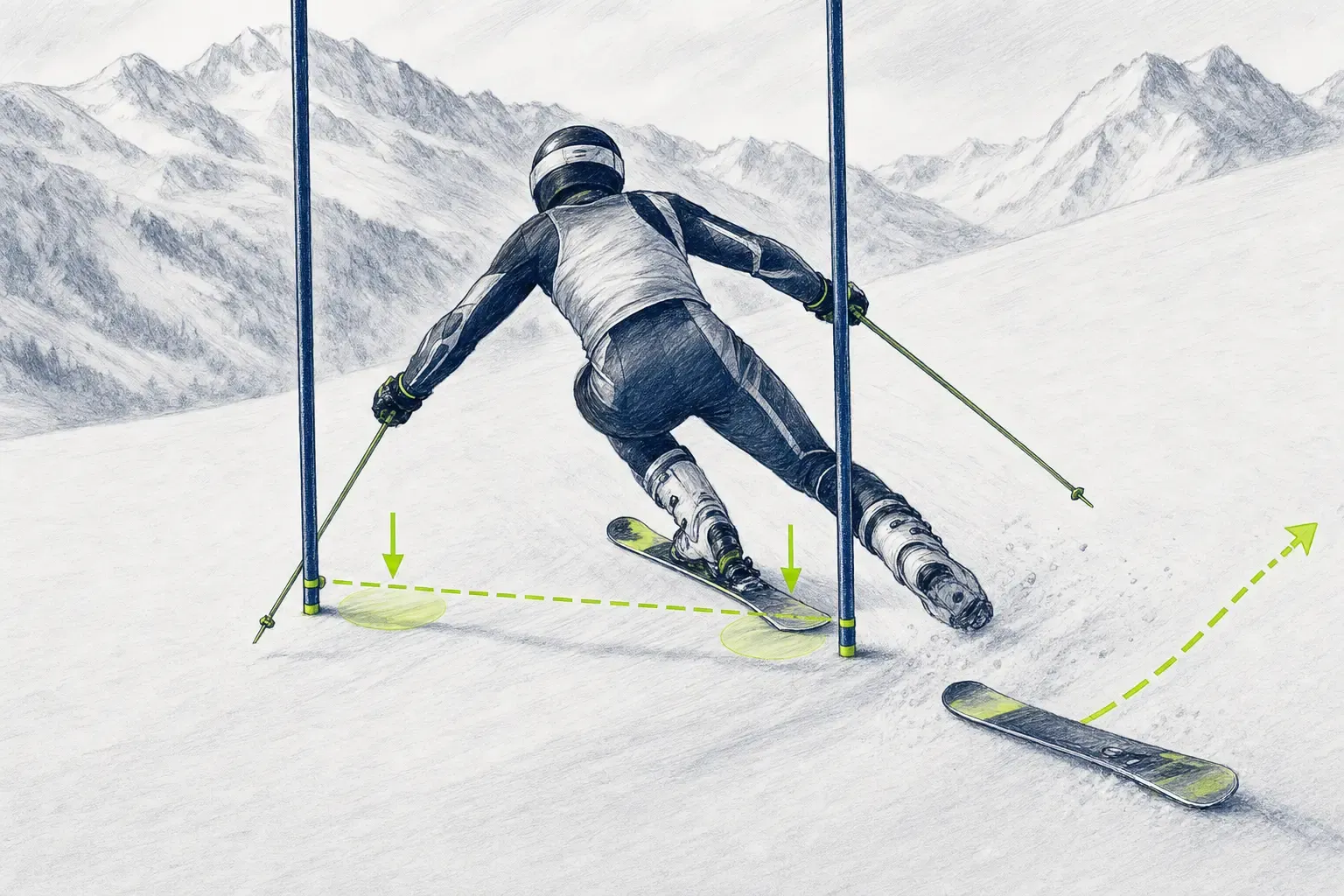
In slalom the racer may, after a mistake, go back uphill and pass the missed gate correctly, as long as it does not interfere with the next racer and they have not been passed. However, they must correct the gate they just passed incorrectly, not merely go around its pole from the other side below the gate line.
In giant slalom, super-G and downhill the rules after a full stop do not allow continuing the run. Going back uphill, known mainly from slalom, therefore cannot be automatically applied to the other disciplines. At children’s and national events, the applicable rules of the relevant federation and the race regulations must also be respected.
Children’s and training context
In younger children, a missed gate may not be caused only by inattention. It often relates to a late start of the turn, too much speed for their ability, loss of balance, or the child watching only the nearest pole and not perceiving the next direction of the course. Vertical sections, hairpins and gates with a change of rhythm are especially challenging.
Training practice: the coach can, appropriately to the age, practice recognizing gate colors and order, looking ahead, the correct line before the gate, and skiing through simple combinations at lower speed. In the event of an error, it is important first to ensure the safety of the child and the other skiers. Returning to the gate is practiced only on a closed or controlled section according to the coach’s instructions, not by leaving the active course on one’s own.
From a coach’s perspective, it is more useful to look for the cause of the mistake than to tell the child only that they “missed the pole.” A missed gate often comes from one or two turns earlier – from a poor line, a late pressure transfer, or insufficient course reading.
The rules stated in the entry have been verified according to documents available as of 2. September 2026, especially according to the FIS ICR, Art. 614.2.2, 614.2.3, 629.3 and 661.4.1.
Sources and further reading
- FIS – Alpine Skiing Documents: International Competition Rules (ICR), edition from 6. July 2026
- U.S. Ski & Snowboard – 2026 Alpine Competition Guide
- U.S. Ski & Snowboard – 2026 Alpine Competition Guide, full PDF
- U.S. Ski & Snowboard – Alpine Competition Officials Education Resources
- U.S. Ski & Snowboard – 2025–26 Alpine Precisions
- U.S. Ski & Snowboard – official register of alpine skiing resources
- U.S. Ski & Snowboard – Rules & Equipment